Pages

Showing posts with label blockchain. Show all posts

Thursday, May 30

Portfolio Update: May 2024 - Part I - There's a Supply Deficit

OM was starting to write a short note on the current market environment, but finds those notes dull to consume and OM has little original to say. Broadly, OM’s market view can be summarized as  - things aren’t as good as we’d like but not as bad as people think, though inflation is likelier stickier than the Fed would care to admit.

However, Our Man has made several meaningful changes to the portfolio over the last few 6 months, largely reflecting opportunities that he’s been watching for a while.  As such, it’s probably a good time for a portfolio update – in two parts, so it doesn’t become too long and unwieldy.

Portfolio Update – Part I – There’s a Supply Deficit
The broadest theme across OM’s portfolio is that of a supply deficit; primarily where an under-investment in supply coupled with a slight growth in demand has resulted in the supply deficit.   The theme is most obviously seen across numerous commodity markets, which represent about 1/3 of OM’s exposure.   More generally, this is something that impacts physical markets (commodities, goods, etc) and because of the rise of digital/software driven business models over the last decade+ OM think investors are poor at truly understanding the impacts.   One of attractions of digital/software business models is that marginal cost is (almost) zero and supply is (almost) unlimited.  For example, if I want to use Microsoft Office on my computer, the cost is almost nothing to Microsoft and my usage has no negative impact on your use of Office on your computer.  However, this doesn’t hold true in the physical world – if I use this barrel  of oil then you cannot, and if there is a supply deficit we are effectively competing to use that barrel of oil leading to a very different impacts on price.

Uranium (24.3%) remains OM’s largest position as it is the purest expression of the supply deficit.  Given the 7-year plus time horizon to successfully permit, build and begin to operate a uranium mine, the supply side is relatively easy to project.   Uranium’s sole end use is as they key component in fuel for nuclear power plants, who purchase it under long-term contracts.   Over the last few years, OM has noted the sharp turnaround in sentiment towards nuclear power.  This has seen nuclear power become accepted as part of the clean energy solution (including within the EU’s green taxonomy/bond program), increased uranium demand through life extensions for nuclear plants (even in the US!) and plans for new plants globally.   This imbalance of projectable supply and increasing demand has not gone unnoticed by the markets with both the Uranium price and the mining stocks up multiples over the last few years.  Despite this, OM retains a sizable position believing that while we’ve reached the ‘end of the beginning phase’ there remains further to go.  Why?  The largest miners keep missing production targets, the best assets keep extending their timelines to start production, the US is determined to wean itself from Russian uranium fuel, the continued nuclear plant extensions and starts bolster demand, and finally the largest banks are only now starting to cover the sector.

OM sees similar dynamics are playing out across Commodities/Mining (1.3%), and in particular in the smaller Tin (7.8%) market.  The supply deficit in the Tin market continues to edge closer as supply in Indonesia & Myanmar – major tin producers – run into problems.  The demand-side case continues to strengthen; as a reminder, ~50% of Tin demand is as solder, primarily as the ‘glue’ to make semiconductors – it is a direct beneficiary of the emergence in AI, and the subsequent demand for AI chips and increasing computing power.   Furthermore, Tin has no substitutes in the production of semiconductors, and has a no impact on the price of the end goods – the iPhone contains <25c worth of Tin, but wouldn’t work without out it.  If the tin price increased by multiples, it has almost no impact on end demand.   Finally, while commodities aren’t a core driver of the Brazil (4.7%) thesis, they are a meaningful contributor given the country (and its companies) are a major supplier of many commodities.   OM suspects that we’re seeing the impact of supply deficits in Uranium ahead of in other markets given the simplicity of its story.  As such, it’s likely that as OM’s exposure to uranium decreases over time, much of that capital will find its way into other commodity-related themes that are only starting to recognize the supply deficits in their markets.

Outside of commodities, the impact of limited new supply and increased demand is also clearly visible in Shipping/Tankers (12.1%), where positions have rallied strongly over the last 3-years.  This originally began due to the IMO 2020 changes but has been supercharged as a result of the Russia/Ukraine war.  We’ve previously discussed its impact on the demand side, but the sanctioning of tankers has also reduced supply.   The Russia/Ukraine war has had the effect of highlighting and exacerbating the imbalances in the tanker market, pulling some of the performance forwards and OM expects the position to continue to shrink over the short-to-medium term.

Elements of the supply deficit dynamic also help underpin some other positions including Idiosyncratic Equities (5.7%), Carbon Credits (2.3%) and Blockchain/Crypto (3.8%).  Both idiosyncratic equity companies (TPL and JOE) own real estate where there is increased demand for its usage be it through oil/gas drilling in the Permian (TPL), or increasing population and build out in Northwest Florida (JOE).  California Carbon Allowances are a man-made ‘environmental commodity’ where regulation specifically targets reducing supply over time to drive the price higher.   Finally, OM has added to the Blockchain/Crypto position – while the Bitcoin halving slows future supply, OM suspects that this 12-month post-halving cycle will be driven by Institutional FOMO (vs. prior halvings’ retail FOMO) now that exposure can be more easily obtained via ETFs.   

Part II will look over the rest of the portfolio...


Disclaimer:  Nothing above represents a recommendation in any way, shape or form so please don’t even think of trying to take it that way.  For added clarity, while Our Man is invested in all of the securities mentioned that’s a terrible reason for anyone else to do so.  Our Man also holds some cash and a few other securities (of negligible value).  You should not buy any of these securities because Our Man has mentioned them, but should do your own work and decide what’s best for you given your own circumstances/risk tolerance/etc.

Wednesday, September 21

Portfolio Update – September 2022

A small note on the current environment and market; economic conditions are uncertain and are being impacted by a cross-current of conflicting short and longer-term trends.  These include the consequences of the COVID-19 lockdowns and the subsequent multi-speed re-openings, the varying amounts of fiscal and monetary support provided during COVID, a decade+ of loose monetary policy, and rising inflation caused in part due to supply constraints and as a result underinvestment in commodities that have been exacerbated by the Ukraine/Russia conflict.  As a result, there has been contradictory signals across countries and within different parts of the economy and markets, meaning there are a broad range of outcomes for both growth and inflation and there is data to support almost any view.

Market wise this has led to increased uncertainty and higher rates, which have been bad for stocks and credit.  It has also seen a tendency for the market to extrapolate limited datasets to smooth the uncertainty but then have sharp reversals when contradictory data comes out.  This is further compounded by the uncertainty over the Fed’s preference function due to the absence of inflation over a prolonged period.  What matters most to the Fed between inflation, financial sector stability, economic growth/unemployment, currency strength/stability, etc. and by how much?   

OM’s market view can be summed up as 🤷 with reasonable cases able to be made for almost any stance.  However, Our Man made several changes to the portfolio in early September.  These largely reflected some structural things that OM has been pondering a while with the most notable being profit-taking in Shipping/Tankers and the elimination of the Funds bucket of the portfolio.

For a broader round-up, and thoughts on the various buckets, please see below:

Uranium: 25.4% NAV
Marginal change, through the reduction in the Paladin Energy (PALAF) position
Since its inception, the uranium position has primarily been about the supply deficit and how higher prices would be needed to encourage greater supply.  While there have been signs of changes in the perception of nuclear generation and potentially increased demand (i.e. new power plants) over the last couple of years, the conflict in the Ukraine and resulting energy issues have acted as a catalyst and brought things to the fore.   So far in 2022, we have seen the UK lay out a strategy to build 8 nuclear power plants, Japan signal a return to nuclear power, the US further support its nuclear plants including the Inflation Reduction Act and California trying to u-turn on closing the Diablo Canyon nuclear plant, not to mention a spate of plans for small-modular reactors in Europe.  This unexpected increase in future demand merely underscores the supply deficit and potential upside for uranium.


Shipping/Tankers: 12.6% NAV
Major change through sale of ~40% of the position across all names
The decision to trim the position was relatively easy as OM the Shipping/Tankers position is up 100%+ in 2022.   Tankers have been a significant beneficiaries of the energy market turmoil caused by the Ukraine/Russia crisis.  As simple example, pre-conflict a small Aframax tankers would fill-up in Russia make the short run to Europe (Rotterdam) and then head back to refill.   Due to the conflict this has become something akin to a couple of Aframaxes fill up in Russia, head out to sea to a ship-to-ship transfer to a larger VLCC, which then travels all the way to India or China (and back again), while other tankers service Europe with oil from the US or Middle East.  While this is a massive simplification it’s a good demonstration of how inefficient today’s reality is compared to pre-conflict!   Tankers are traveling a lot of extra miles and with fixed supply, unsurprisingly price is the variable that has changed.

So why keep the position (and in larger size vs. end-2021).  The tanker fleet is getting old and the order book is the lowest since 1996 so supply will be constrained for a long time.  Furthermore, while Tankers will be hurt if/when there’s a resolution in Ukraine and/or a recession, we’re also unlikely to revert to the pre-crisis trade routes.  This is especially the case when we look at where the oil is being exported (US oil production/exports near all time highs), where the refineries are and where the end consumers are.  

Given the above, OM leans to the view that the dislocation phase of the tanker trade is over, and the tanker market super cycle is finally beginning.  To reflect this, OM will move Tankers from dislocation to thematic at year-end.  The operating and financial leverage (and shady management) in the businesses means it won’t be smooth sailing and the position sizing reflects that and the thematic nature.   


Tin: 8.3% NAV
Minor change through increasing the position in Alphamin Resources (AFMJF)
The tin price has been very volatile over the last year; the current $21K price is down over 50% from its 2022 peak yet also near historical pre-COVID highs.  However, there’s been little change to the long-term outlook and the same demand-supply dynamics remain (https://ourmaninnyc.blogspot.com/2021/05/the-adventures-of-tintin.html).  OM took the opportunity to add to the Alphamin position; it is a largely debt free company that’s profitable at these prices as the lowest cost major producer, and it also has the largest untapped tin deposit adjacent to its existing mine.

 
International: India (6.7% NAV), Greece (3.5% NAV) and Brazil (2.2% NAV)
Minor change, exiting Vietnam but adding to Brazil
The position in Vietnam was exited – while Vietnam will benefit from supply chains being diversified from China, it’s more likely that many of these supply chains will be brought back to Americas than prior to COVID/Ukraine.

OM added to the position in Brazil – it’s a commodity rich country, with a cheap market, where interest rates (at 13.75%, from 2020 lows of 2.00%) are nearer the end of their cycle and with a pivotal election later this year.  It’s something OM continues to spend more time on, and if it’s going to be sized up meaningfully then OM will write in greater depth.   OM is additionally looking at Turkey, as a potential investment idea.

 
Equities/Funds: 5.6% NAV
Major change: exited all of the Funds’ positions (GVAL, CWS, ARTTX, and CAPD) and added marginally to JOE.
The biggest change to the portfolio was OM exited the Funds’ positions.  This is something that OM has been toying with for much of the last year – the positions were introduced a while ago to provide some consistent equity exposure as OM was chronically underinvested.  Today, OM has vastly more ideas, greater conviction in them, and a better understanding of his own investment style.  As such, there’s somewhat less need for the Funds positions and their capital will be allocated elsewhere.


Software/Tech (2.8% NAV) and Biotech (5.0% NAV)
No changes, though both Software and Biotech are approaching levels that are beginning to get attractive.


Carbon Credits: 0.0% NAV
OM exited the position in Global Carbon Credits (KRBN)
While OM is intrigued by the Carbon Credits space, in part because it would take a material event to push Europe and California away from believing their carbon cap-and-trade systems were part of a green solution.  Unfortunately, the Ukraine conflict and its impact on energy and electricity prices in Europe is such a material event.  With Europe representing 50-60% of KRBN and a debate beginning to emerge (https://www.euractiv.com/section/emissions-trading-scheme/news/eus-von-der-leyen-rebuffs-polish-call-to-suspend-carbon-market/) over pausing Europe’s cap-and-trade system, OM decided to exit the position.  However, you should expect to see it back in the portfolio in the future though it may be expressed differently (e.g. KCCA, which just reflects California’s Carbon Allowance system and is trading much more attractively).


Blockchain: 4.1% NAV
Marginal Change; exited Bitcoin (GBTC) but added to position in Overstock (OSTK)
OM was long overdue in exiting the Bitcoin investment, which turned a great profit into a healthy one.  The capital was largely reallocated to the position in Overstock (OSTK).  The broad outline of the case for OSTK is largely unchanged since OM’s original write-up.  The developments include the Founder/CEO departing and Overstock moving its blockchain assets into a vehicle that’s managed by a professional VC.   The most prominent of these blockchain investments – tZERO Group – is a blockchain based exchange that is regulated by the SEC and FINRA.  It received a strategic investment from Intercontinental Exchange (ICE, who run the New York Stock Exchange) earlier this year, which saw David Goone (a long-time ICE executive) become tZERO’s CEO.


Commodities: 1.5% NAV
No changes.  
OM is tentatively interested in increasing the size of this bucket, especially if recession fears increase and prices become more attractive.  After a decade of underinvestment there are supply/demand imbalances across many commodities, which are a core component of electric vehicles and the buildout of renewable energy.  However, OM is cognizant of the strong correlation of this bucket with a number of others in the portfolio (e.g. Uranium!), especially when markets are stressed or recession fears increase.


Shorts/Hedges: 5.7% NAV
Marginal change; added to OM’s position in PFIX
OM expects that future interest rates over the next 5-7 years will be higher than historical ones over the last 5-7 years.  For simplicity, PFIX invests ~50% of its capital into a US Treasury Bond (5-year) and uses the balance to purchase put options at 4.25% on the 20-year rate, expiring in May 2028.  In essence, with the value of the Treasury Bond providing a floor for PFIX should OM be wrong, the option provides substantial upside should medium term rates move beyond 4.25%.


Cash: 16.8% NAV
As a result of the portfolio changes, especially the liquidation of the Funds and reduction in Shipping/Tankers, OM is holding substantially more cash.  This cash level reflects OM’s view of the uncertainty in the economy and markets but expect OM to slowly start to invest it as either this fades or prices become more attractive.


Disclaimer:  Nothing above represents a recommendation in any way, shape or form so please don’t even think of trying to take it that way.  For added clarity, while Our Man is invested in all of the securities mentioned that’s a terrible reason for anyone else to do so.  Our Man also holds some cash and a few other securities (of negligible value).  You should not buy any of these securities because Our Man has mentioned them, but should do your own work and decide what’s best for you given your own circumstances/risk tolerance/etc. 

Friday, May 28

Portfolio Update: May 2021

After a very quiet Q1, OM made a number of changes to the portfolio during April with the catalyst being an influx of cash into the portfolio, aka OM’s retirement account, after he changed jobs.  Given this, and the portfolio’s strong run over the last ~6mos what better time for a broad update.

In the recent post on Tin, OM mentioned that the largest core theme across the portfolio is things where supply is limited and where there is increasing demand.  This is not a sudden change, and regular readers will know this is a core concept and risk that OM has talked about since the Mid-2020 Portfolio Update.  Today, OM’s exposure to it has increased to over half the portfolio from ~38% in mid-2020, driven by the positions in Uranium, Shipping/Tankers, Tin, and Energy.  This theme is also related to a lesser extent with both  the Equities and Blockchain positions.


Positions (size order, all sizing is as of April 30th)
Dislocation - Uranium: 28.0% NAV
The first few months of 2021 have seen a steady stream of positive news flow and catalysts in the Uranium market.  Most surprisingly, we saw a step shift in attitudes in the West where nuclear power had gone from being on its way out to finding new support as part of a green energy future.  France extended the life of its existing nuclear plants and the EU is poised to declare nuclear as a green investment.  The turnaround in the US was even sharper, with the White House backing subsidies for nuclear power plants to help meet its green goals.  Meanwhile, the developing world continues to build nuclear power plants, most notably in both China  and India.

Two major uranium mines, the Ranger Mine in Australia and the COMINAK mine in Niger have closed in 2021.  Though the closure of these mines had been long flagged, it further reminds investors of the supply issues in uranium.   Supply was also tightened in an unconventional way.  A number of junior mining companies raised capital from the markets with the specific intent to use it to purchase physical uranium! The difficulty that they faced, and the delayed delivery schedules, reflect the paucity of supply especially as the two largest global miners (Cameco and Kazataprom) are also purchasing uranium as a result of reduced production due to COVID-19.
 
Finally, Sprott Asset Management – a large well-known player in commodity circles – announced the acquisition of Uranium Participation Corp and the establishment of the Sprott Physical Uranium Trust (“SPUT”).  Sprott will be listing SPUT in New York, where hit has 4 other listed physical metals trusts, and will be marketing it with the ability to raise capital at market prices to purchase more physical uranium!  Most importantly all of these things are happening as utilities are approaching the time when they need to start contracting to meet their future uranium needs.

Uranium stocks have run strongly over the last 6+ months, and in some cases are comfortably ahead of the fundamentals.  However, OM’s belief is that we’re still in the early stages of this bull market and that the volatility should be weathered.

The majority of OM’s holding is in URNM, a well-constructed uranium ETF.  Additionally, OM holds about 25% of his exposure split between CCJ (the largest western producer) and NXE (which owns the single best uranium asset globally).  The balance is split between four junior miners (PALAF, URG, BNNLF and DNM) who are in various stages of production.


Dislocation – Shipping/Tankers: 12.9% NAV
Not much new to report on tankers; rates are between bad and dreadful but as the world moves towards reopening and normality the demand for oil is increasing.   The order book remains exceptionally low, especially for product tankers, and with steel prices increasing there is added incentive for owners to scrap old tankers.  OM's position is reasonably evenly spread across five shipping names (EURN, STNG, TNK, DHT and INSW, which replaces DSSI as the companies are merging).  This combination gives OM a little more exposure to product tankers (which carry petroleum products, such as gasoline, diesel fuel, etc.) than crude oil tankers.


Theme – Blockchain: 12.2% NAV
The volatility in digital assets over the first four months of the year has seen the two listed closed-end trusts move from trading at premiums to their value to trading at discounts to NAV.  OM took advantage of this by retaining the same direct exposure to digital assets but broadening it by adding a smaller position in ETHE (Grayscale Ethereum Trust) after it fell from trading at a healthy premium to a small discount.  To compensate for his new position, the existing position in GBTC (Grayscale Bitcoin Trust) was reduced.  

While digital assets have, and will likely continue to be, exceptionally volatile it works in both directions meaning that the management of position sizes really matters.  As a reminder, OM’s approach to digital assets in this portfolio reflects a shorter-term public market view of the investments rather than any longer-term opinion on the digital assets.  To this end, the portfolio construction reflects (i) a broad band of exposure to these assets (currently 6-10%), (ii) that this band will both be reduced and narrowed during 2021, and (iii) OM wants to capture the broad upward trend but also be diligent about taking profits (i.e. think something similar to a trailing stop once the position grows beyond the upper band).  So far, it has worked reasonably well with OM having crystallized so much profit that even if GBTC and ETHE fell to $0 tomorrow, it would still have been a healthily profitable investment.

OM also re-entered his position in OSTK; the broad concept is similar to OM’s original write-up but the changes in management have had  a material impact.  Though the share price is much higher than when OM originally exited, the business prospects for the retail business have improved markedly and there is significantly less uncertainty around the digital assets.  The core online retail business is better managed and took advantage of the shifts due to COVID.  It has grown significantly and unlike many online retail businesses it is profitable!   Overstock’s array of investments in digital portfolio companies is also now being professionally managed after a transaction with Pelion Venture Partners.  The deal allows Overstock to participate in most of the upside, while also retaining direct stakes in certain of the companies (most notably tZERO, a SEC and FINRA regulated trading platform for digital assets!)


Equities - Funds: 12.6% NAV
No changes.


Theme - 4th Industrial Revolution: 8.6% NAV
One of the things that has become apparent over the last year is that the future is arriving quickly; both in terms of technology and biotech.   On the technology side, much of what OM wrote last June still holds true; the thesis for SaaS (part I and part II) is largely unchanged and the pandemic has hastened the transition to cloud services.  However, the median SaaS company trades at 14x its revenues over the next 12M - something that is hard to justify.  As such, the exposure to technology has continued to slowly shrink and is now ~5%.

After five years of not doing a whole lot, biotechnology finally broke out in 2020 and surpassed its 2015 highs.  The genomics revolution began in April 2003 when the Human Genome Project – an international scientific research project seeking to determine the DNA sequence of the entire euchromatic human genome – was declared complete.  It took a leap forwards around 10-years ago with the emergence of CRISPR, and the ability to sequence and edit genomes.  The cost of this sequencing and editing has fallen significantly over the last decade.  While there are many legitimate debates and questions about the mRNA vaccines (Pfizer and Moderna) and their approval process, these vaccines are also clear beneficiaries of much of this work over the last decade and the first of their ilk.  This coupled with the speedier approval process and renewed interest in the space, means OM has taken a small position (~4%) through the biotech etfs.


Themes – Vietnam, India and Brazil: 7.7% NAV
Unsurprisingly, given the very long-term horizon it is unchanged from when OM wrote about it 18 month ago

Dislocation - Greece: 4.9% NAV
Following New Democracy’s impressive win in the 2019 Greek elections, things were looking up for Greece.  New Democracy inherited an economy that was rebounding and OM’s expectation was that a business-friendly government would help change the narrative around its recovery and draw investor interest.  The new government started well by persuading the EU to allow Greece to cut taxes and making reforms in order to reduce the primary surplus that the Greek government was mandated to run.   However, the arrival of COVID overshadowed all of Greece’s progress and dealt PM Mitsotakis’ government an abysmal economic hand.  The signs of the new government’s competence remain; it has managed the crisis better than most of Europe, and recently submitted a detailed national recovery plan to the EU that has already drawn positive initial evaluations.


Idiosyncratic - Equities: 3.8%
OM holds a couple of small real estate related positions. 
Texas Pacific Land Corp (TPL) was a publicly traded land trust, with land in the Permian basin that benefits primarily from oil & gas royalties from the drilling/pipelines/etc. on its land and from a smaller but growing water business.  The trust was historically self-liquidating, using its excess cash to buy back shares, but finally converted itself to a C corporation earlier in 2021.

The St. Joe Company (JOE) owns approximately 175K acres in the Florida Panhandle.  The stock was a hedge fund battle ground a half decade ago, with bulls arguing it traded for a fraction of its future value and bears saying the land just wasn’t worth much (and there would be limited future value, as nothing significant would be built).   They were both kinda right but on different time horizons - the bears in the short-term, the bulls in the longer-term – and the stock has gone sideways for much of the last decade.  Today, the population in the Panhandle has hit critical mass and JOE is now benefiting from the broader infrastructure on its land and increased building (at attractive prices).  COVID has further sped up the trend.


Theme – Tin: 3.1% NAV
OM recently wrote about Tin, and has subsequently continued to add to the position in Alphamin Resources (AFMJF) that makes up the vast majority of the tin exposure.


Theme - Energy: 2.4% NAV
OM has dipped his toe in Energy, through positions in two natural gas plays (AR and SD) who have both managed their businesses well during the turbulent times.  Longer-term, OM remains interested in the offshore oil services sector but has no current positions.


Cash: <5% NAV


Disclaimer:  Nothing above represents a recommendation in any way, shape or form so please don’t even think of trying to take it that way.  For added clarity, while Our Man is invested in all of the securities mentioned that’s a terrible reason for anyone else to do so.  Our Man also holds some cash and a few other securities (of negligible value).  You should not buy any of these securities because Our Man has mentioned them, but should do your own work and decide what’s best for you given your own circumstances/risk tolerance/etc. 

Monday, January 18

2020: Fourth Quarter Update

 Portfolio Update
- Energy: One of the epicenters of the collapse in March, and OM suspects it will be a substantial dislocation opportunity.  OM thought this opportunity was likely still a year or two away in oil-related names, but there were some interesting US natural gas names.  OM took a position in Antero Resources (AR), who bought back both stock and bonds during the market stress and are well-hedged on their gas production.  

- Blockchain/Crypto:  Our Man sold 25% of his Bitcoin exposure (GBTC) in late December.  The position was up almost 3x from its cost basis and the position was bumping up against the maximum size (~12%).   

Performance and Review
Our Man’s portfolio finally participated in 2020’s equity party, rising over 30% during the fourth quarter and comfortably outperforming the markets.  It was a long time coming after the portfolio suffered mightily in Q1, and failed to join the equity rally until November.   

The fourth quarter’s performance saw the portfolio end the year down -5.8%, which still materially lagged equity markets.  For comparison the MSCI World (ND) was up +15.9%, and the S&P 500 was up +18.4% in 2020.

Fourth Quarter Attribution


The portfolio’s fourth quarter performance was driven by the positions in Uranium (+11.56%) and Blockchain (10.87%).   The Uranium performance was the least surprising; COVID-19 brought the supply deficit in the Uranium market to the fore.  This was further highlighted by Cameco halting production at its Cigar Lake mine in the 4th quarter and increasing its purchases in the spot market.   Unlike earlier in the year, investors were more interested this time with volumes in most Uranium names increasing materially along with prices.  After an almost decade long wait, the bull market in Uranium seems to have finally started.   Given the material supply deficits in the upcoming years, and the lack of capex over the last decade, OM hopes that this is just the start of the Uranium positions contribution.

OM’s position in Bitcoin (within the Blockchain theme) was well-timed with the crypto-asset rallying spectacularly.  Bitcoin is the logical extension of almost everything various market factions currently believe!

  • Software’s taking over the world!  Bitcoin’s software, that’s it…
  • Total Addressable Market (TAM) is more important that profit!  What has a bigger TAM than pristine collateral and/or money!
  • Concerned about Fed money printing, unlimited stimulus and (hyper)inflation?  Bitcoin has limited supply and is a hedge to those risks!
  • Frustrated by the ‘elites’ – politicians, Fed, etc?  Stick it to the man, and own bitcoin.
  • Need faith in something?  Bitcoin’s even been compared to a religion

And so on…Is Bitcoin really all of these things?  Of course not, it may not even be any of them.  However, in this moment, Bitcoin is the reflection that people want to see.  Throw in a reflexive technical situation – an institutionalizing asset where one vehicle (GBTC) is consuming all of the new supply – and there’s a possibility of a bubble that will extend far beyond even the bulls’ imaginations.  As previously noted, OM has some long-term crypto exposure elsewhere and the position in this portfolio is more flexible.  It is currently managed within a 6 to 12% band; when it reaches the maximum it is cut back to the middle, and should it reach the bottom-end OM is inclined to add more.  As bitcoin (and GBTC’s) price increases, expect the position size to fall and that band to narrow.

The 4th Industrial Revolution (+155bps) technology positions in SaaS companies (WCLD) and JD.com were the most consistent performers throughout 2020, and performed well again in Q4.

The portfolio also clearly benefited from the sector rotation in the market, with both the Energy (+44bps) and position in Texas Pacific Land Corporation (TPL, +161bps) rising.   TPL will also complete its reorganization from a Trust to a Corporation following a year-long process at the start of 2021.

The Funds (+254bps) exposure was a healthy contributor, benefiting from the rotation in stocks and the out performance of non-US markets.  This exposure to international markets, especially
Emerging markets, saw healthy gains for India (+67), Vietnam (+77bps), Greece (152bps) and Brazil (17bps).

The sole detractor from performance was the Shipping/Tanker (-34bps).

Portfolio (as at 12/31/20 - all delta and leverage adjusted, as appropriate)
Dislocations: 43.1%
25.7% - Uranium (URNM, CCJ, NXE and URG)
13.2% - Shipping/Tankers (STNG, DSSI, EURN, TNK and DHT)
4.2% - Greece (GREK & ALBKY)
1.1% - Energy (AR)

Thematic: 24.9%
9.6% - Blockchain/Crypto (GBTC)
6.6% - Tech: 4th Industrial Revolution (JD & WCLD)
3.8% - Vietnam (VNM)
3.2% - India (INDA)
0.5% - Brazil (EWZ)

Technical: 0.0%
0.0% - OEW Technical positions (DDM, SSO, and QLD)

Idiosyncratic: 17.3%
14.2% - Funds (ARTTX, CWS, GVAL, and CAPE)
3.1% - Equities (TPL)

Shorts/Hedges: 0.0%

Cash: 14.7%

Disclaimer:  Nothing above represents a recommendation in any way, shape or form so please don’t even think of trying to take it that way.  For added clarity, while Our Man is invested in all of the securities mentioned that’s a terrible reason for anyone else to do so.  Our Man also holds some cash and a few other securities (of negligible value).  You should not buy any of these securities because Our Man has mentioned them, but should do your own work and decide what’s best for you given your own circumstances/risk tolerance/etc. 

Saturday, October 19

2019: Third Quarter Update

Portfolio Update
- Added to Greece (Dislocation):  Greece is the Word…and OM took advantage of the pullback in Q3 to add yet more.

- Added to Shipping (Disruption):  OM sized up the positions in Product Tankers and Crude Tankers as we came towards the seasonally strong fourth quarter and the IMO 2020 regulations going into effect at year-end.  Expect to hear a LOT about Shipping!

- Reduced Uranium (Dislocation):  OM reduced the Uranium dislocation position, but trimming the ETF holding (URA).  While the medium-term prospects remain attractive, the expected catalysts have done nothing to change the narrative.  Though there are discussions for various long-term contracts underway, OM decided he’d prefer to wait with a smaller position until something starts to change the narrative.

- Sold Argentina (Theme): As discussed here, Our Man exited the entire Argentina position.

- Sold Blockchain (Theme):  Our Man exited the position in Overstock.  The key for this position was the “execution"; Overstock selling its retail business and for a decent price leaving a pure blockchain focused company, without the CEO Patrick Byrne’s ‘interesting’ side getting in the way.   Well, Byrne was full of surprises including stepping down as CEO and selling his stake, and when the new CEO almost immediately demurred on selling the retail business, OM didn’t hang around!   For all the investment’s volatility over the last ~9mos, it ended flat (almost to the dollar).


Performance and Review
The second quarter saw the portfolio fall -4.0%, which underperformed both the S&P 500 Total Return (+1.7%) and the MSCI World (Total Return, Net Dividends) (+0.5%).   For the year, this leaves the portfolio at +13.3%, which is trailing both the S&P 500 Total Return (+20.6%) and the MSCI World (Total Return, Net Dividends) (+17.6%).


Thematic
The substantial majority of the losses in the Thematic investments came from the positions in Argentina (-152bps).  This was discussed in depth here, and the positions exited during the quarter. 

The Overstock position, which saw the Blockchain theme contribute +57bps, was also exited during the quarter.   True to form, CEO Patrick Byrne proved ‘interesting’ – his claim that he was involved in assisting the FBI led to the stock to fall 30% in 2-days during August, before it rallied strongly following his resignation.  That resignation letter discussed a personal relationship with a Russian agent, assisting the FBI, and referred to “the deep state”.  When the new CEO indicated that Overstock were happy with the retail business and were continuing with the plan to pay a ‘digital dividend’, Our Man decided to use the run-up in price to  leave the drama behind.

The Fourth Industrial Revolution (-40bps) positions fell back, primarily in the early part of September as the market reconsidered the premium valuations it was offering to growth (especially software) name.  The various thematic country positions - Brazil (-18bps), Vietnam (+11bps), and India (-46bps) – were a mixed bag though there was no major news.

Dislocation
Early July saw the Greek elections, which New Legacy won as expected.  After rallying following the second quarter’s European elections, the market sold the news though New Legacy’s securing of an outright majority was a promising surprise.   New PM Kyriakos Mitsotakis laid out his plans for tax cuts and structural reforms in 2020, and began the process of getting the European Commission to sign-off on his plans.  The Greek positions (-60bps) were a small drag on performance though it created the opportunity to further add to them late in the quarter.

The seasonally weak third quarter saw day rates hold up well, meaning the Shipping positions (-14bps) posted a marginal loss.  OM’s holdings continue to trade at a discount to NAV, but with numerous positive trends on the horizon including the seasonally strong fourth quarter, a better supply/demand balance than in many years, refineries coming back online, and the move towards the US becoming an oil exporter well underway.   This is without even mentioning IMO 2020, which goes into effect on January 1st and has the potential to create a major dislocation. 

The Uranium positions continued to disappoint costing -99bps over the quarter; as noted above, there is limited traction in the names and it seems we will need to see long-term contracts signed at materially higher prices before the stocks move.

Idiosyncratic & Technical
Texas Pacific Land Trust (TPL, -63bps) fell despite the company settling its proxy fight with some major shareholders.  It appointed three people from the shareholder group to the exploratory committee looking at whether the company should convert to a C-Corp, and will come to a recommendation by year-end.  There wasn’t much else to report, with the Funds (-3bps) falling slightly caused by the non-US exposure, and the Technical Book (+18bps) participating in the market’s rise.


Portfolio (as at 09/30/19 - all delta and leverage adjusted, as appropriate)

Dislocations: 45.4%
23.9% - Greece (GREK, ALBKY, and EGFEY)
15.1% - Shipping (STNG, NVGS, DSSI and EURN)
6.4% - Uranium (URA, CCJ and NXE)

Thematic: 24.2%
6.5% - Tech: 4th Industrial Revolution (JD & IGV)
6.1% - India (INDA and SCIF)
6.6% - Vietnam (VNM)
5.0% - Brazil (EWZ)
0.0% - Blockchain (no positions)

Technical: 21.6%
21.6% - OEW Technical positions (DDM, SSO, and QLD)

Idiosyncratic: 13.0%
10.0% - Funds (CWS, GVAL, and CAPE)
3.1% - Equities (TPL)

Shorts/Hedges: 0.0%

Cash: 6.6%

Disclaimer:  Nothing above represents a recommendation in any way, shape or form so please don’t even think of trying to take the above that way.  For added clarity, while Our Man is invested in all of the securities mentioned that’s a terrible reason for anyone else to do so.  Our Man also holds some cash and a few other securities (of negligible value).  You should not buy any of these securities because Our Man has mentioned them, but should do your own work and decide what’s best for you given your own circumstances/risk tolerance/etc

Wednesday, December 12

Portfolio Update: New Theme – Blockchain

Our Man can hear y’all shouting “Don’t do it” at him!!!

This piece started out just over a month ago, as a half-baked idea, but the collapse in cryptocurrency prices and a unique stock-specific situation meant OM did some more work and has started a blockchain theme. As such, this piece is now much longer than originally intended.

Some Scary Finance Terms Made Simpler
Before we dive into the blockchain, a side note on binaries, loss aversion, agency risk/problem, optionality and convexity. Those of us in finance throw around these terms which sound complex but really cover simple concepts.

Most public market investors avoid binary situations – ones where the probabilistic outcomes are bimodal and split, or in plain English where the result it likely either terrible or awesome with very little in between. The most common example is a single drug biotech company where the drug trial result is the difference between commercializing a multi-billion blockbuster drug and losing everything. This avoidance of binaries is not an irrational decision but reflects the traits of as loss aversion and the agency problem. Research has found that the pain of losing a dollar is vastly greater than the joy of making one, and so people understandably seek to avoid that loss, hence “loss aversion”. The agency problem arises since investors are largely managing other people’s money, which influences their decision making. What do I mean? Do you want to go to your boss with an idea that will lose everything if you’re wrong? Do you want to sit with clients and say we lost X% last quarter due to this one position, but that’s okay we knew there was a 40-50% chance of that happening? For almost all, the answer is no… they would invest their money in that idea but they won’t invest client money.

While this avoidance of binaries is a facet of public market investing, this is not the case elsewhere. Studies suggest up to 40% of venture-funded businesses fail and a similar number don’t generate the targeted returns, yet venture capital is a thriving industry. The reason is convexity; an investment is convex if the payoff is unbalanced for equally opposite outcomes – for example, if you can make 10 on that hypothetical drug being a success, while only losing 1 if it fails. It’s why venture capitalists focus on metrics like Total Addressable Market (TAM) for their start-ups – it helps to frame the company’s potential size, and is a proxy for the investment’s convexity. OM uses optionality to express the same concept, just with an acknowledgement that if he’s wrong the downside is losing the capital invested in the position (i.e. like an option!).

Crypto/Blockchain as Optionality
OM is fascinated by blockchain (and yes, cryptocurrencies) but as friends know, is exceptionally reticent to talk about anything to do with investing in it. It’s so early in its lifecycle that any investments are akin to venture capital – it’s almost impossible to accurately value and there’s a significant probability you will lose your money. Thus OM’s sole advice is do your homework and invest as much as you’re willing to mentally write off not matter how fascinating and misunderstood it is.

With that said, OM is going to share just a little of his thinking on the blockchain as its convexity is part of the thesis. However, to avoid diving down rabbit holes, the following should be considered a gross simplification (some links are embedded for those who want to dig deeper).

There are two broad views of blockchain technology (and the related cryptocurrencies).
1. It will disrupt the Federal Reserve and/or become a store of value/money. That’s cool, and could be very valuable, but frankly OM isn’t really that interested in it. Yes, bitcoin *could* become a mix of digital gold and “money” and there will be profits to be made as in that journey, but it’s not for OM.
2. The potential for creating Web 3.0. This came to life with the creation of Ethereum and is what fascinates OM.
• Web 1.0 was the Internet of OM’s young adulthood (the 90s and early noughties, baby!!), where anyone could start a website as services were built on open internet protocols (points to the https at the start of website addresses, or the smtp protocol that allowed this email to reach you) that were ‘controlled’ by the Internet community.
• Web 2.0 is the Internet as we know it over the last 10-15 years, where major software companies have become centralized hubs of data and information. The historical resolution that occurs whenever an industry sees this type of extreme centralization, aka a monopoly, has been regulation.
Web 3.0 could be the return of decentralization through blockchains, which use consensus mechanisms and cryptocurrencies to better align incentives. OM will spare you all the long explanations, but heartily recommends reading this piece (and everything else) by Chris Dixon.

The arguments for Web 3.0 are manifold but two that intrigue Our Man are:
(i) That you can build more advanced protocols – they’re decentralized and have fixed rules (like Web 1.0), but with greater functionality and better aligned incentives.
(ii) USV’s Fat Protocol Thesis. In Web 1.0 working groups and non-profits created protocols that produced massive value, which was predominantly captured by the applications (e.g. Google, Facebook, etc.). In the blockchain, this is reversed with the value flowing to the protocols (and, if well structured, their cryptocurrencies) rather than the applications built on top of them.

To be clear, it will take a long time. Progress will definitely not be linear and it is far from obvious which protocols and blockchains will ‘win’. However, if – and it is a huge if – blockchains do help engender Web 3.0 and we start to see applications that are native to blockchain (rather than mere copies of what exists elsewhere today), then the related protocols/blockchains will be worth substantially more than they are today. This is the type of convexity that intrigues OM and is drawing software engineers and venture capitalists into the industry.

So what does OM own?
Overstock (OSTK)! The crappy e-commerce stock, what does that have to do with Blockchain?

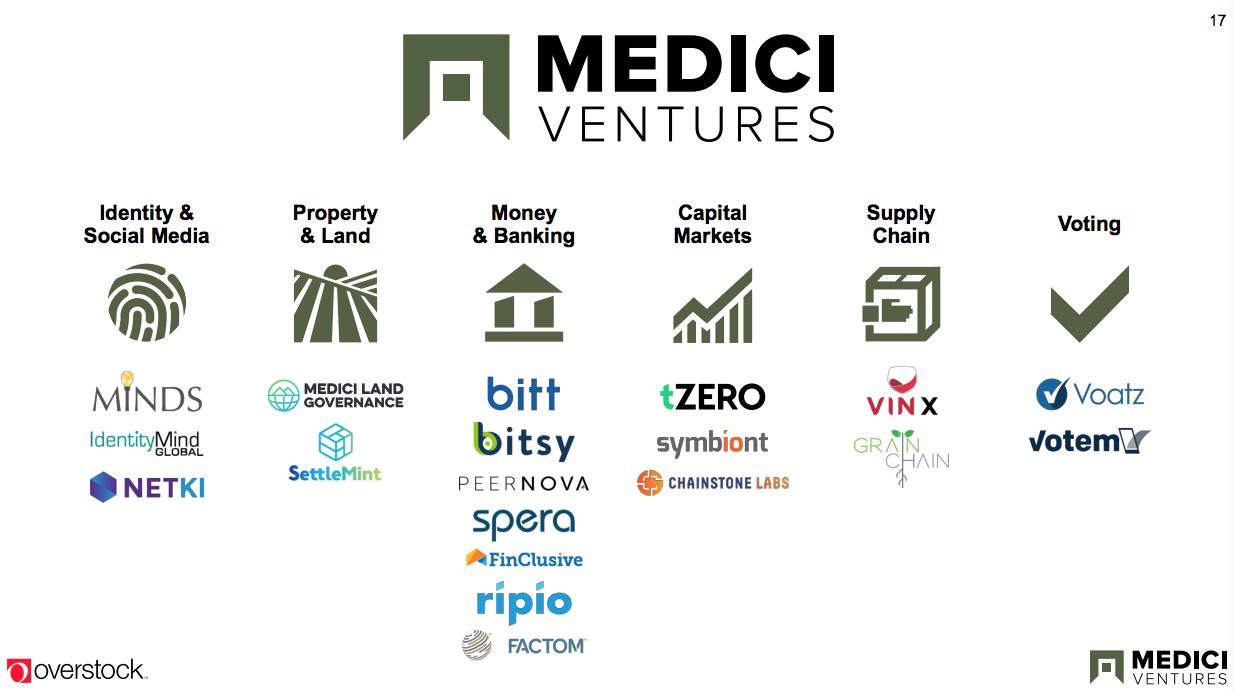
Well, largely unknown to most OSTK has slowly been turning itself into a blockchain VC firm. Four years ago, Overstock was the first retailer to accept bitcoin and over the last 4-years it has been putting capital into blockchain technology through its Medici Ventures subsidiary. Medici has invested in a dozen start-ups focused on six areas of blockchain adoption; capital markets, money and banking, property, voting and underlying technologies supporting blockchain.

The price over the last 18 months has started to reflect this transformation 
So, why invest?
Convexity, of course! In addition to the convexity in the entire blockchain theme, discussed above, the collection of circumstances around Overstock has created meaningful convexity in the stock.

Some facts and figures on Overstock; it’s a ~$550mn market capitalization company with ~$180mn in cash on its balance sheet with no debt (~$3mn) and very limited liabilities. Patrick Byrne, the CEO, is exceptionally controversial with opinions running the gamut from genius to insane. He’s also a “true believer” in blockchain technology, with Overstock being the first retailer to accept bitcoin back in 2014. Finally, as noted it has two businesses; the online retail one that you likely recognize, and the blockchain venture capital one.

Retail Business
- The big news in November was that Overstock announced it was looking to sell its retail business in 2019.
- The retail business is a $1.8bn revenue business that has been slightly loss-making over the last decade, though losses accelerated in early 2018 before tempering.
- Since announcing it was looking to sell its retail business, Wall Street’s analyst’s valuation ranges on the business have been between $400mn and $1bn+. Our Man suspects the top-end is unrealistic; Overstock has never traded at the kind of valuation offered to similar e-commerce businesses (e.g. Wayfair). However, astute readers will note that even the low-end means that you get the blockchain business for free.
- The key will be execution, Overstock selling the business and for a decent price.

Blockchain Business
- Overstock’s blockchain business is through its wholly-owned subsidiary, Medici Ventures, a blockchain VC company.
- Overstock has invested $175mn in blockchain ventures through Medici, and its holdings can be seen below. 


- The most promising Medici asset is tZero, which is an alternative trading system. Initially, it’s looking to transform the trading in ICOs, by making them compliant with SEC and FINRA regulations.
- Overstock is in talks with GSR (a Chinese PE firm) who completed their legal due diligence in Q3. The deal involves taking a stake in tZero equity and a purchase of Overstock equity, in addition to GSR’s position in the recently completed tZero ICO.
- The key again is execution; the market doesn't believe the deal gets done, and definitely not at the $1bn+ valuation that’s been mooted for tZero.

Again, the mathematically astute reader will notice that *if* the GSR deal can be completed, Overstock’s holding in tZero will be worth more than the current valuation. This of course, places no value on the rest of Medici’s blockchain ventures. This, together with the potential from selling the retail business starts to create the convexity, and that’s without tZero or the blockchain businesses becoming something in the long-term.

Technical Accelerant
While OM believes the blockchain theme creates some long-term convexity, and the particulars of Overstock’s fundamental story creates short-term opportunity, it’s the technical factors that have the potential to act as accelerant to really drive the convexity.

A little backstory; Overstock came to Our Man’s attention after speaking with some short-sellers who having been short the name previously, were now long it. That is very rare! One, Marc Cohodes, was involved in litigation with Patrick Byrne (Overstock’s CEO) a decade+ ago. The pair recently settled their differences and Cohodes’ long position and strong views are well known.

While the presence of shorts-turned-longs is interesting, the accelerant is in the amount of short interest and the associated technical dynamics. At October-end, around ~1/3 of Overstock’s shares were short. This in a tightly held stock; Byrne and his family own around 1/3 of the stock, and that’s before you get to any other long-term holders. Accounting for this, 50%+ of the available float is currently short.

Should Overstock manage to execute well, then OM thinks the shorts scrambling to cover their positions will likely help create meaningful additional convexity. For the older financial folks amongst you, think a much scaled down version of Porsche/VW from 2008 as being the best case scenario.

Sizing
Our Man thinks that Overstock offers convexity in multiple ways, but he’s quite aware that (i) both the Blockchain theme and Overstock are potentially binary outcomes, and (ii) he could be 100% right on Blockchain and still lose all his $ in Overstock. As such, you should expect the Blockchain theme and the individual positions to be small, on a cost basis. Over the next couple of years, until either the stocks or the theme become less binary, OM will be biased towards taking profits rather than aggressively letting the position run. Overstock, and the Blockchain theme, are a ~2% position.  

Disclaimer: OM is long Overstock (OSTK), as noted above.