Pages

Showing posts with label Ptf Mgmt. Show all posts

Thursday, July 17

2025: Second Quarter Review

Portfolio Update 
As noted in the recent portfolio update, Our Man made several changes to the portfolio during the second half of April.   

- Uranium: OM increased and consolidated the exposure, by adding to the Uranium Miners ETF (URNM) and the Uranium Junior Miners ETF (URNJ), while fully exiting the remaining single name positions (NXE and SMR).

- US Reindustrialization: OM remains confident that the market continues to underestimate the scale and impact of US reindustrialization.  OM increased the position in the American Industrial Renaissance ETF (AIRR).

- Carbon: OM materially increased the position in California Carbon Allowances (KCCA) as prices traded near their floor.

- Commodities: A small position in Lundin Mining Corp (LUNMF) – inherited through the takeover of Filo Mining Group (FLMMF) - was modestly increased.

- European/UK Banks: Positions in Barclays Bank (BARC), Lloyds Banking Group (LYG) and Natwest Group (NWG) were all trimmed.

- Position Exits: OM fully exited several smaller holdings to reallocate capital towards higher conviction ideas.  These included positions in Greece (ALBKY), Brazil (EWZ), and Biotech (IBB and XBI) and the Idiosyncratic Equity position in Texas Pacific Land (TPL).

Performance and Review
Our Man’s portfolio bounced back strongly during the second quarter, posting strong gains in each month and rising 19.4% during the quarter.  This was comfortably ahead of the S&P 500 TR (+10.9%) and the MSCI World (+9.5%).

The portfolio’s Q2 gains saw it end the quarter at 12.0% YTD, which is comfortably ahead of the market (S&P 500 TR: +6.2% and MSCI World: +6.6%).

Second Quarter Attribution
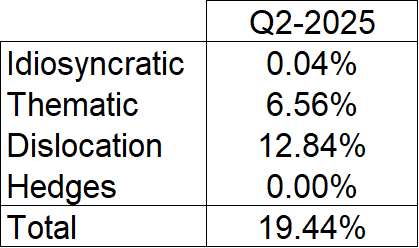


While nearly all positions contributed positively, Q2 performance was driven primarily by the Uranium position (+1,107bps), which rallied just under 50% in the quarter.  Truthfully, little new or special occurred in Q2 - OM simply benefited from having a well-sized position and the discipline to look through Q1s volatility.  The position gained from several ongoing tailwinds:OM increased the Uranium position by 600bps in mid/late April, though some of the gain from this was offset by consolidating into ETFs (with SMR rallying over 2.4x after OM’s exit). Given the rally and increased sizing, OM expects to materially reduce the position during Q3.

Other major contributors: European/U.K. Financials (+298bps) and US Reindustrialization (+224bps) rallied after Q1 earnings exceeded expectations and forward guidance helped ease investor concerns.  Tin (+158bps) surged in April after geopolitical risk around Alphamin’s Congo mine eased, following a U.S.-brokered settlement between DR Congo and Rwanda. The position also benefited from a strategic shift, with Alphamin’s largest shareholder agreeing to be bought out by Abu Dhabi–based International Resources Holding.  Blockchain/Crypto (+110bps) was supported by expanding global liquidity and a post-halving price trend consistent with prior cycles. OM still expects to exit this theme during 2025.

The only significant detractor was Argentina (-128bps), which gave back a portion of its strong 2024 gains.  While President Milei’s reforms are off to a solid start and are improving the macro outlook and buoying investor confidence, progress remains early.  The upcoming October midterms will be a key test.   Short-term sentiment was also dented after Argentina was not added to the MSCI Emerging Markets Index in June – a disappointment for some investors and a drag on local equity market performance.

The portfolio saw healthy performance from Shipping/Tankers (+66bps), India (+53bps), Carbon (+43bps), and Commodities (+30bps).  Meanwhile, China (+1bp) and Idiosyncratic Equities (+4bps) had no material impact on performance.  Positions that were exited during the quarter modestly detracted from performance – Greece (-11bps), Biotech (-17bps), and Brazil (+7bps) – though this capital was redeployed profitably elsewhere.   

Portfolio (as at 06/30/25 - all delta and leverage adjusted, as appropriate)
Dislocations: 54.3%
28.0% - Uranium (URNM & URNJ)
12.4% - European/UK Financials (BCS, LYG, & NWG)
8.7% - Argentina (BMA, GGAL, & SUPV)
5.2% - China (KWEB, FXI & JD)

Thematic: 42.4%
11.7% - US Reindustrialization (AIRR)
9.2% - Carbon Credit Allowances (KCCA)
6.7% - Shipping/Tankers (STNG, INSW, TNK, DHT & FRO)
4.9% - India (IBN, INDA & SMIN)
4.8% - Tin (AFMJF, MLXEF & SBWFF)
3.9% - Blockchain/Crypto (IBIT, ETHE/ETH & OSTK)
1.2% - Commodities/Mining (LUNMF)

Idiosyncratic: 2.5%
2.5% - Equities (JOE)

Shorts/Hedges: 0.0%

Cash: 0.7%

Disclaimer:  Nothing above represents a recommendation in any way, shape or form so please don’t even think of trying to take it that way.  For added clarity, while Our Man is invested in all of the securities mentioned that’s a terrible reason for anyone else to do so.  Our Man also holds some cash and a few other securities (of negligible value).  You should not buy any of these securities because Our Man has mentioned them, but should do your own work and decide what’s best for you given your own circumstances/risk tolerance/etc.

Friday, May 2

2025: First Quarter Review

Portfolio Update
There were no changes to the portfolio during Q1.
However, OM made a number during April so expect an update on them (soon).

Performance and Review
Our Man’s portfolio started 2025 slowly, falling by -6.3% during the first quarter, underperforming the MSCI World (-2.7%) and the S&P 500 TR (-4.3%).


First Quarter Attribution


Investors often look for "inefficient" markets where prices don’t reflect an asset’s true value, offering a chance to profit. However, these same inefficiencies - or a lack of capital to correct them - can cause prices to stray much further from fair value, and for much longer, than expected. OM has learned, often through mistakes, that it’s wise to keep positions undersized in such markets. Smaller positions allow for patience: staying in winning trades longer and avoiding the need to sell too early in losing ones and possibly even adding to them.

OM’s performance was driven largely by losses across 4 investments - Argentina (-205bps), Uranium (-439bps) Tin (-241bps), and Blockchain/Bitcoin (-103bps) - that clearly display traits of being inefficient markets.   The three primary drivers are discussed below:

In Argentina, President Milei has rightly received accolades for the speed, size and scope of his reforms.  OM’s Argentinean Bank equities have been significant beneficiaries, generating over 1,000bps of contribution in 2024.  Unsurprisingly, with negotiations over a deal with the IMF dragging on and those same equities using their increased valuation to raise capital, the positions saw healthy profit taking in Q1.  

We’ve talked about how Uranium is an inefficient market. One key reason is that most uranium is bought through complex private long-term contracts while the spot market (unlike other commodities) is small and heavily influenced by sentiment. Despite this, investors tend to focus on the spot price, which is much more volatile. For example, spot Uranium dropped from over $100 in January 2024 to $64 by March 2025, while the long-term price actually rose from $72 to $80. Uranium miners tend to act like a leveraged version of the spot price; URNM, the Uranium Miners ETF, fell from over $60 in early 2024 to under $30 by March 2025. While spot prices have swung wildly the underlying value, which is reflected more in the long-term price, has continued to grow steadily. This is because we're approaching a supply-demand crunch, and current prices aren’t high enough to encourage new production. OM sees this shift - from over-excitement to under appreciation - as a potential opportunity.

Tin took a major hit this quarter due to rising conflict in the Democratic Republic of Congo (DRC). In Q1, the M23 rebel group - reportedly backed by Rwanda - captured significant territory. Alphamin Resources, which operates the world’s most important tin mine in the DRC, chose to suspend operations and evacuate staff as a precaution, even though the mine is some distance/hard to access from the fighting. This caused the stock to drop sharply. While the actual risk may be lower than the market fears - “the map is not the territory” - it was a well-known risk in investing in Alphamin, and limited OM’s position size.  Some of the losses in Alphamin were offset by strong gains in Metals-X. Late in the quarter, the DRC proposed a minerals-for-security deal with the US, which has led to peace talks between the DRC, M23, and Rwanda.

These losses were partially offset by strong performance in China (+90bps), which rallied on hopes of government support and stimulus coupled with low valuations, and UK/European Financials (+270bps).  Large UK banks like Barclays aren’t seen as undercovered or inefficient investments. However, the years of post-financial crisis challenges - cleaning up balance sheets, low interest rates, weak economic and political sentiment, and low economic growth - have led the market to expect little change, even as conditions start to improve. For example, even after Barclays’ stock more than doubled in the last 18 months, it still trades at just 0.6x its Tangible Book Value (TBV). While the lofty pre-GFCs valuations of over 3x TBV are unlikely to return, OM believes there's still upside as earnings improve and the market gradually recognizes that the future looks better than the post-GFC past.

The rest of the portfolio was a wash; Idiosyncratic Equity (+61bps), Brazil (+48bps), Greece (+43bps) and Commodities (+1bp) contributed positively.  Their performance was offset by Reindustrialization of the US (-51bps), Biotech (-30bps), Carbon (-24bps), India (-24bps), and Shipping/Tankers (-22bps).


Portfolio (as at 03/31/25 - all delta and leverage adjusted, as appropriate)
Dislocations: 55.5%
16.8% - Uranium (URNM, URNJ, NXE, and SMR)
16.7% - European/UK Financials (BCS, LYG, NWG)
11.8% - Argentina (BMA, GGAL, SUPV)
6.3% - China (KWEB, FXI and JD)
4.0% - Brazil (EWZ)

Thematic: 32.3%
7.4% - Shipping/Tankers (STNG, INSW, TNK, DHT and FRO)
5.3% - India (IBN, INDA and SMIN)
4.7% - Biotech: 4th Industrial Revolution (IBB & XBI)
4.3% - US Reindustrialization (AIRR)
4.2% - Tin (AFMJF, MLXEF and SBWFF)
3.5% - Blockchain/Crypto (IBIT, ETHE/ETH and OSTK)
1.4% - Carbon Credit Allowances (KCCA)
1.2% - Greece (ALBKY)
0.3% - Commodities/Mining (LUNMF)

Idiosyncratic: 6.1%
6.1% - Equities (TPL & JOE)

Shorts/Hedges: 0.0%

Cash: 6.1%

Disclaimer:  Nothing above represents a recommendation in any way, shape or form so please don’t even think of trying to take it that way.  For added clarity, while Our Man is invested in all of the securities mentioned that’s a terrible reason for anyone else to do so.  Our Man also holds some cash and a few other securities (of negligible value).  You should not buy any of these securities because Our Man has mentioned them, but should do your own work and decide what’s best for you given your own circumstances/risk tolerance/etc.  

Wednesday, January 29

2024: Fourth Quarter Review

Portfolio Update
There were no changes to the portfolio during Q4.

Performance and Review
After a strong start to the quarter the portfolio fell back sharply in December, ending at -0.60% for the quarter.  This put it well behind equity markets with the S&P 500 TR up +2.41% and the MSCI World up +1.93%.   The result was that the portfolio ended the year at +19.9%, which unfortunately trailed both the S&P 500 TR (+25.0%) and MSCI World (+21.0%).

Over the last 5-years, the portfolio has marginally underperformed the S&P 500 TR though it has outperformed the MSCI World by ~200bps per annum.


Fourth Quarter Attribution

Despite underperforming the market, 2025 was a strangely satisfying year for OM; this was largely due to successes in position sizing.  A well-sized position allows an investor to be proactive because they’re rarely a forced seller.  OM has learned that for his ‘regret minimization’ this equates to being a little undersized (vs. his idealistic intentions).  


The sizable positions in Uranium (-104bps in Q4) and Shipping (-295bps) have been key drivers of the portfolio over the last 3-years but were both flat for the year.  Despite being major detractors in Q4, Our Man lost no sleep over them and with fundamentals broadly unchanged will potentially add to them in Q1.   The same is true of the position in Carbon (-8bps); while OM originally expected it to become a material position during 2024 it ended up detracting in every quarter!  However, the small size (2.5%) constrained the drawdown and by being disciplined and not adding during the year, OM is now well positioned as California Carbon Allowance prices trade close to the projected 2026 floor price.


The position sizing largely worked on the positive side too; Argentina (+532bps) and European/UK Financials (+32bps) were strong again in Q4 and delivered approximately 3/4 of the portfolio’s total gains during 2024.  They have both derisked during the year – as President Milei successfully implements his agenda in Argentina and as the UK banks continue to positively surprise and buyback stock – and have grown into material positions.
Elsewhere, three potentially interesting positions for 2025 showed mixed results, and the next few quarters will be vital for all three.   China (-40bps) gave back some of its Q3 gains as investors questioned the government’s willingness to support the economy (and market).   Blockchain (+75bps) rallied on the likelihood of a change in regulatory approach in the US following President Trump’s victory.  The likelihood remains that even if sized up and successful these investments will largely be out of the book within 12months or so; they are ones to rent not own.   Finally, the Brazilian market continues to struggle with the bond and currency markets punishing the ruling government for its hefty deficit.  OM suspects with the mid-term elections over we may see a more pragmatic President Lula, and markets respond to that.


Elsewhere, there was a negative cadence to the portfolio during the final quarter with a broad array of positions contributing small losses including Idiosyncratic Tin (-53bps), Biotech (-47bps), India (-36bps), Equities (-29bps), Commodities (-13bps), and Greece (-7bps).  The sole outlier was the Reindustrialization of the US theme (+14bps).


Portfolio (as at 12/31/24 - all delta and leverage adjusted, as appropriate)
Dislocations: 55.0%
20.4% - Uranium (URNM, URNJ, NXE, and SMR)
13.2% - Argentina (BMA, GGAL, SUPV)
13.1% - European/UK Financials (BCS, LYG, NWG)
5.0% - China (KWEB, FXI and JD)
3.3% - Brazil (EWZ)

Thematic: 36.7%
7.4% - Shipping/Tankers (STNG, INSW, TNK, DHT and FRO)
6.4% - Tin (AFMJF, MLXEF and SBWFF)
5.3% - India (IBN, INDA and SMIN)
4.8% - Biotech: 4th Industrial Revolution (IBB & XBI)
4.6% - US Reindustrialization (AIRR)
4.4% - Blockchain/Crypto (IBIT, ETHE/ETH and OSTK)
1.6% - Carbon Credit Allowances (KCCA)
1.6% - Commodities/Mining (FLMMF)
0.7% - Greece (ALBKY)

Idiosyncratic: 5.1%
5.1% - Equities (TPL & JOE)

Shorts/Hedges: 0.0%

Cash: 3.2%

Disclaimer:  Nothing above represents a recommendation in any way, shape or form so please don’t even think of trying to take it that way.  For added clarity, while Our Man is invested in all of the securities mentioned that’s a terrible reason for anyone else to do so.  Our Man also holds some cash and a few other securities (of negligible value).  You should not buy any of these securities because Our Man has mentioned them, but should do your own work and decide what’s best for you given your own circumstances/risk tolerance/etc.  


Monday, January 20

How OM Thinks about Sizing Shipping

Given the recent and likely ongoing volatility, OM wanted to talk about how plans on managing his Shipping positions.  As such, this post is primarily a way to help OM clarify his own thoughts and commit them to paper.    

An advantage of being in the investment world over the last 20-years is that OM has seen many otherwise intelligent and rational folks make appalling investment decisions. Typically, these decisions come at times of stress and often around the investor’s high conviction positions! These experiences mean that OM his keenly aware that it is as important to protect your mental capital as it is your financial capital when investing.

This is particularly the case for OM’s position in Shipping. It will be very volatile; the underlying supply/demand dynamics mean shipping rates will fluctuate significantly, the operating and financial leverage of the stocks will add to this and the terrible history of the sector means the marginal investor will initially focus too heavily on short-term data points.   For Our Man’s portfolio, this is magnified further due to the size of the position – it is indubitably the highest risk position in the portfolio. That is not an oversight. 

So how to deal with this volatility and the uncertainty it will naturally engender? 
First of all accept it is coming and be comfortable with the consequences of that.  Shipping will likely dominate the moves of OM’s portfolio over the coming weeks, months and quarters.  It will happen regularly and so OM will not be writing up every 20-30% move up or down in the stocks, or adjusting the portfolio for them.

Second, remember why you’re invested.  For Our Man, it’s a high conviction Dislocation position that is fully sized and ‘on the clock’ now that the catalyst (IMO 2020) to engender investor interest has occurred. The goal for Dislocation positions is that they return multiples of invested capital within a relatively defined time period. To capture the compounding required to generate this performance, OM treats them more like private-equity positions. This means, the positions aren’t really resized or traded unless (i) the long-term thesis changes or (ii) the capital at risk in the position goes beyond OM’s preset tolerance.  

Currently, OM’s view is that “too much” capital at risk would be 25-30% NAV in Shipping and 10% in any of individual names. However, if OM’s thesis is correct then these max capital at risk levels will slowly decline.  So while Shipping is currently OM’s highest risk position, he’s comfortable with the potential mark-to-market losses and expecting to be paid for that risk.

The difficulty of dislocation positions is that even after the ‘catalyst’ they require patience and will-power. This will particularly be the case in Shipping, and Bob Farrell’s Rule Number Four (10 Market Rules to Live By) sums up what to expect.

“Exponential rapidly rising or falling markets usually go further than you think, but they do not correct by going sideways” -- Bob Farrell

Third, have a plan!  A plan is a starting point, and it should change over time as circumstances and data change. Here are the key elements to OM’s plan.  OM is primarily focusing on the fundamentals - relevant crude/product tanker shipping day rates and how they show up in company earnings. He is most interested in the general level of rates and how they compare to prior years, and less so with the short term moves.  The short-term changes will likely be substantial and inconsistent, and overly focusing on them is how you destroy mental capital through obsessing about the trees but missing the forest.  Remember, for Dislocation investments the time horizon for the thesis is 18-24mos (max 30mos), in this case from Jan 2020, so the longer-term levels and their trends matters more. Secondly, Shipping is a very seasonal sector and so comparison to prior years is more important than vs. recent months. Obviously, strong day rates should lead to strong corporate earnings (and potentially dividends), which will help attract other investors.

Meanwhile, understand it is shipping and the crappy history that created the opportunity means that new(er) investors will be skeptical. It will take day rates being meaningfully and consistently higher than previous years, and the companies showing they’re not spending their free cash flow on more ships for the investor community to start to get very interested. Until then, every downturn in rates will lead to “it’s the end of the cycle” comments.  This is another factor that will only exacerbate the volatility in both directions.

Fundamentals will also be the simplest and most important way for OM to be proven wrong.  So expect him to exit if (i) the recent rise in shipping rates is brief and cyclical and then they consistently look like 2018/2019’s rates, or (ii) better rates don’t flow through to company earnings and free cash flow, or (iii) companies repeat the folly of past cycles and order new ships!

What could make OM sell if he’s right?
If OM is correct in his thesis then there are two ‘rules’ – on position size and holding period – for Dislocation positions in addition to any qualitative rationale, for reducing/exiting positions.   As mentioned about these rules are of a typical holding period of 18-24 months (and 30 months maximum) from the narrative changing event (IMO 2020 on Jan 1st, 2020), and OM has set the maximum position size he’s comfortable with at 25-30% today (and 10% per individual position) though both will decline as the thesis progresses.

Assuming the fundamentals continue to trend well, then the qualitative decision is based around price, valuation and sentiment.  The extreme limits of these are easy to specify; expect OM to be well out of these names when you start seeing the companies trading at multiples of NAV, or read/hear about shipping companies as “high dividend names” or that shipping day rates will stay at elevated levels for years (i.e. the sector is no longer cyclical). Finally, Our Man is also watching to see when the names are added to different ETFs. While the stocks will certainly benefit from the wall of passive money flowing into them it’s a strong signal that the end is near for Shipping as a dislocation position in OM’s portfolio*.

Conclusion
Our Man hopes that the three points above – accepting that Shipping will be volatile (and will drive the portfolio’s short-term moves), remembering why he’s invested, and having a plan – will help him manage the shipping positions over the coming quarters.  He’s also listed some of the fundamental and other qualitative factors he’s watching to try and help prevent thesis creep, so expect updates on these during the quarterly reviews.   Finally, if you ever hear OM talking about how Shipping cos are high dividend names…then less than politely ask him what the hell he’s doing and remind him of this post!!


* For future reference, today the stocks are barely owned by ETFs – STNG (3.3% of market cap is held by ETFs), DSSI (2.5%) and EURN (2.1%).  For comparison, large bell weather stocks (AAPL, GOOGL, FB, BA, GE, etc.) have ~10% of their market cap owned by ETFs and some stocks can have 40%+ of their market cap owned by passive investors.


Disclaimer:  Nothing above represents a recommendation in any way, shape or form so please don’t even think of trying to take it that way.  For added clarity, while Our Man is invested in STNG, DSSSI and EURN that’s a terrible reason for anyone else to invest in them.  You should not buy any of these securities because Our Man has mentioned them, but should do your own work and decide what’s best for you given your own circumstances/risk tolerance/etc. 

Saturday, September 21

Ptf Update: Don't cry for me (over) Argentina

Argentina fell under the same thematic umbrella as the positions in Brazil, India and Vietnam; a relatively ‘young’ nation that had moved towards capitalism.

The position was originally a dislocation idea after the election of President Macri in late 2014 ended the long populist (and incompetent, etc.) rule of President Cristina Fernandez de Kirchner.  While President Macri did a fine job of cultivating the low hanging fruit (independent Central Bank, removing capital controls, settling with bond holdouts, etc.), Argentina’s macroeconomic fragility meant he was always walking a fine line.  His government’s management of the more complex reforms was far less impressive, and this combined with the weak macro conditions eventually forced the agreement of a $57bn deal with the IMF in 2018.  This deal provided a much needed capital buffer for the country to stabilize the currency, but came with the IMF’s strict conditions (austerity!) leaving Macri with limited options to boost the economy.   With an election rematch expected in late 2019, and Macri’s position weakening, OM reduced the position size in the first quarter of this year.


The second quarter saw surprises as new political alliances formed; firstly, Mrs. Kirchner decided to run as Vice President inviting her former Chief of Staff, Alberto Fernandez, to lead the ticket.  Then, a third candidate Roberto Lavagna, a former Finance Minister under Mrs. Kirchner’s husband in the early 2000s, formed an alternative option to the polarized Marci-Kirchner battle.  Finally, Macri shocked everyone by naming the Senate Majority (and Opposition) Leader, Miguel Pichetto as his VP candidate!   With all the Presidential tickets announced, Macri’s position improved, Argentinean stocks rallied and OM hung around with his smaller position.
 
However, Macri suffered a huge defeat in the primary polling to get into the general election. Though Macri had no problem getting onto the general election ballot, trailing your opponent by 15 points and doing far worse than even the most pessimistic estimates doesn’t fill people with confidence.   The market’s reaction made clear how little confidence…


Add in an 11% fall in the peso, and the S&P Merval fell 48% on the day; the second largest single day drop globally since 1950!  For comparison, the Dow Jones dropped 22.6% on Black Monday in 1987!   OM managed a pyrrhic victory, with the portfolio’s Argentinean exposure falling a mere ~26% on the day! 


So what now? 
Well, the uncertainty surrounding a Fernandez/Kirchner government makes Argentina uninvestable and hence OM exited his Argentinean positions.  They certainly didn’t help in Q3, though since the start of 2016 Argentina has added ~400 basis points to performance.  As for the future, if Macri should somehow overturn the long and increasing odds to get a second term, then perhaps the situation would be similar to the original dislocation opportunity in 2015.  

The Argentina position was one that’s provided OM with many lessons.  Initially, it helped spur the research that cemented the Dislocation strategies’ rule of typically holding 18-24 months (and 30 months maximum) from the narrative changing event (in this case Macri winning in late-2014).  This time, it served as a reminder that emerging markets are never boring and the downside skew is always worse than you think!  OM would have been better trimming on the IMF deal which reduced Macri’s degrees of freedom and exiting in full back in March.  In both cases, the upside on a Macri victory was so great that missing the first 20-30% wouldn’t matter.  Remind OM of that, if Vietnam, Brazil or India start to go off the rails…


Disclaimer: Our Man held the above positions (GLOB, AGRO, GGAL and DESP) in Argentina.

Sunday, July 28

2019: Second Quarter Update

Portfolio Update
- 4th Industrial Revolution:  OM added a small position in the iShares Technology-Software ETF (IGV) at the very end of the quarter, as a way to gain exposure to Enterprise SaaS companies.

Performance and Review
The second quarter saw the portfolio rise +6.80%, which outperformed both the S&P 500 Total Return (+4.30%) and the MSCI World (Total Return, Net Dividends) (+4.01%).   For the year, this leaves the portfolio at +17.93%, which is nestling in between the S&P 500 Total Return (+18.54%) and the MSCI World (Total Return, Net Dividends) (+16.98%).


As the table intimates, performance was driven by the Dislocation positions and in particular those in Greece (+398bps) and Shipping (+216bps). 

Greece rallied strongly in the final weeks of the month after New Democracy, the opposition party, comfortably won the European elections.  This led to Prime Minister Tsipras calling an early election, and investors began to think about Greece’s future under a pro-business New Democracy government.   Subsequent to quarter-end, New Democracy successfully won a majority in the snap Greek election.  New Democracy has been talking to investors for the last two years, and immediately presented a financial bill including tax cuts that it hopes will help spur growth.

Within the context of OM’s approach to dislocations, the election is the catalyst that OM believes will change the narrative around Greece and get other investors to look at it.  What does that mean for OM’s holding? Empirically, the most attractive risk/reward in dislocations is the 12-24months after the catalyst – the honeymoon period, where there’s low hanging fruit and investors want to believe the story.   Thus expect Greece to almost certainly remain in the portfolio for the next 12-24mos, with the caveat that price movement should justify this – seeing May’s lows ($7.80 for GREK) revisited would be concerning and the position would be exited if we returned to December 2018’s low ($6.75).  On the other hand, don’t expect OM to take profits for at least the first 12 months – setups like this are rare, and the compounding impact to performance is worth the residual volatility.

The Shipping (+216bps) dislocation was driven by its exposure to product tankers, which benefited from Clean Tanker rates holding up well.  The sub-sector continues to see favorable supply/demand characteristics and OM believes it is best placed to benefit from IMO 2020.  The Uranium dislocation (-60bps) fell back slightly during the quarter.

The Thematic positions were a wash during the quarter; gains in Argentina (+75bps) and Brazil (+38bps), offset by losses in Vietnam (-33bps), India (-21bps) and Blockchain (-41bps).  The 4th Industrial Revolution positions made no great contribution (+2bps) in the second quarter.

Elsewhere, the portfolio benefited from the positive trend in markets with the Technical positions (+61bps) buoyed by rising markets, which also helped the Funds (+43bps) in the idiosyncratic book.  Finally, Texas Pacific Land Trust (+8bps) was largely flat for the quarter, despite machinations between management and a group of activist shareholders.

Longer-term Chartology
With the portfolio having been run in this form for 3+ years, Our Man thought he’d throw in a rotating cast of “interesting” charts/statistics on the portfolio’s performance, drawdowns, losses, etc.   The chart below is a simple one, showing what would have happened if OM had put his money in a couple of other instruments.  As you can see, he’d have been better off (so far) putting it into US equities, Global Equities or even a simple 60% Equity/40% Bond.  Obviously, OM expects this to change …


Portfolio (as at 6/30/19 - all delta and leverage adjusted, as appropriate)

Dislocations: 42.1%
21.9% - Greece (GREK, ALBKY, and EGFEY)
11.4% - Shipping (STNG, NVGS, DSSI and EURN)
8.7% - Uranium (URA, CCJ and NXE)

Thematic: 30.4%
6.5% - Tech: 4th Industrial Revolution (JD & IGV)
6.3% - India (INDA and SCIF)
6.2% - Vietnam (VNM)
5.0% - Brazil (EWZ)
4.6% - Argentina (DESP, GLOB, GGAL and AGRO)
1.9% - Blockchain (OSTK)

Technical: 20.4%
20.4% - OEW Technical positions (DDM, SSO, and QLD)

Idiosyncratic: 13.2%
9.6% - Funds (CWS, GVAL, and CAPE)
3.6% - Equities (TPL)

Shorts/Hedges: 0.0%

Cash: 4.1%

Disclaimer:  Nothing above represents a recommendation in any way, shape or form so please don’t even think of trying to take the above that way.  For added clarity, while Our Man is invested in all of the securities mentioned that’s a terrible reason for anyone else to do so.  Our Man also holds some cash and a few other securities (of negligible value).  You should not buy any of these securities because Our Man has mentioned them, but should do your own work and decide what’s best for you given your own circumstances/risk tolerance/etc. 

Saturday, October 20

Portfolio Update - (Early) October 2017


Portfolio Update 
- Thematic - Vietnam:  OM took advantage of the recent sharp market moves to add to the position in Vietnam, bringing it from a small/starter position (2-4%) to a more medium-sized one (~6-8%) within the thematic book.  While there has been much talk about a slow down in global growth and concerns over the future of global trade, it’s important to recognize that countries start from different places.   For the long-term, it’s likely much better for Vietnam to have a trade agreement with the EU (such as the one signed this week) even if there’s uncertainty regarding global trade, than it was not having one over the last few years (when global trade saw fewer issues).  Ceteris paribus, Vietnam is likely to continue to increase in size within the portfolio over the coming year. 

- Technical Book: Unsurprisingly, after decorating the field with yellow flags in the second half of September, OM’s technical model flashed a second sell signal.  OM used the bounce earlier this week to exit the technical book’s positions.  Initial analysis suggests the probable scenario is more like the pull backs in 1984 and 2015/2016 - ~6months of 15-20% - rather than some of the grander falls.  However, the mantra of the mentor within OM’s technical group is worth stating – “Project, Monitor and Adjust”.  These initial scenarios are just that…probabilistic projections, to be monitored and adjusted to the reality that prices are showing us. 

- Dislocations - Brazil:  OM used the market strength to exit ~2/3 of the Brazilian position, reducing it to a 6-8% position.  Brazilian stocks rallied strongly into the first round of the election (Oct 7th), and have continued rallying in the week or so since on the back of Jair Bolsonaro’s exceptionally strong performance.  Bolsonaro is view as the most ‘market friendly’ candidate and is now the clear favorite in late October’s two-person second round. 
Why exit now?  Well, risk and uncertainty.  For all the various global politicians described as “the Trump of XYZ”, Bolsonaro is the best fit; while the market may like his Finance Minister and approach, there are other significant questions and risks surrounding a Bolsonaro Presidency.  With the ETF at $38-40 today compared to the $30-32 of a month ago, more of this risk is embedded in the trade today.  Add in the uncertainty of the market environment (see Technical Book above), especially in Emerging Market countries (see Argentina’s issues over the last 6mos) and Brazil fails to justify being an outsized positions. 

- Idiosyncratic – TPL: OM further reduced to the TPL position, selling another ~30% of the original holding for the same reasons as discussed in the last quarterly update, which leaves a 2-4% position.

Portfolio Thoughts 
Some brief thoughts on the portfolio:
- The below notwithstanding, the portfolio changes mean that OM has likely locked in this year’s performance as a negative number (and most likely -5% to -15%).  That’s a strange feeling!  
- If OM’s current expectations are correct, it’s going to be vital to take advantage of having a lot of cash to buy at attractive prices and earn out-sized returns.  That will be a harder decision that the ones over the last few weeks.   If OM is wrong, and the market rallies away to much higher highs…the performance is going to really really suck both absolutely and relatively!!  I’ll say it now, OM is comfortable with that…he’d regret it MUCH more if he ignored the signs he’s seeing, did nothing and the market pulled back.
- Though the portfolio is only ~56% invested, it is heavily biased towards Emerging Markets.  As a result, OM expects the portfolio will have a higher beta and potentially a negative skew in the coming few weeks.  The higher beta means that the portfolio will behave like it’s more heavily invested (e.g. 66-75%), while the negative skew means it will likely capture a little more of the downs than it will of the ups.
- The negative skew is potentially the most concerning, if it reaches an extreme (e.g. capturing 50-60% of the market’s upside but suffering 90-100% of the downside).  This extreme is most likely to occur due to a rally in the dollar; a US-listed ETF (holding foreign country stocks) would suffer both from the fall of those stocks and also the dollar movement.  Suffice to note, this is a risk OM is monitoring and currently comfortable with.
- OM has a LOT of ideas so expect some half-baked ideas posts in the coming weeks, including a Short/Hedge and a Dislocation.
- OM will be ☹ if Greece isn’t a large/outsized position & huge contributor next year. 


Portfolio (as at 10/17/18 - all delta and leverage adjusted, as appropriate) 
Dislocations: 20.8% 
9.6% - Uranium (URA, and NXE)
6.8% - Brazil (EWZ, and EWZS)
4.5% - Greece (GREK, and ALBKY)

Thematic: 20.8% 
6.9% - Argentina (PAM, DESP, and AGRO)
6.1% - Vietnam (VNM)
5.5% - Tech: 4th Industrial Revolution (JD, VIPS and IBB)
2.3% - India (IFN)

Idiosyncratic: 14.8% 
11.5% - Funds (CWS, GVAL, and CAPE)
3.3% - Equities (TPL and FNMA)

Shorts/Hedges: 0.0%

Technical: 0.0%

Cash: 43.6% 

Disclaimer:  Nothing above represents a recommendation in any way, shape or form so please don’t even think of trying to take the above that way.  For added clarity, while Our Man is invested in all of the securities mentioned that’s a terrible reason for anyone else to do so.  Our Man also holds some cash and a few other securities (of negligible value).  You should not buy any of these securities because Our Man has mentioned them, but should do your own work and decide what’s best for you given your own circumstances/risk tolerance/etc.