Pages

Sunday, January 20

Things from my Newsblur; 2019 Part I

Let’s begin this year as we mean to go on, with an early edition of “Things from my Newsblur”.  As usual, the most investment-related stuff is at the end.

Dwarf planet 'The Goblin' discovery redefining solar system
Approaching Halloween last year, one of Our Man’s son’s was very into space and especially the hypothetical Planet 9 and the  Dwarf planets.  Imagine the joy, at (i) the discovery of a new dwarf planet, (ii) that it’s called ‘The Goblin’, and (iii) that its existence and orbit further suggest Planet 9 is out there.  Happy days, though the song needs updating!
(Hannah Devlin, The Guardian)

Women’s Pockets are Inferior
Mrs. OM hcompains about the frustration of women’s pockets, and especially the decorative faux pockets.  Well, here’s the data (and cool graphics) on the differences in pocket sizes and shapes in twenty of the most popular blue jeans for men and women.   Spoiler alert:  No shock but the data proves that women have a right to be upset!
(Jan Diehm & Amber Thomas, Pudding.cool)

Rodney Brooks: Tech Prediction Scorecard, January 2019
Predicting the future is fraught with the risk of looking foolish…and more so when you’re looking at to 2050 and thinking about technological change.  A year ago, Rodney Brooks made multiple predictions on self-driving cars, artificial intelligence and machine learning, and the space industry.  He will revisit them and highlight the progress, as well as where he is on track or off base.  If you only read one blog post on those subjects, each year, make it this one.
Why is it interesting?  Well, the future is interesting, and Dr. Brooks is more qualified than most to hazard these guesses.  Additionally, we can see how the data and his thinking evolve each year - process matters!  Dr. Brooks is the Panasonic Professor of Robotics at MIT, where he was also the Director of the MIT Artificial Intelligence Lab.  He’s also a Founder, former Board Member and former CTO of iRobot.
(Rodney Brooks, his blog).

Vietnam is Winning the US-China Trade War
With the current US-China trade war picking up, and the sense that it’s the start of a new dynamic between the two countries rather than a one-off spat, technology manufacturers are starting to set-up factories elsewhere.  This coupled with Vietnam opening up to free trade (e.g. the TPP and a trade deal with Europe) has meant that “Vietnam, once dependent on garments and other cheap exports, has begun to rival China’s tech sector.”  This is not something new, but merely Vietnam starting to tread down the path that Thailand took ~30yrs ago, and China ~20-25yrs ago.  Absent a major change, expect Vietnam to be Our Man’s portfolio for a looooooong time!
(Bennett Murray, Foreign Policy)

How Open-Source Software Took Over the World
Regular readers will know that OM has been reading about, linking to, and mentioning software (especially enterprise) a lot recently.  Five years ago, the idea that open-source software was viable let alone would be dominant was met with skepticism from investors.  The world has certainly changed, with IBM’s purchase of Redhat (for $32 billion!!) headlining a list of multi-billion dollar takeovers, IPOs and companies!  Mike Volpi goes through the evolution of open-source software from Linux and MySQL, through the second generation and how it evolved towards Software-as-a-Service business models enabled by the cloud.
(Mike Volpi, TechCrunch)

But…
AWS, MongoDB, and the Economic Realities of Open Source
What if enterprise open-source software is music; and the software cos are the record cos?  Music like open-source software is relatively worthless once it’s been produced, since it can be copied endlessly.  Record companies don’t sell music, but rather the tools that make music usable (i.e. CDs in the good ole days)…and it is the same with open-source software, especially in the cloud era.  Therein lies the rub, will the value accrue to software cos (or record companies) or to those companies (and products) like Amazon Web Services, Microsoft's Azure, etc. (or Spotify, Apple Music, etc in the case of music) that provide the convenience to the end customer.
(Ben Thomspon, Stratechery – if you like technology and read nobody else on a weekly basis, read Ben!).

Tuesday, January 15

2018: Fourth Quarter Review

Portfolio Update
Our Man’s working view is that things are okay despite the market’s gyrations and what you might have read.  While there is much uncertainty, the probability of a recession or credit market crunch currently remains low.  Markets have just moved from pricing in a scenario where everything goes perfectly, to one which suitably acknowledges the uncertainties.   Our Man expects that the market may retest the December lows, or at least see a meaningful pullback when this rally ends, and he will look to continue buying during that move.  

What’s he looking to add to the portfolio?
It will be a barbell approach; either positions where there is an event or catalyst in the coming year that will focus investors’ attention, or where the long-term secular trend is understood yet the current price provides a decent entry point for a multi-year holding.  OM also expects to re-enter the Technical book’s position, once he receives the requisite buy-signal.

Looking back at the 4th quarter, the changes to the portfolio occurred in three distinct phases: 
- The first set of trades, in early-to-mid October were largely discussed in prior posts.  Our Man added to his Vietnam position (VNM) and exited the Technical Book (SSO, QLD and DDM), further reduced the idiosyncratic TPL position and trimmed his Brazil exposure (EWZ and EWZS).   Later in the month,  he also went from long biotech (IBB) to short biotech (BIS).
- At the end of November, Our Man started a new Theme-Blockchain position, with a position in Overstock (OSTK).
- In the second half of December, Our Man added materially to the Dislocation-Greece position through the existing positions in the Greece ETF (GREK) and Alpha Bank (ALBKY), as well as a new position in Eurobank (EFGEY).  This recent piece from the last “Things from my Newsblur”, offers a detailed look at Greece (and especially Eurobank).  Our Man will write more but in essence; valuation is now reaching an absolute extreme, investor sentiment is terrible and has significantly diverged from fundamentals, but there is also a catalyst (elections!) in 2019 that can change that sentiment.

Performance and Review
The final quarter saw the portfolio fall -5.7%, which was substantially better than the S&P 500 Total Return (-13.5%) and the MSCI World (Net Dividends) (-13.4%).   Unsurprisingly, the majority of OM’s negative performance (-3.24%) came in the first 11 days of October before any of the changes were made to the portfolio.

Overall, Our Man’s October assertion that the portfolio changes had likely locked in 2018’s performance between -5% and -15% just about held true; the portfolio’s YTD performance ended at -14.9%.  Disappointingly this trailed both S&P 500 Total Return (-4.3%) and the MSCI World (ND) (-8.7%) by a material amount – though the damage was done early in 2018.


There were very few surprises in the portfolio’s performance during the 4th quarter, as it held-up consistently well and Brazil’s strength prevented any negative skew from developing. 

Dislocations
- Brazil was a major contributor, adding 268bps to performance, following Bolsonaro’s win in the Presidential elections. Our Man took advantage of the strong rise during October to significantly reduce the position.  Brazil remains attractive and while a Bolsanaro presidency will likely help economically, unlike Greece and Argentina a change of government wasn’t part of OM’s thesis.  As such, with reduced certainty and conviction, the position is smaller.

- Greece cost 141bps in the quarter.  As noted, the discrepancy between OM perception of reality and investor sentiment/the market’s belief is now significant.  If the technical picture was just a little better, OM would be all in.

- Uranium cost 122bps, as the stocks fell with equity markets.  The last 15 months have seen numerous positive fundamental developments, especially the actions by Cameco & Kazatomprom to reduce supply, but no reaction from stock prices.  The fourth quarter was similar with Uranium spot prices finally started to pick up (and long-term contract prices bottoming out) and Kazatomprom IPO’ing.  If these can’t encourage investors to relook at the space over the next few months, and drive stock prices higher then Our Man really shouldn’t be here (and certainly not in this size).

Thematic
Argentina (-6bps) and India (0bps) were flat for the quarter, while Vietnam (-25bps) saw only a minimal loss.  Argentina remains the most intriguing situation in the portfolio but it’s heavily dependent on whether President Macri runs again (and wins).  Our Man can see a scenario where Argentina is down 50% this year, but also one where it’s the equivalent of buying US stocks in 1984!  OM suspects you’ll see much discussion here about it over the course of the year…

While the above positions held up well, the same could not be said for the Tech: 4th Industrial Revolution (-97bps) and Blockchain (-69bps) themes, which both fell heavily.  The technology positions are both Chinese so suffered with both the retreat in Technology names and the weakness in China.  As for the Blockchain position; Our Man received a sympathetic “Investing is hard” email from a friend after Overstock announced a delay in the GSR deal within a week of OM’s post.   They did not execute well!
Other
The Technical (-130bps in Q4) book was reduced in late September following an initial sell signal, but still suffered during the market’s pullback in early October.  The pullback triggered the second sell signal, and the Technical positions were liquidated preventing any further loss.  This meant that the technical book proved a healthy contributor for 2018.

The Idiosyncratic book’s losses (-307bps in Q4) were evenly split between the Funds book (-155bps) and the Equities (-152bps).  Though Funds book fell, it managed to out-perform the market in the quarter.  Despite being cutback (twice), Texas Pacific Land Trust (TPL) still cost 147bps.  The company predominantly earns its revenue through royalties/leases for oil and gas production and easements (e.g. for oil pipes), largely in the Permian Basin.  The stock suffered as the oil price collapsed during the quarter; though the medium-term impact on production (if any) will prove more meaningful for TPL. 


Portfolio (as at 12/31/18 - all delta and leverage adjusted, as appropriate)
Dislocations: 28.2%
12.2% - Greece (GREK, ALBKY, EGFEY)
9.1% - Uranium (URA, and NXE)
6.9% - Brazil (EWZ)

Thematic: 22.0%
6.8% - Argentina (PAM, DESP, and AGRO)
6.0% - Vietnam (VNM)
4.5% - Tech: 4th Industrial Revolution (JD and VIPS)
2.7% - India (IFN)
2.1% - Blockchain

Idiosyncratic: 13.2%
10.8% - Funds (CWS, GVAL, and CAPE)
2.4% - Equities (TPL and FNMA)

Shorts/Hedges: -14.0%
-14.0 – Short Biotech (BIS)

Technical: 0.0%

Cash: 29.6%

Disclaimer:  Nothing above represents a recommendation in any way, shape or form so please don’t even think of trying to take the above that way.  For added clarity, while Our Man is invested in all of the securities mentioned that’s a terrible reason for anyone else to do so.  Our Man also holds some cash and a few other securities (of negligible value).  You should not buy any of these securities because Our Man has mentioned them, but should do your own work and decide what’s best for you given your own circumstances/risk tolerance/etc.

Wednesday, December 12

Portfolio Update: New Theme – Blockchain

Our Man can hear y’all shouting “Don’t do it” at him!!!

This piece started out just over a month ago, as a half-baked idea, but the collapse in cryptocurrency prices and a unique stock-specific situation meant OM did some more work and has started a blockchain theme. As such, this piece is now much longer than originally intended.

Some Scary Finance Terms Made Simpler
Before we dive into the blockchain, a side note on binaries, loss aversion, agency risk/problem, optionality and convexity. Those of us in finance throw around these terms which sound complex but really cover simple concepts.

Most public market investors avoid binary situations – ones where the probabilistic outcomes are bimodal and split, or in plain English where the result it likely either terrible or awesome with very little in between. The most common example is a single drug biotech company where the drug trial result is the difference between commercializing a multi-billion blockbuster drug and losing everything. This avoidance of binaries is not an irrational decision but reflects the traits of as loss aversion and the agency problem. Research has found that the pain of losing a dollar is vastly greater than the joy of making one, and so people understandably seek to avoid that loss, hence “loss aversion”. The agency problem arises since investors are largely managing other people’s money, which influences their decision making. What do I mean? Do you want to go to your boss with an idea that will lose everything if you’re wrong? Do you want to sit with clients and say we lost X% last quarter due to this one position, but that’s okay we knew there was a 40-50% chance of that happening? For almost all, the answer is no… they would invest their money in that idea but they won’t invest client money.

While this avoidance of binaries is a facet of public market investing, this is not the case elsewhere. Studies suggest up to 40% of venture-funded businesses fail and a similar number don’t generate the targeted returns, yet venture capital is a thriving industry. The reason is convexity; an investment is convex if the payoff is unbalanced for equally opposite outcomes – for example, if you can make 10 on that hypothetical drug being a success, while only losing 1 if it fails. It’s why venture capitalists focus on metrics like Total Addressable Market (TAM) for their start-ups – it helps to frame the company’s potential size, and is a proxy for the investment’s convexity. OM uses optionality to express the same concept, just with an acknowledgement that if he’s wrong the downside is losing the capital invested in the position (i.e. like an option!).

Crypto/Blockchain as Optionality
OM is fascinated by blockchain (and yes, cryptocurrencies) but as friends know, is exceptionally reticent to talk about anything to do with investing in it. It’s so early in its lifecycle that any investments are akin to venture capital – it’s almost impossible to accurately value and there’s a significant probability you will lose your money. Thus OM’s sole advice is do your homework and invest as much as you’re willing to mentally write off not matter how fascinating and misunderstood it is.

With that said, OM is going to share just a little of his thinking on the blockchain as its convexity is part of the thesis. However, to avoid diving down rabbit holes, the following should be considered a gross simplification (some links are embedded for those who want to dig deeper).

There are two broad views of blockchain technology (and the related cryptocurrencies).
1. It will disrupt the Federal Reserve and/or become a store of value/money. That’s cool, and could be very valuable, but frankly OM isn’t really that interested in it. Yes, bitcoin *could* become a mix of digital gold and “money” and there will be profits to be made as in that journey, but it’s not for OM.
2. The potential for creating Web 3.0. This came to life with the creation of Ethereum and is what fascinates OM.
• Web 1.0 was the Internet of OM’s young adulthood (the 90s and early noughties, baby!!), where anyone could start a website as services were built on open internet protocols (points to the https at the start of website addresses, or the smtp protocol that allowed this email to reach you) that were ‘controlled’ by the Internet community.
• Web 2.0 is the Internet as we know it over the last 10-15 years, where major software companies have become centralized hubs of data and information. The historical resolution that occurs whenever an industry sees this type of extreme centralization, aka a monopoly, has been regulation.
Web 3.0 could be the return of decentralization through blockchains, which use consensus mechanisms and cryptocurrencies to better align incentives. OM will spare you all the long explanations, but heartily recommends reading this piece (and everything else) by Chris Dixon.

The arguments for Web 3.0 are manifold but two that intrigue Our Man are:
(i) That you can build more advanced protocols – they’re decentralized and have fixed rules (like Web 1.0), but with greater functionality and better aligned incentives.
(ii) USV’s Fat Protocol Thesis. In Web 1.0 working groups and non-profits created protocols that produced massive value, which was predominantly captured by the applications (e.g. Google, Facebook, etc.). In the blockchain, this is reversed with the value flowing to the protocols (and, if well structured, their cryptocurrencies) rather than the applications built on top of them.

To be clear, it will take a long time. Progress will definitely not be linear and it is far from obvious which protocols and blockchains will ‘win’. However, if – and it is a huge if – blockchains do help engender Web 3.0 and we start to see applications that are native to blockchain (rather than mere copies of what exists elsewhere today), then the related protocols/blockchains will be worth substantially more than they are today. This is the type of convexity that intrigues OM and is drawing software engineers and venture capitalists into the industry.

So what does OM own?
Overstock (OSTK)! The crappy e-commerce stock, what does that have to do with Blockchain?

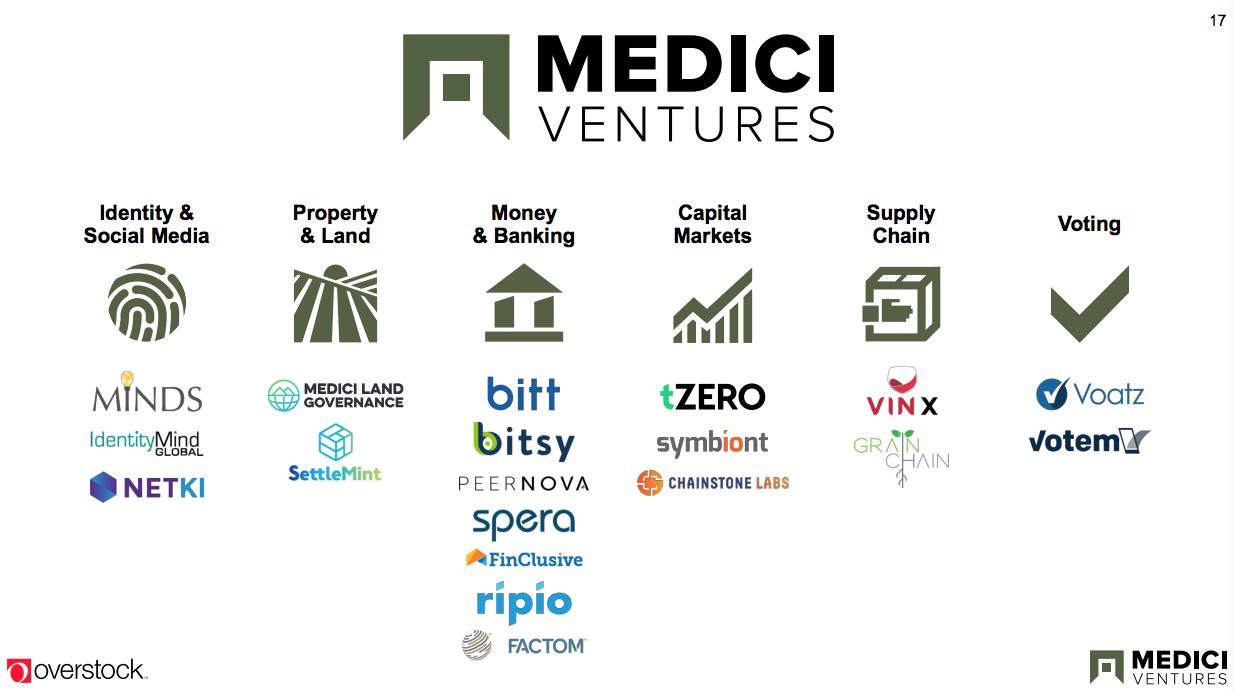
Well, largely unknown to most OSTK has slowly been turning itself into a blockchain VC firm. Four years ago, Overstock was the first retailer to accept bitcoin and over the last 4-years it has been putting capital into blockchain technology through its Medici Ventures subsidiary. Medici has invested in a dozen start-ups focused on six areas of blockchain adoption; capital markets, money and banking, property, voting and underlying technologies supporting blockchain.

The price over the last 18 months has started to reflect this transformation 
So, why invest?
Convexity, of course! In addition to the convexity in the entire blockchain theme, discussed above, the collection of circumstances around Overstock has created meaningful convexity in the stock.

Some facts and figures on Overstock; it’s a ~$550mn market capitalization company with ~$180mn in cash on its balance sheet with no debt (~$3mn) and very limited liabilities. Patrick Byrne, the CEO, is exceptionally controversial with opinions running the gamut from genius to insane. He’s also a “true believer” in blockchain technology, with Overstock being the first retailer to accept bitcoin back in 2014. Finally, as noted it has two businesses; the online retail one that you likely recognize, and the blockchain venture capital one.

Retail Business
- The big news in November was that Overstock announced it was looking to sell its retail business in 2019.
- The retail business is a $1.8bn revenue business that has been slightly loss-making over the last decade, though losses accelerated in early 2018 before tempering.
- Since announcing it was looking to sell its retail business, Wall Street’s analyst’s valuation ranges on the business have been between $400mn and $1bn+. Our Man suspects the top-end is unrealistic; Overstock has never traded at the kind of valuation offered to similar e-commerce businesses (e.g. Wayfair). However, astute readers will note that even the low-end means that you get the blockchain business for free.
- The key will be execution, Overstock selling the business and for a decent price.

Blockchain Business
- Overstock’s blockchain business is through its wholly-owned subsidiary, Medici Ventures, a blockchain VC company.
- Overstock has invested $175mn in blockchain ventures through Medici, and its holdings can be seen below. 


- The most promising Medici asset is tZero, which is an alternative trading system. Initially, it’s looking to transform the trading in ICOs, by making them compliant with SEC and FINRA regulations.
- Overstock is in talks with GSR (a Chinese PE firm) who completed their legal due diligence in Q3. The deal involves taking a stake in tZero equity and a purchase of Overstock equity, in addition to GSR’s position in the recently completed tZero ICO.
- The key again is execution; the market doesn't believe the deal gets done, and definitely not at the $1bn+ valuation that’s been mooted for tZero.

Again, the mathematically astute reader will notice that *if* the GSR deal can be completed, Overstock’s holding in tZero will be worth more than the current valuation. This of course, places no value on the rest of Medici’s blockchain ventures. This, together with the potential from selling the retail business starts to create the convexity, and that’s without tZero or the blockchain businesses becoming something in the long-term.

Technical Accelerant
While OM believes the blockchain theme creates some long-term convexity, and the particulars of Overstock’s fundamental story creates short-term opportunity, it’s the technical factors that have the potential to act as accelerant to really drive the convexity.

A little backstory; Overstock came to Our Man’s attention after speaking with some short-sellers who having been short the name previously, were now long it. That is very rare! One, Marc Cohodes, was involved in litigation with Patrick Byrne (Overstock’s CEO) a decade+ ago. The pair recently settled their differences and Cohodes’ long position and strong views are well known.

While the presence of shorts-turned-longs is interesting, the accelerant is in the amount of short interest and the associated technical dynamics. At October-end, around ~1/3 of Overstock’s shares were short. This in a tightly held stock; Byrne and his family own around 1/3 of the stock, and that’s before you get to any other long-term holders. Accounting for this, 50%+ of the available float is currently short.

Should Overstock manage to execute well, then OM thinks the shorts scrambling to cover their positions will likely help create meaningful additional convexity. For the older financial folks amongst you, think a much scaled down version of Porsche/VW from 2008 as being the best case scenario.

Sizing
Our Man thinks that Overstock offers convexity in multiple ways, but he’s quite aware that (i) both the Blockchain theme and Overstock are potentially binary outcomes, and (ii) he could be 100% right on Blockchain and still lose all his $ in Overstock. As such, you should expect the Blockchain theme and the individual positions to be small, on a cost basis. Over the next couple of years, until either the stocks or the theme become less binary, OM will be biased towards taking profits rather than aggressively letting the position run. Overstock, and the Blockchain theme, are a ~2% position.  

Disclaimer: OM is long Overstock (OSTK), as noted above.

Saturday, December 1

Things from my Newsblur; 2018 Part V


Time for (probably) the final 2018 edition of “Things from my Newsblur”.  As usual, the most investment-related stuff is at the end, though this version does give a glimpse at a future theme and an update on Greece.  Before that it’s a mixed bag of spying, left turns, Fortnite, London Underground and music!

This is the most important story written this year; it’s about a unit of the Chinese PLA allegedly embedding tiny microchips in server motherboards bound for US corporations.  Either Bloomberg have researched and written an exceptional exposé that suggests every national security fear about “made in China” isn’t nearly paranoid enough.  Or this is one of the most irresponsible and dangerous pieces of journalism in many years; “fake news” would be a massive understatement.  Since the original story, both Apple and Amazon have pushed back exceptionally aggressively on this story with Tim Cook (Apple CEO) demanding a retraction and Amazon’s Chief Security Officer, Stephen Schmidt, providing an adamant and clear rejection of the story.  Bloomberg for its part doubled down, with a follow-up story a few days later.
(Jordan Robertson & Michael Riley, Bloomberg Businessweek)

A great article on how a small, cheap and simple change – installing various rubber items at intersections where there are left turns – is improving pedestrian safety in NYC.  The greater incidence of pedestrian injury when cars make left turns was known for a while, but not understood.  NYC combed through its trove of data on accidents, finding that left turns by cars cause 3x as many pedestrian and bicycle casualties as right-turns.  Armed with the data, they studied the causes and came up with a redesign of the streets that is both simple and cheap!  Government can work sometimes!
(Karen Hao & Amanda Shendruk, Quartz)

Thankfully, OM’s kids aren’t old enough to play Fortnite because if they were at least one (no prizes for guessing which one) would definitely be addicted!   This article looks at how Fortnite has become a crazy phenomenon and some of the behavioral and psychological tricks it’s employing to stay there.
(Nick Paumgarten, New Yorker)

Our Man’s first job saw him battle the masses at Bank station a couple of times each day; it isn’t a cherished memory.  This look at the challenging renovation of the entire Bank/Monument train stations complex is fascinating.  Amazingly, Transport for London opted for the most innovative option and the result will be a truly transformational change, despite substantial engineering and construction challenges.  What challenges?  Well it’s all taking place deep underground, and there is one small rectangular shaft through which everything (including the diggers) has to descend.  The process has been described as trying to redecorate your living room with all the items being sent in through your letterbox.
(Ian, at his blog Ian Visits).

An oral history on the back story of how the ubiquitous compilation series came to rule the market.  Amazingly, it continues to prove resistant to the numerous playlists/compilations available through online streaming.  It sold an amazing 3.2million albums in the UK in 2017, managing to outsell the leading artist (Ed Sheeran).
(Mark Savage, BBC)

Marc Andreessen’s seminal WSJ article that “Why Software Is Eating the World” came out over 7-years ago, thus we cannot be surprised by its increasing prevalence in our lives.  This blog post by Tren Griffin highlights how the emergence of mobile and the cloud has led to a new subscription based business model for software companies that is both increasing their reach and speeding up the pace of change.  Subscription business models in software (think Netflix, as the most basic example) will have profound changes across the economy.  Why?  It is an almost 0% marginal cost business – that is, once the code is written it is infinitely divisible (me watching Yes, Minister on Netflix doesn’t affect you watching it on Netflix, at the same time!) and distribution costs via the cloud are negligible (i.e. no producing disks, packaging, paying for retail space, etc.).  This affects simple financial metrics (like total addressable market and company valuation) but also has profound impacts on more important things like employment.  It isn’t robots (like C3PO) that’s going to take your job but software that automates parts of it and makes businesses more efficient.  This will also start to disproportionately impact white collar jobs that have been largely immune from the technological changes of the last decade.  Think of the payroll software that means you need 3-4 people in that department not 5-6, or the legal software that does large parts of a junior person’s case research.
(Tren Griffin, at his blog 25IQ)
[Spoiler Alert – Can you see a Software Thematic position coming soon…]

Greece is the word, people!  You know OM has previously mentioned that he thinks Greece will be the largest position in the portfolio at some point next year.  Everything is slowly but surely lining up; it’s exceptionally cheap, the fundamentals are improving yet are being ignored because it’s hated.  Our Man is hoping 2019 sees the technicals bottom and that the upcoming elections set the stage for the narrative to change and investors to return.  Thankfully, Lyall Taylor’s long but excellent post saved Our Man having to write about the difference between the improving reality and people’s assumptions!  (Lyall Taylor, at his blog The LT3000 Blog)

Thursday, October 25

Portfolio Update and Short Biotech


Portfolio Update
On Monday morning, OM exited the small residual position in the Nasdaq Biotech ETF (IBB) within the Thematic – 4th Industrial Revolution names.
OM also added the portfolio’s first short, Short…the Nasdaq Biotech ETF (the 2x levered inverse ETF – BIS - as there is no single levered version), which represents 10% of capital (leverage-adjusted).


Short: Biotech
If you have ever spent time with professional investors, which describes a portion of Our Man’s day job, you’ll quickly hear some truisms about the short-side; (i) don’t short good companies (or those with secular tailwind), (ii) don’t short on valuation grounds and (iii) for heaven’s sake don’t do it when the stock has price momentum and is rising quickly.  There are good reasons why professional investors hold these views; high quality businesses/management create options for themselves (and easy to understand secular stories offer a strong multi-period tailwind), an expensive stock can get more expensive (see Tesla, to many a short’s chagrin…so far!), and as the saying goes “the trend is your friend until it hits a bend”.  Most who have shorted to any degree have been caught on the wrong side of one of these truisms, and sometimes on the wrong side of all three – even those who should know better.

So, why start with this public service announcement on short selling.  Well, because if you have ever spent time with professional short-sellers (i.e. short-selling is MOST of what they do) you will have learned that some of the BEST shorts violate those rules, but that context matters!   In essence, investors should be so certain in their position that complacency has set in.  The secular theme should be regarded as obvious (or the company as close to flawless) and the valuation should be either ‘new’ or accepted as appropriate without the requisite thought to whether they make sense.  Additionally, the stock should have performed exceptionally well for a prolonged period (strong momentum) - this helps create substantial unrealized profits, complacency in analysis and substantial downside (especially in combination with the valuation).  Finally, and most importantly, that price trend should have already hit its bend – missing the first 10% of a move is less important than timing it right, since the downside is substantial.


So why Biotech, and why now? 
- Company/Trend:
Our Man has talked about the secular trend in biotechnology – in this, his opinion has changed little BUT the context is that it is a long-term trend and expectations have overshot current reality.  

- Valuation:
To help think about valuation in context, here’s a 2002 quote from Scott McNealy, the former CEO of Sun Microsystems (which traded at 10x revenue in 2000). 
At 10 times revenues, to give you a 10-year payback, I have to pay you 100% of revenues for 10 straight years in dividends. That assumes I can get that by my shareholders. That assumes I have zero cost of goods sold, which is very hard for a computer company. That assumes zero expenses, which is really hard with 39,000 employees. That assumes I pay no taxes, which is very hard. And that assumes you pay no taxes on your dividends, which is kind of illegal. And that assumes with zero R&D for the next 10 years, I can maintain the current revenue run rate. Now, having done that, would any of you like to buy my stock at $64? Do you realize how ridiculous those basic assumptions are? You don’t need any transparency. You don’t need any footnotes. What were you thinking?”

In short, the only ways that 10x revenue is not an absolutely crazy multiple is (i) if you’re a quasi-monopoly/oligopoly that’s growing double digits and already has huge margins (we can see you Visa and Mastercard), or (ii) you’re about to turn into one of those companies (i.e. insane revenue growth with future high margins)

For those of OM’s vintage (or older) 1999/2000 were heady days, a mass hysteria of craziness that was never to be repeated…right?
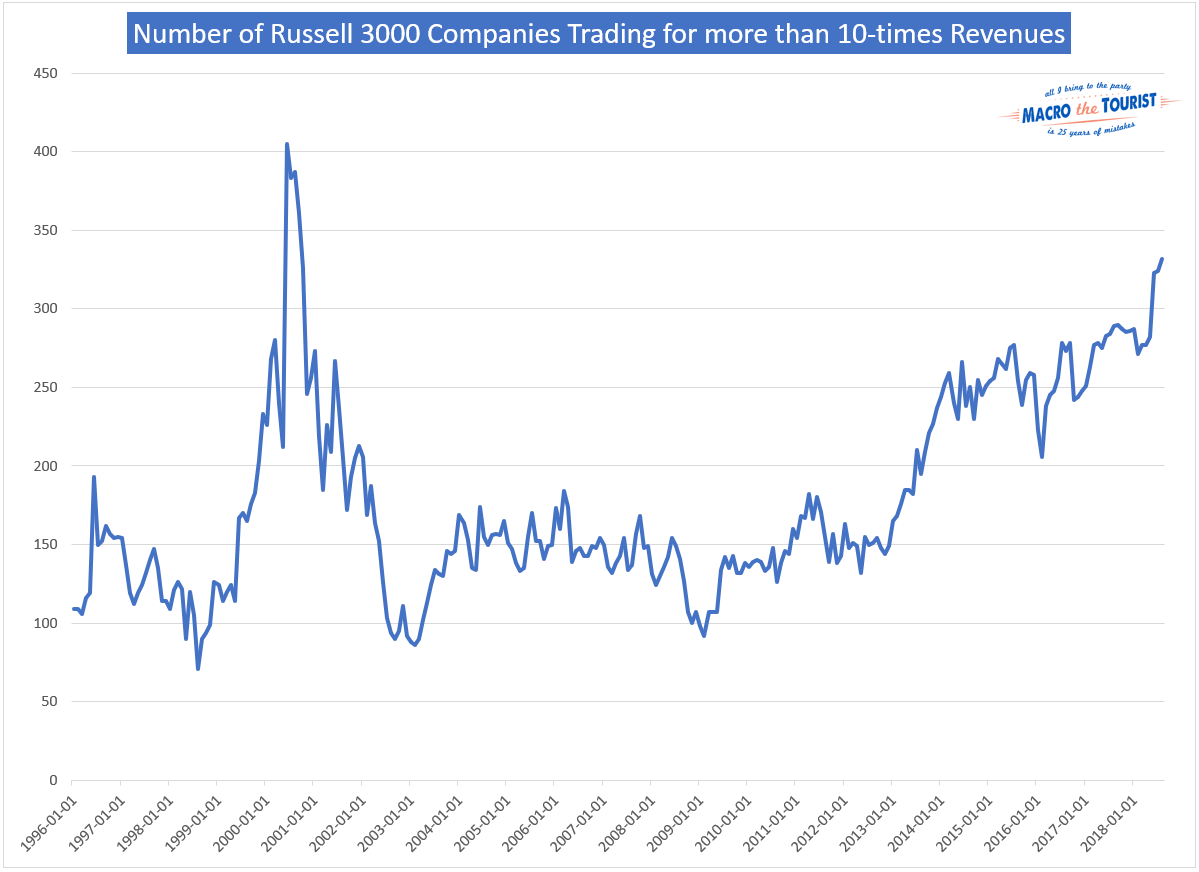
Well…the excellent Keith Muir (The Macro Tourist) posted this chart a couple of weeks ago.


When you start parsing through the list of names, two sectors stand out Healthcare (especially Biotech) and Technology.


So, why short just Biotech not Technology?
- Well, OM uses a very blunt instrument (an inverse ETF) to short rather than finding specific names and so general traits are more important than individual names.
- For technology companies, OM can see the argument that true subscription software companies should see higher valuations that their historical peers.  For these companies, as they scale the marginal cost* approaches 0%.  For example, it costs Adobe Creative Cloud/Netflix/etc. (almost) nothing to add an extra customer – no shipping costs and the cloud-based product (Photoshop, video on demand, etc.) is infinitely divisible (i.e. me editing my holiday photos or watching “House of Cards” doesn’t stop you from doing either).  As such, if these business have a large user base (or are rapidly on their way to having one) they will benefit from this low marginal cost, and deserve a revenue multiple that’s higher than it has been historically.  OM suspects that Technology – and especially those companies that purport to be software companies but are not – will get their comeuppance, but the breadth of the ETF means it’s hard to have confidence in putting on that position.
- For Biotech companies, OM has had discussions with a number of professional investors over the last 6-months where a central theme has been the market’s willingness to ascribe high valuations to numerous companies in the early stages of drug development (i.e. with very limited revenues).  In some cases, these valuations would be aggressive even if the drugs were in market today (as opposed to years away from market).  Given the number of these companies, and the companies’ inability to control the drug approval process (and timing), the valuation gap seems compelling.  While the optimal & vastly more profitable strategy would be to set-up a co-investment vehicle with one of these professional investors to short a basket of these names, OM will instead have to settle for the blunt instrument that is the ETF. 

- Broken Momentum
Applying the same technical analysis, as inspires OM’s Technical book, suggests that the ~10-year bull market in biotech is over with the market peak in September**.  While it’s very early to make projections, the early indications are for a substantial decline.


In summary, Biotech offers an interesting opportunity as there’s an attractive long-term secular theme that’s well understood but has over-extended in the short-term.   The stocks are well-held, and trading at exceptionally high valuations, and until recently they had very strong long-term momentum.  This momentum appears to have broken leaving substantial room for re-rating.

--------------------------

*Yes, there are other costs like programming costs, salaries, etc. but the cost of software production is largely fixed (vs variable) and so over a very large user base tends towards 0%.   These articles by Chris Kluis and Basab Pradhan talk more about the concept of (almost) zero marginal cost.
For those wanting to think more about software subscription businesses in general, you should read this fantastic article by Tren Griffin (in 25IQ, his blog).

** OEW is a technical theory that takes a quantified approach to Elliot Wave Theory.  For the Biotech chart attached, the bull market has 5 waves (each marking a peak, such as 3, or a trough such as 2 or 4) which ended at [1].  The theory suggests a substantial pullback is now expected…


Disclosure:  OM owns BIS, and is thus short Biotech.  Shocking, given the above, I know.