OM used the ‘Liberation Day’ volatility in the market to concentrate the portfolio into his highest conviction ideas and reduce/exit others during mid-April. The most notable exits were the positions in Brazil, Greece and TPL (Equities); all are interesting but lower conviction, and the market volatility offered attractive entry points elsewhere. OM will spare you the market and political commentary and instead give you a sense of the core positions in the portfolio.
OM has increased his allocation to Uranium, now comprising 22.6% of the portfolio as of May 22nd. He has also streamlined the position, consolidating it into two ETFs that represent both major and junior uranium miners. In a fast-changing and often complex world, Uranium stands out as an anomaly. It is remarkably straightforward - its only use is as fuel for nuclear power plants - and everything about its market operates at a slow, deliberate pace. The core investment thesis has remained consistent for years: the lifespan of existing nuclear plants is being extended, new ones are gradually being built, and demand continues to rise. Meanwhile, mining uranium remains challenging and won’t scale meaningfully without higher incentive prices. The uranium market moves slowly: long-term contracts dominate, new plants take years to construct and therefore don’t immediately impact demand, and new mines require lengthy permitting and development timelines. For long-term investors, this creates a market where supply and demand are easier to track, and where dislocations - like the dip in sentiment seen recently due to a falling spot price - can offer compelling entry points.
OM reduced his exposure to UK and European Financials, which now represent 12.9% of the portfolio, after a strong performance that saw many of these stocks double over the past 18 months. The investment thesis, first laid out in Q4 2023, remains largely intact. As UK banks have addressed legacy issues - cleaning up their balance sheets and strengthening capital ratios - and benefited from a more favorable post-COVID environment (stable economies and higher interest rates), their underlying earnings power is beginning to emerge. This has prompted a market reassessment: stocks that were once priced as dire investments - such as Barclays, which traded at just 0.3x Tangible Book Value and 4.0x forward earnings - are now viewed as merely undervalued, with valuations improving to 0.6x TBV and 7.0x expected earnings. OM continues to believe these banks will deliver further earnings growth and return substantial capital to shareholders through dividends and buybacks. However, with much of the re-rating already behind us, future gains are expected to be more measured.
OM maintained his ~12.5% position in Argentina, expressed through holdings in the country’s banks. As noted in the previous quarterly update, the scale, ambition, and early success of President Milei’s reform agenda have been remarkable, leading to a significant repricing of Argentine assets. Despite the positions appreciating 2-3x over the past year, OM has chosen not to reduce exposure. With many of the reforms now enacted into law, OM believes these investments are lower risk than when initially established. Looking ahead, OM expects the reform momentum to continue - particularly if Milei’s party performs well in the upcoming mid-term elections - which could provide further upside.
The final two core positions have been part of the portfolio for some time but were meaningfully increased during April. Each will be covered in detail in upcoming write-ups but below is a brief summary of the current investment thesis for both.
OM increased exposure to the U.S. Reindustrialization theme, which now accounts for 11.5% of the portfolio. While those in urban centers - particularly in the Northeast - may not see it firsthand or find it plausible, an industrial resurgence is already underway across the U.S. Although President Trump is likely to take credit for this trend, the movement predates his current efforts. The shift began in the wake of COVID-19 and has since gained momentum through substantial legislative support under President Biden, including the CHIPS Act, the Inflation Reduction Act (IRA), and the Infrastructure Investment and Jobs Act (IIJA). While reshoring had been under consideration before the pandemic, COVID served as a stark reminder of supply chain vulnerabilities. The advances in automation that have reduced the impact of labor costs have helped to make domestic manufacturing more financially viable.
OM significantly increased the position in California Carbon Allowances (“CCA”), which now represents 9.4% of the portfolio, following an Executive Order (“EO”) signed by President Trump in April that questioned the legality of California’s Cap-and-Trade program. This EO marked the latest in a series of political and regulatory headwinds that had introduced uncertainty and pushed CCA prices down to their mandated floor. Despite the headline risk, the likelihood of a successful legal challenge appears low and, importantly, would take years to play out. In response, California’s political leadership has moved decisively, unveiling plans to extend the Cap-and-Trade program through 2045 - an action that both reaffirms long-term policy support and enhances the investment case.
Portfolio (as at 05/22/25 - all delta and leverage adjusted, as appropriate)
Dislocations: 53.4%
22.6% - Uranium (URNM & URNJ)
12.9% - European/UK Financials (BCS, LYG, NWG)
12.5% - Argentina (BMA, GGAL, SUPV)
5.4% - China (KWEB, FXI and JD)
Thematic: 43.8%
11.5% - US Reindustrialization (AIRR)
9.4% - Carbon Credit Allowances (KCCA)
7.3% - Shipping/Tankers (STNG, INSW, TNK, DHT and FRO)
5.0% - India (IBN, INDA and SMIN)
5.4% - Tin (AFMJF, MLXEF and SBWFF)
4.2% - Blockchain/Crypto (IBIT, ETHE/ETH and OSTK)
1.1% - Commodities/Mining (LUNMF)
Idiosyncratic: 2.4%
2.4% - Equities (JOE)
Shorts/Hedges: 0.0%
Cash: 0.4%
Disclaimer: Nothing above represents a recommendation in any way, shape or form so please don’t even think of trying to take it that way. For added clarity, while Our Man is invested in all of the securities mentioned that’s a terrible reason for anyone else to do so. Our Man also holds some cash and a few other securities (of negligible value). You should not buy any of these securities because Our Man has mentioned them, but should do your own work and decide what’s best for you given your own circumstances/risk tolerance/etc.
Friday, May 23
Portfolio Update: Apr/May 2025 – The Time is Now!


Friday, July 5
Portfolio Update – Part II – Everything Else
The positions in European/UK Banks (11.5% position) and Argentina (7.0%) represent classic dislocations, where investors have been disappointed by so much and for so long that they have given up. The result is an attractively valued opportunity, with prices having bottomed, at a time when material changes are happening.
The European/UK Banks’ (11.5%) 2023 year-end results finally led to sharp moves in the stocks, but it’s telling that even after rising ~40% year-to-date that Barclays still trades at ‘only’ 6.6x analysts’ 2025 Earnings and at 0.5x Tangible Book Value. It doesn’t take a vivid imagination to see the possibility that things continue to improve from here and OM expects the UK banks to continue to surprise investors. One of the counterarguments has been that the post-Brexit, the UK has been a hot mess encapsulated by Liz Truss’ short Prime Ministership. The recent election campaign did little to dissuade this but today’s massive ‘centrist’ Labour majority means that the UK looks politically stable for the foreseeable future in sharp contrast to the uncertainty engulfing France, Germany and the US!
In Argentina (7.0%) it has quickly become clear that President Milei is seeking to make major changes very quickly. While many will feel it is too fast, Milei has learned from Macri’s failed attempt at gradual reform a decade ago. The reforms are broadly things that have been discussed for years including liberalizing the exchange rate regime, shrinking the money supply (including running down the central bank notes, LELIQs, which were held by the banks), balancing the budget and the start of structural reforms. The reforms will be imperfect, and their passage into law and implementation will be complicated, but the direction remains positive. So far, Milei has played his political hand well.
The new position in China (4.6%) bears the dislocation traits; China has fallen from being THE place to invest for much of the last two decades to being described as ‘uninvestable’. There are very good reasons for this, most prominently China’s actions reminding the world that it is not a capitalist country and it has a very different approach to the rule of law. Unsurprisingly, stocks have fallen substantially with large cap China (FXI) bottoming early this year down 55-60%, and China Tech names (KWEB) down ~75%, from their respective February 2021 peaks. This leads to two natural questions – when is the downside priced in and why now? The answers are unfulfilling; it’s near impossible to tell when things are priced in, especially given a large part of the issue is structural. However, the risk/reward is interesting – for example, Chinese Tech stocks trade at half the valuation of US ‘peers’ and the Chinese government has made incremental equity-positive steps (e.g. approving buybacks, etc.). Though OM has started a position, he fully recognizes that China operates under a non-capitalist framework, and thus the size is smaller and the holding period will be shorter than otherwise.
The balance of OM’s portfolio is spread across a handful of themes; India (5.8%), Biotech (5.2%) and US Reindustrialization (4.2%). The first two represent long-term themes that have been in the portfolio a while, and OM expects to outperform broader markets.
The US Reindustrialization (4.2%) theme is newer to the portfolio and is the one most ‘missed’ long-term theme by professional investors. What is the reindustrialization of the US? Well it’s electrification (EVs), energy transition (renewables), the second order effects of digitisation and AI, coupled with the reshoring trend and massive multi-year fiscal stimulus programs (CHIPS Act, and especially Inflation Reduction Act, which changes the ROE on industrial capex).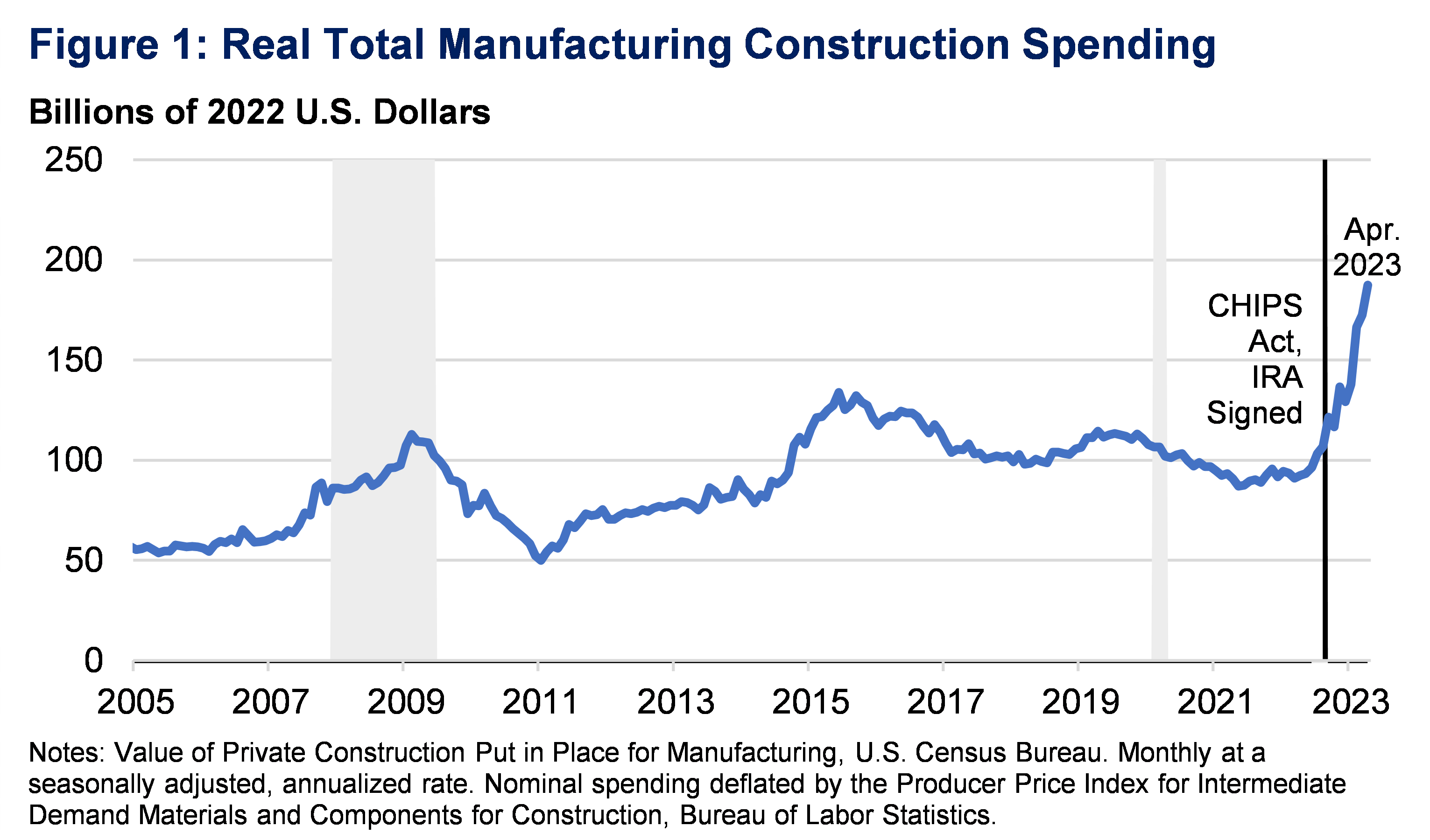
While investors are aware of the above chart and boom in manufacturing capex it is largely viewed as a one-off spike rather than the early innings of a multi-year surge. The problem is that it’s driven by a combination of numerous trends and lots of companies are seeing their own little part of these. These companies can explain how they’re benefiting, but there is an inability to clearly articulate the scale of what’s happening and thus the longevity and size of the opportunity. Well this is true except for 1 company; megacap Eaton, who are seeing it all, explaining it to the market, and have been handsomely rewarded for it (ETN: +60% over 1-year, +160% over 3 years). OM’s belief is that in the coming years, as the market better understands the scale and scope of US Reindustrialization the collection of smaller companies that are facilitating the different parts of it will be rewarded.