Portfolio Update
On Monday morning, OM exited
the small residual position in the Nasdaq Biotech ETF (IBB) within the Thematic
– 4
th Industrial Revolution names.
OM also added the portfolio’s
first short, Short…the Nasdaq Biotech ETF (the 2x levered inverse ETF – BIS -
as there is no single levered version), which represents 10% of capital
(leverage-adjusted).
Short: Biotech
If you have ever spent time
with professional investors, which describes a portion of Our Man’s day job,
you’ll quickly hear some truisms about the short-side; (i) don’t short good
companies (or those with secular tailwind), (ii) don’t short on valuation
grounds and (iii) for heaven’s sake don’t do it when the stock has price
momentum and is rising quickly. There are good reasons why
professional investors hold these views; high quality businesses/management
create options for themselves (and easy to understand secular stories offer a
strong multi-period tailwind), an expensive stock can get more expensive (see
Tesla, to many a short’s chagrin…so far!), and as the saying goes “the trend is
your friend until it hits a bend”. Most who have shorted to any
degree have been caught on the wrong side of one of these truisms, and
sometimes on the wrong side of all three –
even those who should know better.
So, why start with this public
service announcement on short selling. Well, because if you have
ever spent time with professional short-sellers (i.e. short-selling is MOST of
what they do) you will have learned that some of the BEST shorts violate those
rules, but that context matters! In essence, investors should
be so certain in their position that complacency has set in. The
secular theme should be regarded as obvious (or the company as close to
flawless) and the valuation should be either ‘new’ or accepted as appropriate
without the requisite thought to whether they make sense. Additionally,
the stock should have performed exceptionally well for a prolonged period
(strong momentum) - this helps create substantial unrealized profits,
complacency in analysis and substantial downside (especially in combination with
the valuation). Finally, and
most importantly, that price trend
should have already hit its bend – missing the first 10% of a move is less
important than timing it right, since the downside is substantial.
So why Biotech, and why now?
- Company/Trend:
Our Man has talked about the
secular trend in biotechnology – in this, his opinion has changed little BUT the
context is that it is a long-term trend and expectations have overshot current
reality.
- Valuation:
To help think about valuation
in context, here’s a 2002 quote from Scott McNealy, the former CEO of Sun
Microsystems (which traded at 10x revenue in 2000).
“At 10 times revenues, to give you
a 10-year payback, I have to pay you 100% of revenues for 10 straight years in
dividends. That assumes I can get that by my shareholders. That assumes I have
zero cost of goods sold, which is very hard for a computer company. That
assumes zero expenses, which is really hard with 39,000 employees. That assumes
I pay no taxes, which is very hard. And that assumes you pay no taxes on your dividends,
which is kind of illegal. And that assumes with zero R&D for the next 10
years, I can maintain the current revenue run rate. Now, having done that,
would any of you like to buy my stock at $64? Do you realize how ridiculous
those basic assumptions are? You don’t need any transparency. You don’t need
any footnotes. What were you thinking?”
In short, the only ways that
10x revenue is not an absolutely crazy multiple is (i) if you’re a
quasi-monopoly/oligopoly that’s growing double digits and already has huge
margins (we can see you Visa and Mastercard), or (ii) you’re about to turn into
one of those companies (i.e. insane revenue growth with future high margins)
For those of OM’s vintage (or
older) 1999/2000 were heady days, a mass hysteria of craziness that was never
to be repeated…right?
Well…the excellent Keith Muir
(
The Macro Tourist) posted this
chart a couple of weeks ago.
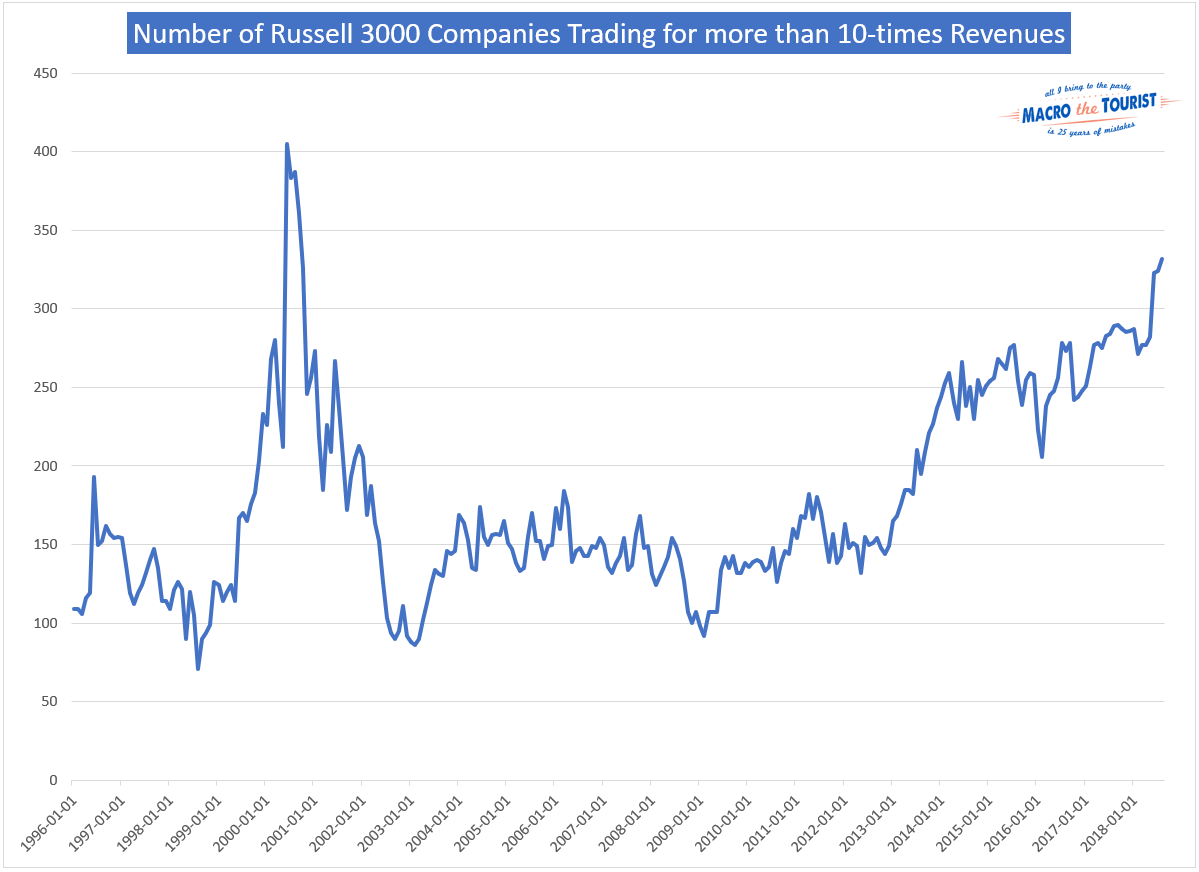
When you start parsing through
the list of names, two sectors stand out Healthcare (especially Biotech) and
Technology.
So, why short just Biotech not
Technology?
- Well, OM uses a very blunt
instrument (an inverse ETF) to short rather than finding specific names and so
general traits are more important than individual names.
- For technology companies, OM
can see the argument that true subscription software companies should see
higher valuations that their historical peers.
For these companies, as they scale the marginal cost* approaches
0%. For example, it costs Adobe Creative Cloud/Netflix/etc. (almost)
nothing to add an extra customer – no shipping costs and the cloud-based
product (Photoshop, video on demand, etc.) is infinitely divisible (i.e.
me editing my holiday photos or watching “House of Cards” doesn’t stop you from
doing either). As such, if these business have a large user base (or
are rapidly on their way to having one) they will benefit from this low
marginal cost, and deserve a revenue multiple that’s higher than it has been
historically. OM suspects that Technology – and especially those
companies that purport to be software companies but are not – will get their
comeuppance, but the breadth of the ETF means it’s hard to have confidence in
putting on that position.
- For Biotech companies, OM
has had discussions with a number of professional investors over the last
6-months where a central theme has been the market’s willingness to ascribe
high valuations to numerous companies in the early stages of drug development
(i.e. with very limited revenues). In
some cases, these valuations would be aggressive even if the drugs were in
market today (as opposed to years away from market). Given the number of these companies, and the
companies’ inability to control the drug approval process (and timing), the valuation
gap seems compelling. While the optimal &
vastly more profitable strategy would be to set-up a co-investment vehicle with
one of these professional investors to short a basket of these names, OM will
instead have to settle for the blunt instrument that is the ETF.
- Broken Momentum
Applying the same technical
analysis, as inspires OM’s Technical book, suggests that the ~10-year bull
market in biotech is over with the market peak in September**. While it’s very early to make projections,
the early indications are for a substantial decline.
In summary, Biotech offers an
interesting opportunity as there’s an attractive long-term secular theme that’s
well understood but has over-extended in the short-term. The stocks are well-held, and trading at
exceptionally high valuations, and until recently they had very strong
long-term momentum. This momentum
appears to have broken leaving substantial room for re-rating.
--------------------------
*Yes, there are other costs
like programming costs, salaries, etc. but the cost of software production is
largely fixed (vs variable) and so over a very large user base tends towards
0%. These articles by
Chris Kluis
and
Basab Pradhan
talk more about the concept of (almost) zero marginal cost.
For those wanting to think
more about software subscription businesses in general, you should read this
fantastic article by
Tren Griffin (in 25IQ, his blog).
** OEW is a technical theory that
takes a quantified approach to Elliot Wave Theory.
For the Biotech chart attached, the bull
market has 5 waves (each marking a peak, such as 3, or a trough such as 2 or 4)
which ended at [1].
The theory suggests
a substantial pullback is now expected…
Disclosure: OM owns BIS, and is thus short Biotech. Shocking, given the above, I know.


