Pages

Monday, August 3

Things from my Newsblur: 2026, Part II

It's only been a few weeks since OM's last Things from my Newsblur — maybe this is the new cadence. As a treat, a couple of fun ones lead things off instead of the usual finance closer. The rest splits into two camps: the difference between loving something enough to do the work, and what happens when AI lets you skip it entirely.

Check out these photos of New Yorkers celebrating the Knicks' historical NBA championship win this weekend
A 53 year wait; the City lost its collective mind and OM’s kids were very happy.   This one’s for OM's fellow New Yorkers!  
(Time Out New York)

Why There Are Only Two Escalators In All Of Wyoming
Wyoming has more national parks than escalators — and nobody seems to mind. Both are in Casper, the last one installed in 1979. With 583,000 people across 97,000 square miles, you just don't need many moving staircases.
(Andrew Rossi, Cowboy State Daily)

Failing is Common, Trying is Rare
Something OM hopes his kids learn early: most people don't actually fail at things — they just talk themselves out of really trying them. Later, the story becomes "Well, I tried but it just didn't work out".  If only that were true...
(David Cain, Raptitude)

Our Achilles Heel
Most of humanity's greatest achievements looked statistically absurd — and that's the point. We're wired to misunderstand probability, which makes us needlessly miserable — 25,000 valedictorians graduate every year in the US, but the Ivy League only has 15,000 freshman spots. Yet if you love the pursuit enough, the odds don't really matter.
(Ted Lamade, Collaborative Fund)

The Odyssey: Nolan's Enduring Commitment to Practical Effects
Real ships in real oceans, seven-foot giants achieved with forced perspective and a 4'6" stunt double, custom flickering LEDs built to mimic firelight because real flames wouldn't work — Nolan’s obsessed with putting something real in front of the camera. OM’s a fan, and The Odyssey is on pace to be one of the biggest R-rated films ever made. 
(
Nanditha Anand, The Week)


Brown Professor Suspects Most of His Class Used AI to Cheat
A Brown economics professor gave a take-home exam for the first time ever — the class average was 96%. When he made the final in-person, it dropped to 48%, and a third of the class simply dropped the course rather than sit it unassisted. Let's hope he's right: "We cannot choose to become idiots." 
(Emma Whitford, Inside Higher Ed)

If You Let AI Do Your Writing, I Will Come to Your House and Kill You
Some great sustained fury from Sam Kriss, whose argument is simple: AI writing is always bluffing, always detectable, and the people peddling it are thieves. The Commonwealth Prize section alone is worth the read.
(Sam Kriss, Numb at the Lodge)

The Second Derivative: Why No One Understands the AI Boom
Everyone wants to compare the AI boom to 2000 — a bubble that deflated over years, letting capital absorb the hit. Groundbreaker argues this is more like 2008: a bubble financed with debt, not equity, and debt doesn't slowly deflate — it seizes, all at once. Given it's a debt-driven bubble, what's important isn't how fast things are growing, but whether that growth is slowing down.
(Groundbreaker)

Thursday, July 23

2026: Second Quarter Review


Portfolio Update 
- Uranium (URNJ): Exited at the end of April – a couple of months later than ideal, as flagged last quarter. OM is now more actively using technical signals to help time position sizing; having ignored the first warning in January, he acted on the second in April.

- Crypto/China/India: Exited the remaining stub positions mid-quarter.

Together, these exits pushed cash above 25% by quarter-end. Part of this is a timing mismatch – capital left Crypto, India and China before new ideas (Brazil) were sized up. That, plus a likely re-investment in Uranium, should bring cash down in the third quarter.

Performance and Review
Our Man’s portfolio rose +4.3% during the second quarter, substantially lagging both the S&P 500 TR (+15.2%) and the MSCI World (+14.0%). The portfolio underperformed in every month of the quarter – rising in April (+6.5%), well behind the index rally, then falling outright in May (-0.2%) and June (-1.8%) while markets continued higher.

For the year, the portfolio (+8.5%) sits a little behind the S&P 500 TR (+10.2%) and MSCI World (+10.4%).

The medium-term history of the portfolio is below: 


Second Quarter Attribution

 
There are few surprises behind the underperformance: an average of ~20% cash during the quarter, no direct AI exposure, and weak commodity performance. The cash drag isn’t as bad as it looks – about one-third of it came from exiting URNJ at a small profit, which helped avoid a 20%+ loss over the rest of the quarter.

OM was late to recognize AI’s demand pull through the supply chain and missed the initial move, choosing instead to hold indirect exposure – through the US Reindustrialization theme (data centers, grid buildout, etc.) and Commodities (metals used in chips and power). That indirect exposure worked well over the last year but got hurt in Q2 as capital rotated hard into direct AI/growth names. Nothing changed in the theses on Uranium (-261bps) and Commodities (-40bps) – capital simply rotated out, and that will happen intermittently.

Not investing in HBM/DRAM manufacturers was a major error of omission. The setup mirrors Shipping/Tankers, Tin and Uranium: supply is fixed, demand jumps, and price is the variable that adjusts.  AI data centers need HBM (high-bandwidth memory) to feed GPU clusters, and it draws roughly 3x the wafer capacity of standard DRAM per bit; manufacturers are shifting production toward HBM’s better margins, tightening conventional DRAM supply and pushing DRAM prices up 90%+ per quarter. OM has known this was coming for almost a year but wasn’t invested.  Before April 2026 this was because there was no effective way to own it; the manufacturers are mostly single non-US companies (Samsung, SK Hynix, Kioxia), there was no dedicated ETF, and the names were too small a slice of broad semiconductor ETFs to matter.  This changed with the April 2026 launch of a Roundhill DRAM Memory ETF. The sin was knowing this ETF was launching but not acting. The excuses are the usual ones – “up too much already,” “wait for a pullback,” “don’t want to buy the top” – and none of them really matter.
This is a recurring lesson for OM, tied to his personality and approach rather than a rule for everyone, and a reminder of why investing is hard.  It is better to be early and small than not there at all, and if you can't be early but do have conviction then at least be small. It's easier to size up an existing position than start a new one.

The rest of the portfolio held up well:
-    European/UK Financials (+200bps) began to re-rate on strong results – particularly returns on tangible equity – aggressive buybacks, and analyst upgrades.
-    US Reindustrialization (+184bps) benefited from capital rotating toward direct AI beneficiaries.
-    Tin (+155bps) prices remained strong – Alphamin Resources returned ~10% of its market cap as a dividend, though the stocks remain underappreciated by the market.
-    Carbon Credit Allowances (+101bps) strengthened after CARB removed the policy overhang and began finalizing steeper cap-tightening trajectories (10-14% per annum vs. 4% previously).
-    Argentina (+74bps) banks benefited from continued pro-market reform, accelerating private credit growth, and healthy net interest income.
 

Shipping/Tankers (+4bps) and Idiosyncratic Equities (-0bps) were flat.  The exited stub positions added small gains: India (+5bps), China (+5bps) and Blockchain/Crypto (+6bps).

Portfolio (as at 6/30/26 - all delta and leverage adjusted, as appropriate)
Dislocations: 33.7%
14.1% - Uranium (URNM)
6.9% - Argentina (BMA, GGAL, SUPV)
6.6% - Tin (AFMJF, MLXEF and SBWFF)
6.1% - Commodities/Mining (LUNMF, TLOFF, PMCOF and IVPAF)

Thematic: 37.4%
10.4% - US Reindustrialization (AIRR)
10.2% - European/UK Financials (BCS, LYG, NWG)
9.2% - Shipping/Tankers (STNG, INSW, TNK, DHT and FRO)
7.6% - Carbon Credit Allowances (KCCA)

Idiosyncratic: 2.5%
2.5% - Equities (JOE)

Shorts/Hedges: 0.0%

Cash: 26.3%

Disclaimer: Nothing above should be considered investment advice or a recommendation to buy or sell any security. While Our Man is invested in all of the securities mentioned, that alone is a terrible reason for anyone else to be. Our Man also holds some cash and a few other positions (of negligible value). Investors should always do their own work and make decisions based on their own circumstances, objectives, and risk tolerance—and not because Our Man happened to mention something here. 

Tuesday, June 2

Things from my Newsblur; 2026 Part I

It's been a while since OM's last Things from my Newsblur, and the reading pile has not disappointed. This edition runs the full gamut — from the personal to the philosophical to the financial — with a few pieces that, on the surface, seem unrelated but share a common thread: what happens when we stop valuing the things that actually matter.

Proof You Can Do Hard Things
Something OM tries to instill in his kids — do hard things, not because they're useful, but because proving to yourself that you can is the whole point.
(Nat Eliason’s Newsletter)

The Decline of Deviance
The world is getting less weird — and not just in the ways you'd expect. Fewer cults and teenage pregnancies is a good thing, but there's also less original art, stranger architecture, and scientists willing to rock the boat. This isn't because of the internet — it started long before. When life gets safer and more comfortable, the incentive to be genuinely strange and creative quietly disappears. 
(Adam Mastroianni, Experiment History)

10 Questions to Answer Before You Die 
Avoiding death planning doesn't protect you or the people you love — it just moves the chaos to the worst possible moment. A practical, no-excuses guide to the things that actually matter; not just the financial stuff, but the conversations, the medical decisions, and the things left unsaid.
(Maura Mcinerney-Rowley, Hello, Mortal)

Your Power Tools Got Worse on Purpose
OM isn't a tool guy, but this is what happens when people who don't make things buy the people who do. Two conglomerates hoovered up every tool brand on the shelf — one invested and left the craftsmen alone; the other optimized the financials and extracted all the value until there was nothing left.  You've already seen this happen in other industries whose products you do use! 
(Keyana Sapp, Worse on Purpose)

The Ethiopian Running Secret
Ethiopian runners dominate marathons while largely rejecting the data-driven individualized training that Western sports science swears by. Have we become so seduced by quantification that we've stopped recognizing expertise that doesn't come with a spreadsheet attached?
(Michael Crowley, AEON)

The Bezzle and the Bull Market
Bull markets make us all 'feel' wealthier - and that feeling makes fraud, illusion, and self-deception much easier to sustain. Nobody questions things when everyone's getting rich.  The reckoning always comes later.
(Novel Investor)

Two Takes on New Fed Chair Ken Warsh
Ken Warsh (Claudia Sahm, Stay-At-Home-Macro)
Weighing Warsh (Marvin Barth, Seriously, Marvin?!) 
Most of the commentary has focused on whether Warsh is a hawk or a dove but is it the wrong question? 
Sahm's piece uses his 2010 FOMC record to argue he's unfit for the role. 
Marvin Barth has a completely different view; Warsh represents a genuine philosophical rejection of how the Fed has operated for the last 16 years. If he's right, the debate isn't about interest rates but about whether the post-2008 central banking experiment was a mistake.

Sunday, April 12

2026: First Quarter Review

Portfolio Update 
- After an extended period without the anticipated rebound, OM exited substantially all Blockchain exposure (with Bitcoin at approximately ~$75K). While the position was given time to recover, that near-term bounce did not materialize as expected and OM exited.  OM may look to re-enter at more attractive levels should a broader market dislocation occur. 

-  OM also exited almost all the India exposure. The decision reflects relative opportunity set considerations rather than concerns with the underlying thesis, with similar investments (notably Brazil) offering more compelling risk/reward at this stage.

-  Following a strong start to the year, OM trimmed its US Reindustrialization exposure after it reached approximately ~12% of NAV.  The theme remains core, supported by continued momentum in domestic industrial policy and infrastructure investment. However, given strong performance and elevated positioning, partial de-risking was appropriate. The portfolio retains meaningful exposure.

Cash now sits at ~15% of NAV. Despite this, the portfolio remains positioned for volatility, with a meaningful allocation to dislocation-driven and commodity-linked exposures.

Performance and Review
Our Man’s portfolio rose +4.0% during the first quarter, outperforming the S&P 500 TR (-4.3%) and the MSCI World (-3.2%).  However, performance was marked by elevated volatility; with strong gains in January (+13.2%) and February (+1.6%) followed by a sharp pullback March (-9.6%).   

The volatility reflected the underlying positioning—particularly exposure to commodities and US Reindustrialization—both of which are sensitive to shifts in sentiment and risk appetite. Early strength provided an opportunity to reduce exposure selectively, though OM could have been more aggressive (e.g. Uranium).

The medium-term history of the portfolio is below:


First Quarter Attribution


The first quarter was unusual and, at times, chaotic. January in particular saw a near indiscriminate rally across most positions, with the notable exceptions of Blockchain/Crypto and India. That kind of broad price action across the portfolio is typically not sustainable and, in OM’s experience, is better used to reduce risk than chase further upside. 

Uranium (+347bps) and US Reindustrialization (+147bps) were the primary drivers of performance.

Uranium continues to reflect a structural supply-demand imbalance. Demand is increasingly supported by reactor life extensions and new project pipelines, while market pricing still assumes a relatively efficient supply response that has yet to show signs of materializing at scale. The disconnect remains in expectations rather than fundamentals.

US Reindustrialization reflects a broader policy-driven shift toward domestic capacity rebuilding. Markets continue to underweight the durability of this trend, treating decades of deindustrialization as structurally irreversible rather than a policy choice. That gap between perception and policy trajectory remains the core driver of returns, though it also increases sensitivity to sentiment shifts.

Elsewhere, Tin (+10bps) and broader Commodities (-9bps) ended the quarter roughly flat, but not without significant volatility along the way.

Shipping/Tankers (+374bps) was again a meaningful contributor during a time of uncertainty in the oil markets. Disruptions in key transit routes—most notably around the Strait of Hormuz—have increased effective shipping distances and constrained effective supply, pushing rates higher. We’ve seen versions of this before: when routes become inefficient, short-term tanker earnings can move well beyond even best-case assumptions.  The question is always duration. These conditions don’t persist indefinitely, but they also don’t normalize quickly. In the interim, capital allocation discipline across the sector has improved, with a greater share of earnings being returned to shareholders. Valuations reflect reasonable normalized earnings, though the position is expected to naturally decline over time as dividends are realized

The Idiosyncratic Equity position in JOE contributed +16bps.

Losses were broadly distributed, with the largest detractors coming from European/UK Financials (-131bps)Argentina (-126bps), and China (-44bps). The common factor was rising macroeconomic uncertainty, compounded by geopolitical risk, including US/Israel-Iran tensions and ongoing US-China frictions (e.g. the postponed Trump-Xi meeting didn’t help sentiment).

Carbon Credit Allowances (-98bps) were again a detractor. While the regulatory direction remains supportive over the medium term, the sizable impacts were pushed further into 2028, later than expected. This timing shift weighed on near-term pricing, despite reinforcing the longer-term supply tightness thesis.  At current levels, prices are approaching the regulatory floor price, which should limit downside. The upside case depends on whether CARB successfully implements the changes in a timely manner over the next ~6 months. The obvious risk is political—energy affordability is an easy place for pressure to build, particularly if broader geopolitical issues persist – though Governor Newsom is incentivized to encourage implementation before his term ends.

The India (-19bps) and Blockchain/Crypto (-69bps) were largely crystallized in early February as the positions were exited.


Portfolio (as at 1/1/26 - all delta and leverage adjusted, as appropriate)
Dislocations: 47.5%
24.6% - Uranium (URNM & URNJ)
6.8% - Commodities/Mining (LUNMF, TLOFF, PMCOF and IVPAF)
6.6% - Argentina (BMA, GGAL, SUPV)
5.8% - Tin (AFMJF, MLXEF and SBWFF)
3.7% - China (KWEB, FXI and JD)

Thematic: 35.5%
10.0% - Shipping/Tankers (STNG, INSW, TNK, DHT and FRO)
9.1% - US Reindustrialization (AIRR)
8.8% - European/UK Financials (BCS, LYG, NWG)
6.9% - Carbon Credit Allowances (KCCA)
<1.0% each in residual Blockchain/Crypto and India

Idiosyncratic: 2.6%
2.6% - Equities (JOE)

Shorts/Hedges: 0.0%

Cash: 14.3%

Disclaimer: Nothing above should be considered investment advice or a recommendation to buy or sell any security. While Our Man is invested in all of the securities mentioned, that alone is a terrible reason for anyone else to be. Our Man also holds some cash and a few other positions (of negligible value). Investors should always do their own work and make decisions based on their own circumstances, objectives, and risk tolerance—and not because Our Man happened to mention something here.

Wednesday, January 14

2025: Fourth Quarter Review

Portfolio Update 
All portfolio additions this quarter were in Commodities/Mining, with new positions in Ivanhoe Mines (IVPAF), Prospector Metals (PMCOF), and Talon Metals (TLOFF, see here for external in-depth write-up on Talon). Longtime readers will recognize the central theme across OM’s portfolio: supply deficits created by years of under-investment, now colliding with modest demand growth. OM discussed this dynamic in detail ~18 months ago in the context of Uranium, Tin, and Tankers, and it has continued to strengthen.

What has changed is timing. While under-investment has been widespread across commodities for over a decade, it is only now coming to a head as supply deficits begin to emerge, demand increases, and industrial supply chains re-orient. This has been further compounded by a growing recognition that much of global supply for key commodities sits in jurisdictions unfriendly to the West. 

OM’s Commodities/Mining exposure reflects this setup and is focused on high-quality deposits that had secured financing prior to OM’s investment, providing a longer runway toward production.  To better reflect this shift, OM has reclassified Commodities and Tin from a “Theme” to a “Dislocation” for 2026.

Performance and Review
Our Man’s portfolio continued its strong run in the fourth quarter, rising 7.1% though performance was volatile (Oct: +9.2%, Nov: -4.8%, and Dec: +3.0%).  This comfortably outperformed both the S&P 500 TR (+2.7%) and the MSCI World (+3.4%).

The strong final quarter meant the portfolio returned +36.3% for 2025, well ahead of the broader markets (S&P 500 TR: +17.9%; MSCI World: +18.4%).

As a couple of folks have asked, here is the medium-term history of the portfolio:


Fourth Quarter Attribution

Argentina (+476bps) was the largest contributor, recovering roughly two-thirds of its 2025 losses after President Milei’s party performed strongly in the midterms.  This eased concerns that his reform agenda would need to be scaled back. While the position’s performance in 2025 was frustrating, this largely reflected portfolio management errors - most notably not trimming after the outsized gains in 2024 - rather than any material deterioration in the underlying thesis.

UK/European Financials (+200bps) continue to perform strongly, suggesting that the market is not only being driven by the MAG7/AI! The position has contributed positively in each of its nine quarters in the portfolio, with the ADRs of Barclays and NatWest up ~250% (or roughly twice the MAG7). It is a reminder of the excess returns available when stocks are genuinely cheap and paired with changes that the market has yet to fully appreciate. While these names remain relatively inexpensive, they are no longer dislocated. The market now recognizes the earnings benefits of higher rates, leaving the final phase of performance as a rerating driven by more consistent and predictable earnings growth. As a result, OM has moved European Financials from the Dislocation to the Thematic bucket for 2026, and the position is likely to be reduced over time.

Commodities (+149bps) and Tin (+149bps) were beneficiaries of a broader repricing of supply-chain and geopolitical risk. During the quarter, China’s tightening of export controls on rare earth elements served as a reminder of how concentrated—and politically fragile—many commodity supply chains remain. This coincided with growing evidence that years of under-investment are now translating into physical tightness, particularly in smaller markets where incremental demand can have an outsized price impact.  OM suspects many market participants have forgotten how aggressively these smaller markets can move, or haven’t been around long enough to know.

Uranium (-180bps) detracted, largely due to positioning and expectations rather than any deterioration in the longer-term fundamentals. Market optimism around Uranium’s formal inclusion on the US critical minerals list had built into prices, and delays caused by the government shutdown led to disappointment and near-term pressure across the complex.

US Reindustrialization (+21bps) and Idiosyncratic (+47bps) contributed as domestic industrial exposure continued to benefit from resilient US growth and ongoing capital spending tied to reshoring and infrastructure investment. The US Reindustrialization ETF, in particular, extended gains made earlier in the year, ending up over 30%, as mid-cap industrials remained tied to long-term capital expenditure themes rather than cyclical slowdowns.  Smaller gains came from Carbon Credit Allowances (+12bps), Tankers/Shipping (+6bps), and India (+5bps).

China (-54bps) detracted following renewed political tensions with the US, which weighed on sentiment. Chinese equities performed well over 2025, and after a year of improving liquidity there are early signs of economic recovery. After a lost half-decade and with investor interest still limited, Chinese equities may be worth watching in 2026. 

Blockchain/Crypto (-123bps) positions were a disappointment; OM failed to follow his own advice to exit at the end of Q3.   Such an exit would have been near the all-time highs, instead he overthought and overcomplicated the position, based on an extended global liquidity into mid-2026.   Given the sharpness of the descent, OM will look to exit on a bounce during Q1-26.


Portfolio (as at 1/1/26 - all delta and leverage adjusted, as appropriate)
Dislocations: 48.1%
22.4% - Uranium (URNM & URNJ)
8.2% - Argentina (BMA, GGAL, SUPV)
7.2% - Commodities/Mining (LUNMF, TLOFF, PMCOF and IVPAF)
6.0% - Tin (AFMJF, MLXEF and SBWFF)
4.3% - China (KWEB, FXI and JD)

Thematic: 44.1%
11.6% - US Reindustrialization (AIRR)
10.6% - European/UK Financials (BCS, LYG, NWG)
8.2% - Carbon Credit Allowances (KCCA)
7.0% - Shipping/Tankers (STNG, INSW, TNK, DHT and FRO)
3.8% - India (IBN, INDA and SMIN)
2.9% - Blockchain/Crypto (IBIT, ETHE/ETH and BBBY)

Idiosyncratic: 2.6%
2.6% - Equities (JOE)

Shorts/Hedges: 0.0%

Cash: 5.3%

Disclaimer: Nothing above should be considered investment advice or a recommendation to buy or sell any security. While Our Man is invested in all of the securities mentioned, that alone is a terrible reason for anyone else to be. Our Man also holds some cash and a few other positions (of negligible value). Investors should always do their own work and make decisions based on their own circumstances, objectives, and risk tolerance—and not because Our Man happened to mention something here.

Thursday, October 9

2025: Third Quarter Review

Portfolio Update 
Our Man made minor adjustments to the portfolio in the final days of the month, taking profits in Uranium (trimming both the Uranium Miners ETF and the Uranium Junior Miners ETF, reducing exposure by approximately 550bps) and in European/UK Financials (trimming Barclays and NatWest, reducing exposure by about 200bps).

He also added a small position in Commodities through Ivanhoe Mines (IVPAF), though that came on the first day of the fourth quarter.

Performance and Review
Our Man’s portfolio continued its strong run through the third quarter, posting gains in each month (July: +1.2%, August: +5.3%, and September: +6.6%) for a total quarterly return of +13.7%. This comfortably outperformed both the S&P 500 TR (+8.1%) and the MSCI World (+7.5%).

The portfolio’s strong performance over the past two quarters brought its year-to-date return to +27.3% at the end of Q3, well ahead of the broader markets (S&P 500 TR: +14.8%; MSCI World: +14.6%).

As a couple of folks have asked, here is the history of the portfolio over the last few years:


Third Quarter Attribution
 

The biggest driver of performance was Uranium, which contributed +825bps during the quarter. The impact reflected both the size of the position - peaking at 32% before being trimmed on the final day of the month - and its roughly 30% price gain. The position has nearly doubled since OM added to it in April, as it has become widely recognized that the rapid expansion of AI data centers will require significant additional power generation capacity, with nuclear energy a key component. Fundamentals remain strong: the demand-supply imbalance was underscored at the World Nuclear Symposium, while U.S. policy support continued to build, with the Administration encouraging domestic uranium production and signaling an intent to establish a strategic uranium reserve. Technical factors also provided tailwinds, as several financial vehicles (SPUT, YCA, etc.) that purchase physical uranium raised capital and were active buyers in the market, helping to lift spot prices. OM remains comfortable with the current position size while these supportive dynamics persist but expects to trim further during Q4.

Reindustrialization of the US (+220bps) also performed strongly, supported by the ongoing localization of supply chains and the substantial power and electrical infrastructure buildout driven by AI-related data center construction. The theme of localization is well captured by economist Marvin Barth (excerpted below, from Seriously Marvin).
“Long before protectionism, Covid and security concerns accelerated the process, technology began unwinding globalization. Automation allows production to move closer to consumer, obviating extended supply chains. Localization of production is reshaping trade, capex and relative growth. It has driven higher real interest rates, supercharged US earnings, and a decade of emerging market underperformance.”

Other notable contributors included Shipping (+197bps), Tin (+127bps), Blockchain/Crypto (+111bps), Carbon (+92bps), China (+84bps), European Financials (+84bps), and Commodities (+52bps). Among these, Tin and Carbon merit particular mention. Tin remains one of the most attractive risk-reward opportunities in the portfolio; its primary use as the “glue” in making semiconductors comes amid tightening supply, while Alphamin Resources - the industry leader - trades at over a 20% free cash flow yield. California Carbon Allowances (CCAs) rallied after the state reauthorized and extended its Cap-and-Invest program through 2045, removing significant uncertainty. Although regulatory details remain pending, the direction of travel is clear. With CCAs trading near their floor price - which rises by inflation + 5% annually - the setup remains highly asymmetric.

The only significant detractor was Argentina, which fell sharply and detracted -397bps. After a strong first 18 months under President Javier Milei, Argentina encountered its first meaningful setback. Despite an initial devaluation and a crawling peg to the U.S. dollar, the peso weakened sharply through Q2 and Q3, prompting the central bank to use most of its reserves to slow the decline. Investor sentiment deteriorated further after Milei’s party underperformed in a regional election, raising concerns that his reform agenda could be weakened if the upcoming late-October midterms go poorly. However, the currency and equities partially recovered after the U.S. reaffirmed its support for the Milei government, announcing a $20 billion swap line and signaling a willingness to provide material further assistance. While election outcomes remain uncertain, OM believes market sentiment has swung too far negative and is comfortable maintaining the current position, with potential to increase post-election. The “original sin” was not realizing some of the exceptional (and still material) gains earlier in the year. 

The positions in Idiosyncratic Equities (+10bps) and India (-35bps) had a limited impact on the portfolio.

Portfolio (as at 09/30/25 - all delta and leverage adjusted, as appropriate)
Dislocations: 45.5%
26.8% - Uranium (URNM & URNJ)
9.4% - European/UK Financials (BCS, LYG, NWG)
5.3% - China (KWEB, FXI and JD)
4.1% - Argentina (BMA, GGAL, SUPV)

Thematic: 43.6%
12.2% - US Reindustrialization (AIRR)
8.9% - Carbon Credit Allowances (KCCA)
7.5% - Shipping/Tankers (STNG, INSW, TNK, DHT and FRO)
5.1% - Tin (AFMJF, MLXEF and SBWFF)
4.0% - India (IBN, INDA and SMIN)
4.4% - Blockchain/Crypto (IBIT, ETHE/ETH and OSTK)
1.5% - Commodities/Mining (LUNMF)

Idiosyncratic: 2.3%
2.3% - Equities (JOE)

Shorts/Hedges: 0.0%

Cash: 8.5%

Disclaimer:  Nothing above should be considered investment advice or a recommendation to buy or sell any security. While Our Man is invested in all of the securities mentioned, that alone is a terrible reason for anyone else to be. Our Man also holds some cash and a few other positions (of negligible value). Investors should always do their own work and make decisions based on their own circumstances, objectives, and risk tolerance—and not because Our Man happened to mention something here.


Wednesday, September 17

Things from my Newsblur; 2025 Part II

This “Things from” post is the opposite of the last one; a single speech, which I’ve also excerpted the key section of below.   It was made a fortnight ago by the Bank of Japan’s Deputy Governor Ryozo Himino and is about the Trump Administration’s strategy, but not politics. I’d encourage everyone to read the excerpted piece – especially the non-financial folks.

The speech is very good, but the excerpted section is probably the most insightful thing that's come from a policymaker or the mainstream media re. the Trump Administration.  For those who  want to read it, the whole speech is here.

I think it's an impressively concise observation that makes no judgments.  For the finance people, please note his second point - which the markets think of as ‘TACO’ - is far more what regular folks would do if they ran a business, or a portfolio!   

The Philosophy and Policies of the New U.S. Administration
Eight months have passed since the new U.S. administration took office, and I tend to believe I have learned a lot about its approaches. However, the unexpected developments I face almost daily make me realize that there are still things to be learned.

So, I am still in the process of formulating my view, but if I could offer some personal and tentative reflections, I would argue that there are three characteristics that define the current administration's way of thinking.

First, the administration adopts a holistic approach and treats political, economic, and cultural matters, as well as domestic and international affairs, as integral parts of a single, inseparable policy agenda.

Second, while it is highly flexible in its tactical decisions, switching its approaches as situations evolve and choosing when to press ahead, pause, or make temporary retreats, the administration remains persistent in its strategic choices about what it ultimately aims to attain.

Third, it is unfettered from conventional wisdom and orthodoxy, focuses on facts that define the locus and sources of power, and explores opportunities that have thus far not been exploited.

Consider, for instance, trade policy. Our textbooks teach early on that the rationale for preserving a free trade system lies in the principle of comparative advantage -- each country specializes in what it produces best, thereby promoting an international division of labor, enhancing global economic efficiency and growth, and ultimately benefiting all countries. The conclusion, therefore, is that the global community should work together to pursue a positive-sum game. This is part of the foundational logic of the Washington Consensus, and I believe it contains much truth.

However, this framework does not necessarily capture all aspects of the matter. A superpower tends to possess a market large enough for its trade policy to influence import prices. It also has sufficient leverage to deter retaliatory tariffs from trading partners. According to the theory of optimal tariffs, for such superpowers, imposing moderate tariffs may improve the terms of trade and be more advantageous than forgoing tariffs.1

Moreover, given today's geopolitical environment, it is increasingly important to consider economic security and ensure strategic autonomy and indispensability.

Additionally, some argue that the most efficient economic system is not necessarily ideal in terms of fairness and distribution, and that a government's redistribution policies may not be sufficiently effective. This kind of argument may become more relevant as we face increasing social and economic divides.

Even considering tariffs alone, one may thus detect a confluence of various elements: an economic goal (i.e., better terms of trade), foreign policy considerations (economic security), and a political agenda (fairness and distribution). An element of cultural protest against intellectual elites may be at play as well, alleging that they have defended neoliberal systems and the resultant extreme inequality on the grounds of economic efficiency. Tariffs may thus be seen as a manifestation of a broad, transversal movement involving economics, diplomacy, politics, and culture.

In this light, discussing U.S. policy solely in terms of tariffs is too narrow an approach. A more holistic perspective on the policy is needed to assess the medium- to long-term outlook for Japan's economic activity and prices. That said, given that I am not an expert in politics, diplomacy, or culture, in the remarks that follow, let me focus on the near-term effects of tariff policy.

Thursday, July 17

2025: Second Quarter Review

Portfolio Update 
As noted in the recent portfolio update, Our Man made several changes to the portfolio during the second half of April.   

- Uranium: OM increased and consolidated the exposure, by adding to the Uranium Miners ETF (URNM) and the Uranium Junior Miners ETF (URNJ), while fully exiting the remaining single name positions (NXE and SMR).

- US Reindustrialization: OM remains confident that the market continues to underestimate the scale and impact of US reindustrialization.  OM increased the position in the American Industrial Renaissance ETF (AIRR).

- Carbon: OM materially increased the position in California Carbon Allowances (KCCA) as prices traded near their floor.

- Commodities: A small position in Lundin Mining Corp (LUNMF) – inherited through the takeover of Filo Mining Group (FLMMF) - was modestly increased.

- European/UK Banks: Positions in Barclays Bank (BARC), Lloyds Banking Group (LYG) and Natwest Group (NWG) were all trimmed.

- Position Exits: OM fully exited several smaller holdings to reallocate capital towards higher conviction ideas.  These included positions in Greece (ALBKY), Brazil (EWZ), and Biotech (IBB and XBI) and the Idiosyncratic Equity position in Texas Pacific Land (TPL).

Performance and Review
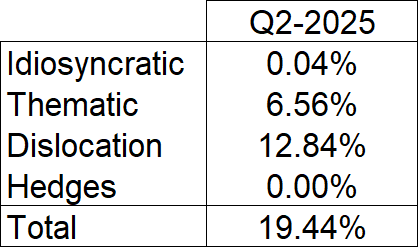
Our Man’s portfolio bounced back strongly during the second quarter, posting strong gains in each month and rising 19.4% during the quarter.  This was comfortably ahead of the S&P 500 TR (+10.9%) and the MSCI World (+9.5%).

The portfolio’s Q2 gains saw it end the quarter at 12.0% YTD, which is comfortably ahead of the market (S&P 500 TR: +6.2% and MSCI World: +6.6%).

Second Quarter Attribution


While nearly all positions contributed positively, Q2 performance was driven primarily by the Uranium position (+1,107bps), which rallied just under 50% in the quarter.  Truthfully, little new or special occurred in Q2 - OM simply benefited from having a well-sized position and the discipline to look through Q1s volatility.  The position gained from several ongoing tailwinds:OM increased the Uranium position by 600bps in mid/late April, though some of the gain from this was offset by consolidating into ETFs (with SMR rallying over 2.4x after OM’s exit). Given the rally and increased sizing, OM expects to materially reduce the position during Q3.

Other major contributors: European/U.K. Financials (+298bps) and US Reindustrialization (+224bps) rallied after Q1 earnings exceeded expectations and forward guidance helped ease investor concerns.  Tin (+158bps) surged in April after geopolitical risk around Alphamin’s Congo mine eased, following a U.S.-brokered settlement between DR Congo and Rwanda. The position also benefited from a strategic shift, with Alphamin’s largest shareholder agreeing to be bought out by Abu Dhabi–based International Resources Holding.  Blockchain/Crypto (+110bps) was supported by expanding global liquidity and a post-halving price trend consistent with prior cycles. OM still expects to exit this theme during 2025.

The only significant detractor was Argentina (-128bps), which gave back a portion of its strong 2024 gains.  While President Milei’s reforms are off to a solid start and are improving the macro outlook and buoying investor confidence, progress remains early.  The upcoming October midterms will be a key test.   Short-term sentiment was also dented after Argentina was not added to the MSCI Emerging Markets Index in June – a disappointment for some investors and a drag on local equity market performance.

The portfolio saw healthy performance from Shipping/Tankers (+66bps), India (+53bps), Carbon (+43bps), and Commodities (+30bps).  Meanwhile, China (+1bp) and Idiosyncratic Equities (+4bps) had no material impact on performance.  Positions that were exited during the quarter modestly detracted from performance – Greece (-11bps), Biotech (-17bps), and Brazil (+7bps) – though this capital was redeployed profitably elsewhere.   

Portfolio (as at 06/30/25 - all delta and leverage adjusted, as appropriate)
Dislocations: 54.3%
28.0% - Uranium (URNM & URNJ)
12.4% - European/UK Financials (BCS, LYG, & NWG)
8.7% - Argentina (BMA, GGAL, & SUPV)
5.2% - China (KWEB, FXI & JD)

Thematic: 42.4%
11.7% - US Reindustrialization (AIRR)
9.2% - Carbon Credit Allowances (KCCA)
6.7% - Shipping/Tankers (STNG, INSW, TNK, DHT & FRO)
4.9% - India (IBN, INDA & SMIN)
4.8% - Tin (AFMJF, MLXEF & SBWFF)
3.9% - Blockchain/Crypto (IBIT, ETHE/ETH & OSTK)
1.2% - Commodities/Mining (LUNMF)

Idiosyncratic: 2.5%
2.5% - Equities (JOE)

Shorts/Hedges: 0.0%

Cash: 0.7%

Disclaimer:  Nothing above represents a recommendation in any way, shape or form so please don’t even think of trying to take it that way.  For added clarity, while Our Man is invested in all of the securities mentioned that’s a terrible reason for anyone else to do so.  Our Man also holds some cash and a few other securities (of negligible value).  You should not buy any of these securities because Our Man has mentioned them, but should do your own work and decide what’s best for you given your own circumstances/risk tolerance/etc.

Sunday, June 22

Things from my Newsblur; 2025 Part I

While it’s been a while before this first Things from my Newsblur, this post is both longer than normal and wider ranging so there should be at least one thing for everyone to enjoy.   

League One: The Return (Main Edition)
As many of you know OM is a huge AFC Wimbledon fan and was in London to see their League Two Playoff Semi-Final (with one of his sons) and subsequent Play-off Final win (with both sons, family and friends!).   We’re somewhere in this mass of 28,000 AFC Wimbledon fans, when the winning goal goes in! 
As befits AFCW’s history it was a wild ride including getting into the playoffs thanks to a goal from player who had a heart attack earlier in the game (!).
(REPD, SW19’s Army) 


Rules of Thumb vs. Rules of Big Toe
A nice short post separating out the wisdom of others (“rules of thumb”) from those lessons we have learned ourselves; there’s nothing like personal pain as a teacher!   
(Matt Ziegler, Cultish Creative) 


Handle Hard Well
A great article on handling adversity and how it matters, which neatly ties together starting NFL quarterbacks and the markets.
(Ted Lamade, A Program that Lasts) 


What Mr. Beast Teaches Us about the American Dream
If you have tween kids, like OM, then you almost certainly know who Mr. Beast is.  This article looks at his leaked 36-page internal memo that documents his approach and standards.   The amazing thing about Mr. Beast’s success, in contrast to prior mediums, is how little creative freedom it provides him
(Matt Johnson, Neuroscienceof.com)
Read also: The Mozart of the Attention Economy: why MrBeast is the world’s biggest YouTube star 


Manifest:  The Inevitability of Trump & Tariffs
If you cannot understand the inevitability of Trade, Trump and Tariffs then force yourself to read this.  It’s probably the most comprehensive/accurate attempt to show how many issues are linked to each other. 
(Hunter, Lewis Enterprises) 


Ain’t misapplyin’
More on the Trump tariffs; while they were immediately decried by ‘serious’ economists, there are a whole litany of flaws in using past studies (often of emerging market economies) as gospel for what will happen to the US.
(Seriously, Marvin?!)
For a different take, you can also read Michael Pettis (in Foreign Affairs) who argues that economists have drawn the wrong lessons from the failures of 1930s. 


AI and Work (Some Predictions)
A good way to start thinking about AI and work, while understanding that things will change as AI involves.  AI is already very useful in text production, smart search and computer programming but the article helps think about what’s next.
(Cal Newport, his blog) 


The Anti-Social Century
While it will be years before we fully understand the impact of the COVID lockdowns, some things have become clear.  In the post-COVID world, people are spending more time alone than ever and its changes are wider reaching than we realize.
(Derek Thompson, The Atlantic)

Friday, May 23

Portfolio Update: Apr/May 2025 – The Time is Now!

OM used the ‘Liberation Day’ volatility in the market to concentrate the portfolio into his highest conviction ideas and reduce/exit others during mid-April.   The most notable exits were the positions in Brazil, Greece and TPL (Equities); all are interesting but lower conviction, and the market volatility offered attractive entry points elsewhere.  OM will spare you the market and political commentary and instead give you a sense of the core positions in the portfolio.   

OM has increased his allocation to Uranium, now comprising 22.6% of the portfolio as of May 22nd. He has also streamlined the position, consolidating it into two ETFs that represent both major and junior uranium miners.  In a fast-changing and often complex world, Uranium stands out as an anomaly. It is remarkably straightforward - its only use is as fuel for nuclear power plants - and everything about its market operates at a slow, deliberate pace. The core investment thesis has remained consistent for years: the lifespan of existing nuclear plants is being extended, new ones are gradually being built, and demand continues to rise. Meanwhile, mining uranium remains challenging and won’t scale meaningfully without higher incentive prices.  The uranium market moves slowly: long-term contracts dominate, new plants take years to construct and therefore don’t immediately impact demand, and new mines require lengthy permitting and development timelines. For long-term investors, this creates a market where supply and demand are easier to track, and where dislocations - like the dip in sentiment seen recently due to a falling spot price - can offer compelling entry points.

OM reduced his exposure to UK and European Financials, which now represent 12.9% of the portfolio, after a strong performance that saw many of these stocks double over the past 18 months. The investment thesis, first laid out in Q4 2023, remains largely intact.  As UK banks have addressed legacy issues - cleaning up their balance sheets and strengthening capital ratios - and benefited from a more favorable post-COVID environment (stable economies and higher interest rates), their underlying earnings power is beginning to emerge. This has prompted a market reassessment: stocks that were once priced as dire investments - such as Barclays, which traded at just 0.3x Tangible Book Value and 4.0x forward earnings - are now viewed as merely undervalued, with valuations improving to 0.6x TBV and 7.0x expected earnings.  OM continues to believe these banks will deliver further earnings growth and return substantial capital to shareholders through dividends and buybacks. However, with much of the re-rating already behind us, future gains are expected to be more measured.

OM maintained his ~12.5% position in Argentina, expressed through holdings in the country’s banks. As noted in the previous quarterly update, the scale, ambition, and early success of President Milei’s reform agenda have been remarkable, leading to a significant repricing of Argentine assets.  Despite the positions appreciating 2-3x over the past year, OM has chosen not to reduce exposure.  With many of the reforms now enacted into law, OM believes these investments are lower risk than when initially established. Looking ahead, OM expects the reform momentum to continue - particularly if Milei’s party performs well in the upcoming mid-term elections - which could provide further upside.

The final two core positions have been part of the portfolio for some time but were meaningfully increased during April. Each will be covered in detail in upcoming write-ups but below is a brief summary of the current investment thesis for both.

OM increased exposure to the U.S. Reindustrialization theme, which now accounts for 11.5% of the portfolio. While those in urban centers - particularly in the Northeast - may not see it firsthand or find it plausible, an industrial resurgence is already underway across the U.S.  Although President Trump is likely to take credit for this trend, the movement predates his current efforts. The shift began in the wake of COVID-19 and has since gained momentum through substantial legislative support under President Biden, including the CHIPS Act, the Inflation Reduction Act (IRA), and the Infrastructure Investment and Jobs Act (IIJA). While reshoring had been under consideration before the pandemic, COVID served as a stark reminder of supply chain vulnerabilities.  The advances in automation that have reduced the impact of labor costs have helped to make domestic manufacturing more financially viable.

OM significantly increased the position in California Carbon Allowances (“CCA”), which now represents 9.4% of the portfolio, following an Executive Order (“EO”) signed by President Trump in April that questioned the legality of California’s Cap-and-Trade program.  This EO marked the latest in a series of political and regulatory headwinds that had introduced uncertainty and pushed CCA prices down to their mandated floor. Despite the headline risk, the likelihood of a successful legal challenge appears low and, importantly, would take years to play out. In response, California’s political leadership has moved decisively, unveiling plans to extend the Cap-and-Trade program through 2045 - an action that both reaffirms long-term policy support and enhances the investment case.


Portfolio (as at 05/22/25 - all delta and leverage adjusted, as appropriate)
Dislocations: 53.4%
22.6% - Uranium (URNM & URNJ)
12.9% - European/UK Financials (BCS, LYG, NWG)
12.5% - Argentina (BMA, GGAL, SUPV)
5.4% - China (KWEB, FXI and JD)

Thematic: 43.8%
11.5% - US Reindustrialization (AIRR)
9.4% - Carbon Credit Allowances (KCCA)
7.3% - Shipping/Tankers (STNG, INSW, TNK, DHT and FRO)
5.0% - India (IBN, INDA and SMIN)
5.4% - Tin (AFMJF, MLXEF and SBWFF)
4.2% - Blockchain/Crypto (IBIT, ETHE/ETH and OSTK)
1.1% - Commodities/Mining (LUNMF)

Idiosyncratic: 2.4%
2.4% - Equities (JOE)

Shorts/Hedges: 0.0%

Cash: 0.4%

Disclaimer:  Nothing above represents a recommendation in any way, shape or form so please don’t even think of trying to take it that way.  For added clarity, while Our Man is invested in all of the securities mentioned that’s a terrible reason for anyone else to do so.  Our Man also holds some cash and a few other securities (of negligible value).  You should not buy any of these securities because Our Man has mentioned them, but should do your own work and decide what’s best for you given your own circumstances/risk tolerance/etc.  


Friday, May 2

2025: First Quarter Review

Portfolio Update
There were no changes to the portfolio during Q1.
However, OM made a number during April so expect an update on them (soon).

Performance and Review
Our Man’s portfolio started 2025 slowly, falling by -6.3% during the first quarter, underperforming the MSCI World (-2.7%) and the S&P 500 TR (-4.3%).


First Quarter Attribution


Investors often look for "inefficient" markets where prices don’t reflect an asset’s true value, offering a chance to profit. However, these same inefficiencies - or a lack of capital to correct them - can cause prices to stray much further from fair value, and for much longer, than expected. OM has learned, often through mistakes, that it’s wise to keep positions undersized in such markets. Smaller positions allow for patience: staying in winning trades longer and avoiding the need to sell too early in losing ones and possibly even adding to them.

OM’s performance was driven largely by losses across 4 investments - Argentina (-205bps), Uranium (-439bps) Tin (-241bps), and Blockchain/Bitcoin (-103bps) - that clearly display traits of being inefficient markets.   The three primary drivers are discussed below:

In Argentina, President Milei has rightly received accolades for the speed, size and scope of his reforms.  OM’s Argentinean Bank equities have been significant beneficiaries, generating over 1,000bps of contribution in 2024.  Unsurprisingly, with negotiations over a deal with the IMF dragging on and those same equities using their increased valuation to raise capital, the positions saw healthy profit taking in Q1.  

We’ve talked about how Uranium is an inefficient market. One key reason is that most uranium is bought through complex private long-term contracts while the spot market (unlike other commodities) is small and heavily influenced by sentiment. Despite this, investors tend to focus on the spot price, which is much more volatile. For example, spot Uranium dropped from over $100 in January 2024 to $64 by March 2025, while the long-term price actually rose from $72 to $80. Uranium miners tend to act like a leveraged version of the spot price; URNM, the Uranium Miners ETF, fell from over $60 in early 2024 to under $30 by March 2025. While spot prices have swung wildly the underlying value, which is reflected more in the long-term price, has continued to grow steadily. This is because we're approaching a supply-demand crunch, and current prices aren’t high enough to encourage new production. OM sees this shift - from over-excitement to under appreciation - as a potential opportunity.

Tin took a major hit this quarter due to rising conflict in the Democratic Republic of Congo (DRC). In Q1, the M23 rebel group - reportedly backed by Rwanda - captured significant territory. Alphamin Resources, which operates the world’s most important tin mine in the DRC, chose to suspend operations and evacuate staff as a precaution, even though the mine is some distance/hard to access from the fighting. This caused the stock to drop sharply. While the actual risk may be lower than the market fears - “the map is not the territory” - it was a well-known risk in investing in Alphamin, and limited OM’s position size.  Some of the losses in Alphamin were offset by strong gains in Metals-X. Late in the quarter, the DRC proposed a minerals-for-security deal with the US, which has led to peace talks between the DRC, M23, and Rwanda.

These losses were partially offset by strong performance in China (+90bps), which rallied on hopes of government support and stimulus coupled with low valuations, and UK/European Financials (+270bps).  Large UK banks like Barclays aren’t seen as undercovered or inefficient investments. However, the years of post-financial crisis challenges - cleaning up balance sheets, low interest rates, weak economic and political sentiment, and low economic growth - have led the market to expect little change, even as conditions start to improve. For example, even after Barclays’ stock more than doubled in the last 18 months, it still trades at just 0.6x its Tangible Book Value (TBV). While the lofty pre-GFCs valuations of over 3x TBV are unlikely to return, OM believes there's still upside as earnings improve and the market gradually recognizes that the future looks better than the post-GFC past.

The rest of the portfolio was a wash; Idiosyncratic Equity (+61bps), Brazil (+48bps), Greece (+43bps) and Commodities (+1bp) contributed positively.  Their performance was offset by Reindustrialization of the US (-51bps), Biotech (-30bps), Carbon (-24bps), India (-24bps), and Shipping/Tankers (-22bps).


Portfolio (as at 03/31/25 - all delta and leverage adjusted, as appropriate)
Dislocations: 55.5%
16.8% - Uranium (URNM, URNJ, NXE, and SMR)
16.7% - European/UK Financials (BCS, LYG, NWG)
11.8% - Argentina (BMA, GGAL, SUPV)
6.3% - China (KWEB, FXI and JD)
4.0% - Brazil (EWZ)

Thematic: 32.3%
7.4% - Shipping/Tankers (STNG, INSW, TNK, DHT and FRO)
5.3% - India (IBN, INDA and SMIN)
4.7% - Biotech: 4th Industrial Revolution (IBB & XBI)
4.3% - US Reindustrialization (AIRR)
4.2% - Tin (AFMJF, MLXEF and SBWFF)
3.5% - Blockchain/Crypto (IBIT, ETHE/ETH and OSTK)
1.4% - Carbon Credit Allowances (KCCA)
1.2% - Greece (ALBKY)
0.3% - Commodities/Mining (LUNMF)

Idiosyncratic: 6.1%
6.1% - Equities (TPL & JOE)

Shorts/Hedges: 0.0%

Cash: 6.1%

Disclaimer:  Nothing above represents a recommendation in any way, shape or form so please don’t even think of trying to take it that way.  For added clarity, while Our Man is invested in all of the securities mentioned that’s a terrible reason for anyone else to do so.  Our Man also holds some cash and a few other securities (of negligible value).  You should not buy any of these securities because Our Man has mentioned them, but should do your own work and decide what’s best for you given your own circumstances/risk tolerance/etc.  

Wednesday, January 29

2024: Fourth Quarter Review

Portfolio Update
There were no changes to the portfolio during Q4.

Performance and Review
After a strong start to the quarter the portfolio fell back sharply in December, ending at -0.60% for the quarter.  This put it well behind equity markets with the S&P 500 TR up +2.41% and the MSCI World up +1.93%.   The result was that the portfolio ended the year at +19.9%, which unfortunately trailed both the S&P 500 TR (+25.0%) and MSCI World (+21.0%).

Over the last 5-years, the portfolio has marginally underperformed the S&P 500 TR though it has outperformed the MSCI World by ~200bps per annum.


Fourth Quarter Attribution

Despite underperforming the market, 2025 was a strangely satisfying year for OM; this was largely due to successes in position sizing.  A well-sized position allows an investor to be proactive because they’re rarely a forced seller.  OM has learned that for his ‘regret minimization’ this equates to being a little undersized (vs. his idealistic intentions).  


The sizable positions in Uranium (-104bps in Q4) and Shipping (-295bps) have been key drivers of the portfolio over the last 3-years but were both flat for the year.  Despite being major detractors in Q4, Our Man lost no sleep over them and with fundamentals broadly unchanged will potentially add to them in Q1.   The same is true of the position in Carbon (-8bps); while OM originally expected it to become a material position during 2024 it ended up detracting in every quarter!  However, the small size (2.5%) constrained the drawdown and by being disciplined and not adding during the year, OM is now well positioned as California Carbon Allowance prices trade close to the projected 2026 floor price.


The position sizing largely worked on the positive side too; Argentina (+532bps) and European/UK Financials (+32bps) were strong again in Q4 and delivered approximately 3/4 of the portfolio’s total gains during 2024.  They have both derisked during the year – as President Milei successfully implements his agenda in Argentina and as the UK banks continue to positively surprise and buyback stock – and have grown into material positions.
Elsewhere, three potentially interesting positions for 2025 showed mixed results, and the next few quarters will be vital for all three.   China (-40bps) gave back some of its Q3 gains as investors questioned the government’s willingness to support the economy (and market).   Blockchain (+75bps) rallied on the likelihood of a change in regulatory approach in the US following President Trump’s victory.  The likelihood remains that even if sized up and successful these investments will largely be out of the book within 12months or so; they are ones to rent not own.   Finally, the Brazilian market continues to struggle with the bond and currency markets punishing the ruling government for its hefty deficit.  OM suspects with the mid-term elections over we may see a more pragmatic President Lula, and markets respond to that.


Elsewhere, there was a negative cadence to the portfolio during the final quarter with a broad array of positions contributing small losses including Idiosyncratic Tin (-53bps), Biotech (-47bps), India (-36bps), Equities (-29bps), Commodities (-13bps), and Greece (-7bps).  The sole outlier was the Reindustrialization of the US theme (+14bps).


Portfolio (as at 12/31/24 - all delta and leverage adjusted, as appropriate)
Dislocations: 55.0%
20.4% - Uranium (URNM, URNJ, NXE, and SMR)
13.2% - Argentina (BMA, GGAL, SUPV)
13.1% - European/UK Financials (BCS, LYG, NWG)
5.0% - China (KWEB, FXI and JD)
3.3% - Brazil (EWZ)

Thematic: 36.7%
7.4% - Shipping/Tankers (STNG, INSW, TNK, DHT and FRO)
6.4% - Tin (AFMJF, MLXEF and SBWFF)
5.3% - India (IBN, INDA and SMIN)
4.8% - Biotech: 4th Industrial Revolution (IBB & XBI)
4.6% - US Reindustrialization (AIRR)
4.4% - Blockchain/Crypto (IBIT, ETHE/ETH and OSTK)
1.6% - Carbon Credit Allowances (KCCA)
1.6% - Commodities/Mining (FLMMF)
0.7% - Greece (ALBKY)

Idiosyncratic: 5.1%
5.1% - Equities (TPL & JOE)

Shorts/Hedges: 0.0%

Cash: 3.2%

Disclaimer:  Nothing above represents a recommendation in any way, shape or form so please don’t even think of trying to take it that way.  For added clarity, while Our Man is invested in all of the securities mentioned that’s a terrible reason for anyone else to do so.  Our Man also holds some cash and a few other securities (of negligible value).  You should not buy any of these securities because Our Man has mentioned them, but should do your own work and decide what’s best for you given your own circumstances/risk tolerance/etc.  


Tuesday, December 24

Things from my Newsblur; 2024 Part III

Some final things from my Newsblur to finish up the year, including helpful 2025 advice (from Cal Newport) and additional information on the development of the core theses in Uranium and Tin.   I hope everyone has a happy holidays, and a great 2025! 


How to Stop Being Lazy and Get More Done
For OM – and I’m guessing most of you – time is the primary constraint and to the to-do list never seems to shrink!   As OM tries to figure how to get more done, Cal Newport has become essential reading.  Here Erik Barker breaks down 5 of Cal’s secrets to better managing time and getting more done.   
(Erik Barker, Barking Up the Wrong Tree) 


The Tao of Cal
If the above piqued your interest then read on!  Cal Newport has proposed a lot of ideas on how the digital environment impacts our lives, both professionally and personally, and how we should respond.  This article serves as a primer that summarizes all of his major ideas.  There are some good new year resolutions in there, and it’s an article that OM is likely to come back to many times in 2025.
(Cal Newport, on his blog - one of the few you should regularly read, even if you don't use Newsblur!) 


Why luxury cheese is being targeted by black market criminals
An article inspired by the Neal’s Yard Dairy theft of £300,000-worth of high-end cheddar cheese!  It’s not just British cheddar; cheese theft has become a thing over the last few years as the price of cheese has risen, and with organized crime infiltrating the food industry.
(Dan Saladino, BBC)


What If We Run It Hot….?
For all of OM’s professional life central banks been focused on inflation - especially consumer price rises - over almost everything else.  While many of us, especially in Finance, are happy to ignore both the implied and the unintended consequences of this, the political costs are now beginning to be felt.   With the return of President Trump to the White House, Kuppy looks at what might happen if they economy is allowed to run hot and generate higher than normal inflation.
(Harris Kupperman, Praetorian Capital) 


The Eucalyptus Tree Goes to the Moon: The Koala’s Visit to Goma & the Bisie Tin Mine
OM’s day job means he cannot visit the companies he owns, let alone do site visits for some of the mining names.   In the case of Alphamin Resources this matters; the broad thesis is clear, the asset quality isn’t disputed, but it’s located in North Kivu, in the Democratic Republic of Congo.   Fortunately, while OM can’t go visit the site it helps to know folks who can – so if you’ve ever wanted to know more about Alphamin's actual mine, this is the article for you.
(The Koala, Substack) 


Repositioning in Uranium
OM’s largest position is still in Uranium.   Trader Ferg gives a good update on Uranium markets, including recapping the simple thesis behind the investment and the incremental positive changes that have occurred in recent years.   While the Uranium opportunity has seen the easy money made, the next leg of the move is substantially less risky than it was a few years ago.
(Trader Ferg, Substack)