OM used the ‘Liberation Day’ volatility in the market to concentrate the portfolio into his highest conviction ideas and reduce/exit others during mid-April. The most notable exits were the positions in Brazil, Greece and TPL (Equities); all are interesting but lower conviction, and the market volatility offered attractive entry points elsewhere. OM will spare you the market and political commentary and instead give you a sense of the core positions in the portfolio.
OM has increased his allocation to Uranium, now comprising 22.6% of the portfolio as of May 22nd. He has also streamlined the position, consolidating it into two ETFs that represent both major and junior uranium miners. In a fast-changing and often complex world, Uranium stands out as an anomaly. It is remarkably straightforward - its only use is as fuel for nuclear power plants - and everything about its market operates at a slow, deliberate pace. The core investment thesis has remained consistent for years: the lifespan of existing nuclear plants is being extended, new ones are gradually being built, and demand continues to rise. Meanwhile, mining uranium remains challenging and won’t scale meaningfully without higher incentive prices. The uranium market moves slowly: long-term contracts dominate, new plants take years to construct and therefore don’t immediately impact demand, and new mines require lengthy permitting and development timelines. For long-term investors, this creates a market where supply and demand are easier to track, and where dislocations - like the dip in sentiment seen recently due to a falling spot price - can offer compelling entry points.
OM reduced his exposure to UK and European Financials, which now represent 12.9% of the portfolio, after a strong performance that saw many of these stocks double over the past 18 months. The investment thesis, first laid out in Q4 2023, remains largely intact. As UK banks have addressed legacy issues - cleaning up their balance sheets and strengthening capital ratios - and benefited from a more favorable post-COVID environment (stable economies and higher interest rates), their underlying earnings power is beginning to emerge. This has prompted a market reassessment: stocks that were once priced as dire investments - such as Barclays, which traded at just 0.3x Tangible Book Value and 4.0x forward earnings - are now viewed as merely undervalued, with valuations improving to 0.6x TBV and 7.0x expected earnings. OM continues to believe these banks will deliver further earnings growth and return substantial capital to shareholders through dividends and buybacks. However, with much of the re-rating already behind us, future gains are expected to be more measured.
OM maintained his ~12.5% position in Argentina, expressed through holdings in the country’s banks. As noted in the previous quarterly update, the scale, ambition, and early success of President Milei’s reform agenda have been remarkable, leading to a significant repricing of Argentine assets. Despite the positions appreciating 2-3x over the past year, OM has chosen not to reduce exposure. With many of the reforms now enacted into law, OM believes these investments are lower risk than when initially established. Looking ahead, OM expects the reform momentum to continue - particularly if Milei’s party performs well in the upcoming mid-term elections - which could provide further upside.
The final two core positions have been part of the portfolio for some time but were meaningfully increased during April. Each will be covered in detail in upcoming write-ups but below is a brief summary of the current investment thesis for both.
OM increased exposure to the U.S. Reindustrialization theme, which now accounts for 11.5% of the portfolio. While those in urban centers - particularly in the Northeast - may not see it firsthand or find it plausible, an industrial resurgence is already underway across the U.S. Although President Trump is likely to take credit for this trend, the movement predates his current efforts. The shift began in the wake of COVID-19 and has since gained momentum through substantial legislative support under President Biden, including the CHIPS Act, the Inflation Reduction Act (IRA), and the Infrastructure Investment and Jobs Act (IIJA). While reshoring had been under consideration before the pandemic, COVID served as a stark reminder of supply chain vulnerabilities. The advances in automation that have reduced the impact of labor costs have helped to make domestic manufacturing more financially viable.
OM significantly increased the position in California Carbon Allowances (“CCA”), which now represents 9.4% of the portfolio, following an Executive Order (“EO”) signed by President Trump in April that questioned the legality of California’s Cap-and-Trade program. This EO marked the latest in a series of political and regulatory headwinds that had introduced uncertainty and pushed CCA prices down to their mandated floor. Despite the headline risk, the likelihood of a successful legal challenge appears low and, importantly, would take years to play out. In response, California’s political leadership has moved decisively, unveiling plans to extend the Cap-and-Trade program through 2045 - an action that both reaffirms long-term policy support and enhances the investment case.
Portfolio (as at 05/22/25 - all delta and leverage adjusted, as appropriate)
Dislocations: 53.4%
22.6% - Uranium (URNM & URNJ)
12.9% - European/UK Financials (BCS, LYG, NWG)
12.5% - Argentina (BMA, GGAL, SUPV)
5.4% - China (KWEB, FXI and JD)
Thematic: 43.8%
11.5% - US Reindustrialization (AIRR)
9.4% - Carbon Credit Allowances (KCCA)
7.3% - Shipping/Tankers (STNG, INSW, TNK, DHT and FRO)
5.0% - India (IBN, INDA and SMIN)
5.4% - Tin (AFMJF, MLXEF and SBWFF)
4.2% - Blockchain/Crypto (IBIT, ETHE/ETH and OSTK)
1.1% - Commodities/Mining (LUNMF)
Idiosyncratic: 2.4%
2.4% - Equities (JOE)
Shorts/Hedges: 0.0%
Cash: 0.4%
Disclaimer: Nothing above represents a recommendation in any way, shape or form so please don’t even think of trying to take it that way. For added clarity, while Our Man is invested in all of the securities mentioned that’s a terrible reason for anyone else to do so. Our Man also holds some cash and a few other securities (of negligible value). You should not buy any of these securities because Our Man has mentioned them, but should do your own work and decide what’s best for you given your own circumstances/risk tolerance/etc.
Friday, May 23
Portfolio Update: Apr/May 2025 – The Time is Now!


Friday, July 5
Portfolio Update – Part II – Everything Else
The positions in European/UK Banks (11.5% position) and Argentina (7.0%) represent classic dislocations, where investors have been disappointed by so much and for so long that they have given up. The result is an attractively valued opportunity, with prices having bottomed, at a time when material changes are happening.
The European/UK Banks’ (11.5%) 2023 year-end results finally led to sharp moves in the stocks, but it’s telling that even after rising ~40% year-to-date that Barclays still trades at ‘only’ 6.6x analysts’ 2025 Earnings and at 0.5x Tangible Book Value. It doesn’t take a vivid imagination to see the possibility that things continue to improve from here and OM expects the UK banks to continue to surprise investors. One of the counterarguments has been that the post-Brexit, the UK has been a hot mess encapsulated by Liz Truss’ short Prime Ministership. The recent election campaign did little to dissuade this but today’s massive ‘centrist’ Labour majority means that the UK looks politically stable for the foreseeable future in sharp contrast to the uncertainty engulfing France, Germany and the US!
In Argentina (7.0%) it has quickly become clear that President Milei is seeking to make major changes very quickly. While many will feel it is too fast, Milei has learned from Macri’s failed attempt at gradual reform a decade ago. The reforms are broadly things that have been discussed for years including liberalizing the exchange rate regime, shrinking the money supply (including running down the central bank notes, LELIQs, which were held by the banks), balancing the budget and the start of structural reforms. The reforms will be imperfect, and their passage into law and implementation will be complicated, but the direction remains positive. So far, Milei has played his political hand well.
The new position in China (4.6%) bears the dislocation traits; China has fallen from being THE place to invest for much of the last two decades to being described as ‘uninvestable’. There are very good reasons for this, most prominently China’s actions reminding the world that it is not a capitalist country and it has a very different approach to the rule of law. Unsurprisingly, stocks have fallen substantially with large cap China (FXI) bottoming early this year down 55-60%, and China Tech names (KWEB) down ~75%, from their respective February 2021 peaks. This leads to two natural questions – when is the downside priced in and why now? The answers are unfulfilling; it’s near impossible to tell when things are priced in, especially given a large part of the issue is structural. However, the risk/reward is interesting – for example, Chinese Tech stocks trade at half the valuation of US ‘peers’ and the Chinese government has made incremental equity-positive steps (e.g. approving buybacks, etc.). Though OM has started a position, he fully recognizes that China operates under a non-capitalist framework, and thus the size is smaller and the holding period will be shorter than otherwise.
The balance of OM’s portfolio is spread across a handful of themes; India (5.8%), Biotech (5.2%) and US Reindustrialization (4.2%). The first two represent long-term themes that have been in the portfolio a while, and OM expects to outperform broader markets.
The US Reindustrialization (4.2%) theme is newer to the portfolio and is the one most ‘missed’ long-term theme by professional investors. What is the reindustrialization of the US? Well it’s electrification (EVs), energy transition (renewables), the second order effects of digitisation and AI, coupled with the reshoring trend and massive multi-year fiscal stimulus programs (CHIPS Act, and especially Inflation Reduction Act, which changes the ROE on industrial capex).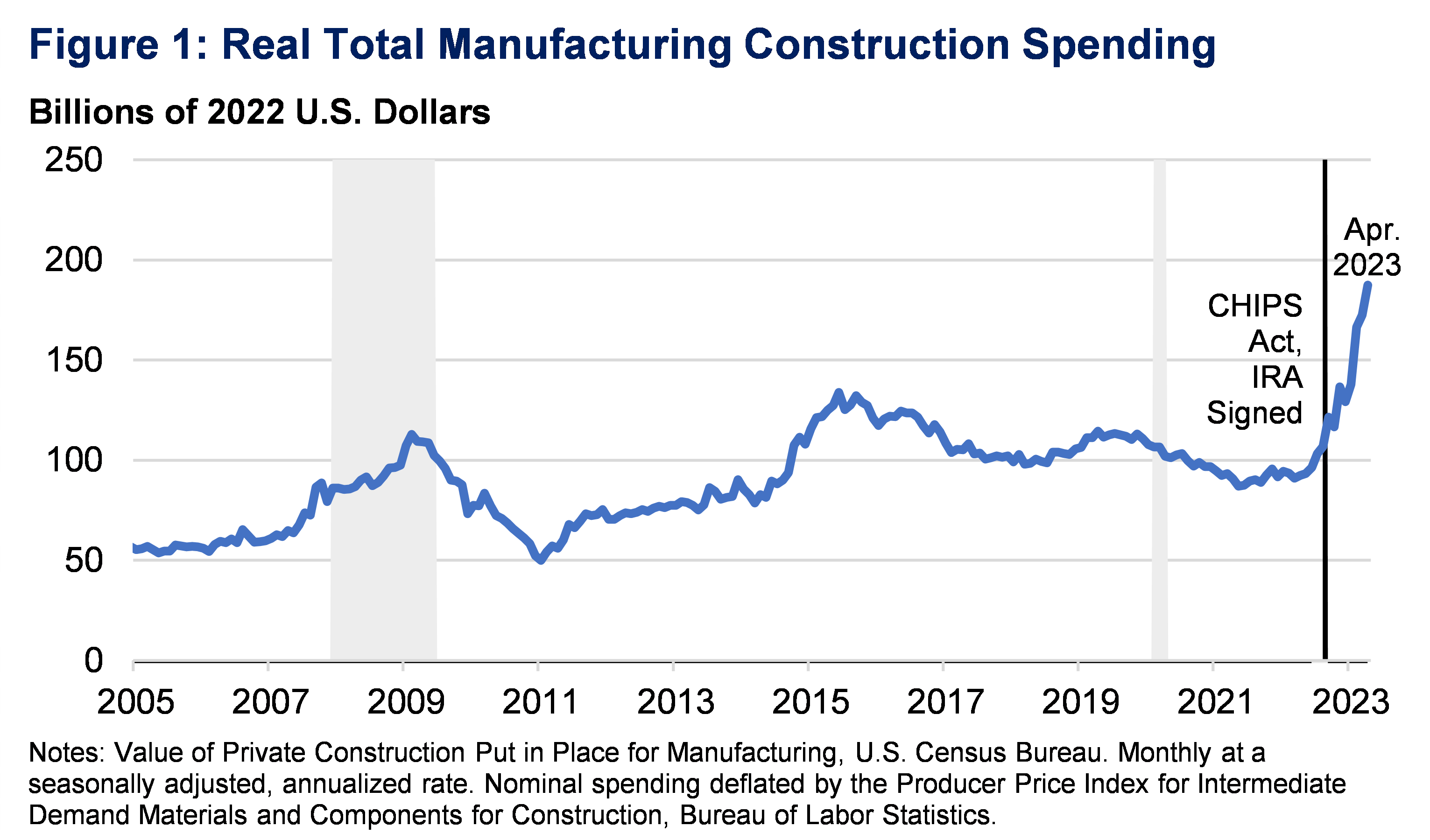
While investors are aware of the above chart and boom in manufacturing capex it is largely viewed as a one-off spike rather than the early innings of a multi-year surge. The problem is that it’s driven by a combination of numerous trends and lots of companies are seeing their own little part of these. These companies can explain how they’re benefiting, but there is an inability to clearly articulate the scale of what’s happening and thus the longevity and size of the opportunity. Well this is true except for 1 company; megacap Eaton, who are seeing it all, explaining it to the market, and have been handsomely rewarded for it (ETN: +60% over 1-year, +160% over 3 years). OM’s belief is that in the coming years, as the market better understands the scale and scope of US Reindustrialization the collection of smaller companies that are facilitating the different parts of it will be rewarded.
Sunday, April 21
2024: First Quarter Review
Portfolio Update
Our Man made a smattering of changes to the portfolio in mid-January. The changes saw some new dislocations/themes added to the portfolio, as well as some adjustment of existing position sizes.
- Added Argentina (new Dislocation): Following President Milei’s victory in the Argentine elections and the initial burst of reforms, especially the moves to liberalize the exchange rate, OM took an initial position in Argentine Banks. OM will pen something in in greater depth, should this position be materially increased, but for those with interest you can read the positive case, as articulated by one of OM’s friends (an EM specialist).
- Added American Reindustrialization (new Theme): Professionally, OM has been discussing this as the biggest under the radar theme in markets today. The difficulty is that it’s hard to express well given it’s a tailwind for a broad swathe of largely mid-cap companies, but a primary driver for very few. Thankfully, the First Trust RBA American Industrial Renaissance ETF (AIRR) captures many of the names impacted by the theme.
- Carbon Credits (new Theme): OM re-entered the Carbon Credits theme, taking exposure to California Carbon Allowances (KCCA).
- Reduced Shipping/Tankers: OM exited the position in EURN as following its transaction with FRO the company is no longer a tanker play.
- Reduced Uranium (URNM): OM took some profits in Uranium, given the exceptional performance in recent months. URNM rallied over 60% between the end of June 2023 and OM’s trim in mid-January 2024.
- Added to Brazil – OM made a small addition to the Brazil position.
Performance and Review
The portfolio rose with the markets during the first quarter of the year; its +11.04% increase slightly surpassing both the S&P 500 TR (+10.56%) and the MSCI World (+10.09%).
First Quarter Attribution

There were four primary drivers of performance in Q1 - two long-held positions and two of the newer positions. The positions in Uranium (+248bps) and Tankers/Shipping (+230bps) were again the largest drivers of performance. They both continue to benefit from a continual stream of incrementally positive news and have gone from controversial and ignored ideas, to broadly accepted but underappreciated and underinvested ones.
The US’ relationship with nuclear (and thus uranium) is similar to the rest of the world; over the last 2-3 years the US has seen growing bipartisan acceptance of nuclear culminating in President Biden’s recent endorsement. However, despite this the US is likely to be the last place to commission a significant expansion in nuclear power as the US has high construction costs and amongst the lowest electricity prices in the world. OM’s expectation is that US firms will first learn by building plants overseas, using this to help reduce the cost structure to something closer to that achieved by the Koreans (but still more expensive than the Chinese). Thus, despite the broad acceptance, new US nuclear plants are likely to signal the end of the Uranium trade than being a purely positive sign.
The newer positions in Argentina (+210bps) and European/UK Financials (+169bps) were strong contributors. The UK Banks continue to suggest improvements in their earnings and have been rewarded with steadily increasing estimates and investor interest. In Argentina, it has quickly become clear that President Milei is seeking to make major changes very quickly. There is, and will continue to be, much debate about the pace of the changes but Milei has learned from Macri’s failed attempt at gradual reform a decade ago. The reforms are broadly things that have been discussed about Argentina for years including liberalizing the exchange rate regime, shrinking the money supply (including running down the central bank notes, LELIQs, which were held by the banks), balancing the budget and the start of structural reforms. The reforms will no doubt fail to be perfect, and their passage into law and implementation will be complicated, but the general direction is positive.
Elsewhere, the portfolio received healthy gains from positions in the Blockchain thesis (+117bps) after a spot Bitcoin ETF was approved by the SEC. The most successful time to own cryptocurrencies has historically been from ~6mos before the Bitcoin halving to ~1 year afterwards. Despite this being well known, OM suspects this will once again prove to be the case around the May-24 halving. Thus, while the exposure here may increase in 2024, expect it to only last till this time next year.
Elsewhere the gains slightly outpaced the losses, which is unsurprising given the strong market performance. There were solid contributions from Reindustrialization of the US (+64bps), Tin (+43bps), Greece (+31bps), India (+25bps), Biotech (+21bps) and Commodities (+14bps). The only detractors came from positions in Brazil (-41bps) and Carbon (-24bps).
Portfolio (as at 03/31/24 - all delta and leverage adjusted, as appropriate)
Dislocations: 46.3%
24.2% - Uranium (URNM, CCJ, NXE, PALAF, DNN, BNNLF, URG and SMR)
10.7% - European/UK Financials (BCS, LYG, NWG)
6.2% - Argentina (BMA, GGAL, SUPV)
5.2% - Brazil (EWZ)
Thematic: 48.2%
13.4% - Shipping/Tankers (STNG, INSW, TNK, DHT and FRO)
6.6% - Tin (AFMJF, MLXEF and SBWFF)
5.5% - Biotech: 4th Industrial Revolution (IBB & XBI)
5.5% - India (IBN, INDA and SMIN)
4.4% - Blockchain/Crypto (ETHE and OSTK)
4.0% - Greece (GREK & ALBKY)
3.3% - US Reindustrialization (AIRR)
2.5% - Carbon Credit Allowances (KCCA)
1.7% - Software: 4th Industrial Revolution (JD & WCLD)
1.4% - Commodities/Mining (FLMMF)
Idiosyncratic: 5.2%
5.2% - Equities (TPL & JOE)
Shorts/Hedges: 0.0%
Cash: 0.3%
Disclaimer: Nothing above represents a recommendation in any way, shape or form so please don’t even think of trying to take it that way. For added clarity, while Our Man is invested in all of the securities mentioned that’s a terrible reason for anyone else to do so. Our Man also holds some cash and a few other securities (of negligible value). You should not buy any of these securities because Our Man has mentioned them, but should do your own work and decide what’s best for you given your own circumstances/risk tolerance/etc.
Saturday, September 21
Ptf Update: Don't cry for me (over) Argentina


Disclaimer: Our Man held the above positions (GLOB, AGRO, GGAL and DESP) in Argentina.
Monday, September 3
OM’s Philosophy: How Today’s Portfolio Fits
Dislocations – 35.4% NAV, as of end of June 2018
OM seeks to take advantage of dislocations – areas of the market where performance has been abysmal and investors have lost hope. In addition to cheap valuations and fundamentals that are turning around, these investments require a narrative to help encourage investors to reexamine the opportunity.
Brazil (20.3% NAV)
The longer-version of the thesis can be found here. The shorter version is that Brazilian equities lost 80% (in USD-terms) between 2011 and 2016, and investor sentiment reached a nadir in early 2016 as the Carwash Scandal enveloped Brazil’s elite culminating in the successful impeachment of President Rousseff. With sentiment at a trough, there were positive signs; new President Temer was viewed as competent and a short-term fix, and the length-and-depth of the recession meant that politicians were open to reform (especially pension) and companies had spent 5-years cutting costs to survive (i.e. created operating leverage to any pick-up in demand). This was supplemented by the macro environment picking up (Brazil exited recession in 2017) and stock prices rising.
However, the big current question is whether the narrative peaked in December 2017, when Brazilian stocks continued to rise even as the planned pension reforms were shelved. If so, this position should be vastly smaller especially considering the uncertainty of the upcoming election.
Uranium (9.5% NAV)
Uranium remains the most frustrating position in the portfolio, which is a sign that it should probably be a smaller one. Nothing has changed in the thesis;
- The primary demand is nuclear power plants which are slowly coming back online (post Fukushima) and being built (mainly in China and India). These plants have long-term contracts (2-10yrs) and the majority of existing contracts come due in the 2018-2020 time frame.
- The supply-side is now rational. A multi-year price war saw suppliers seek to build/retain market share, but the continued falling price meant there was no investment and most mines currently operate at a loss. Two suppliers (Cameco and Kazakhstan) now control over 50% of the market, and have both been disciplined and aggressive in shutting down capacity. Our Man hoped that these public demonstrations of supply-side discipline, especially the major cuts coming into 2018, would help start to drive the narrative and price but despite strong rallies on the shut-downs, there’s been little price follow-through.
Greece (5.6% NAV)
Greece suffered through the Great Depression (and more) and everyone’s still annoyed/frustrated with them, with investors having been burned more than once. However, Greece exited its third (and final?) adjustment program a couple of weeks ago and the IMF/EU came to a French-brokered understanding re. its future debt path earlier in the year. While there is much reform that still needs to happen, it’s also too easy for outsiders to discount what’s already been done (e.g. reforms making it easier to fire workers, new laws to work out NPLs, etc.).
OM has limited the position size since while all the ingredients are in place there is no compelling narrative to force people to look at Greece again. As such, OM is waiting to see (i) Greece come to market with another debt issue, and especially (ii) elections. OM suspects that the latter will prove a strong driver of the narrative, especially if Kyriakos Mtzitokis’ New Democracy look like winning. They represent a much more palatable partner to investors/the EU/the ‘media’/etc. than current Greek PM Alex Tsipras and his Syriza party.
Thematic – 28.8% NAV, as of June-end 2018
This represents OM’s exposure to long-term secular themes. The themes likely won’t change much over time though the underlying components and position sizes may do.
The 3rd/4th Industrial Revolutions (14.2% NAV)
The Digital Revolution (3rd Industrial Revolution) was the shift from mechanical/analogue technology to digital electronics; at the simplest level think sending mail to email. It began with the invention of the transistor (1947) which led the advent of digital computers, and it continues through today cellphones and the Internet. The Fourth Industrial Revolution is building upon and extending the Digital Revolution, and seems likely to transform society in the coming years/decades. So far, it has been characterized by breakthroughs in fields such as robotics, artificial intelligence, machine learning, autonomous vehicles, genome science, and cryptography. Most will have at least heard of some/most of these fields, but they are all still emerging and their impacts and relative importance isn’t yet known.
Our Man has long-held various technology and biotech names in the old Equities book; while the companies have their own attractive traits, these “Industrial Revolutions” are the overarching theme that binds them together. OM suspects that by classing all the positions that are predominantly driven by this theme together, it will help from a sizing and risk management perspective.
If you’d like to read a simple primer on the 4th Industrial revolution, here’s a good one from World Economic Forum.
Argentina (8.0% NAV)
Argentina started in the dislocation book; Kirchnerism from 03-15 resulted in a poorly managed and distorted economy, with no access to global capital markets. However, political change was imminent; President Cristina Fernandez de Kirchner couldn’t run in the 2015 elections, and any of the 3 candidates would be more market friendly. She was replaced at the end of 2015 by President Macri, the most market friendly of the candidates. President Macri began an impressive liberalization of the economy including removal of currency controls, inflation targeting independent central bank, settling with the bond hold-outs allowing Argentina to access capital markets, etc.
The thematic bet is long-term that Macri-ism succeeds and Argentina becomes a ‘normal’ country and market economy, with single digit inflation and normalized interest rates. This allows the development of a broader credit market (both corporate and personal) and businesses have greater ability to plan/invest for the future. Think of the US in the early 1980s, following Volker’s raising rates to tame inflation, as a good but vastly simpler historical rhyme.
India (4.9% NAV)
The long-term bull case for India is widely known, and OM doesn’t have much special insight. The thematic case starts with the 2nd largest country in the world, which also has great demographics and is (relatively) technologically advanced. These natural advantages are supplemented by some self-help. While there is much to criticize the Modi government over, it has made some structural shifts (taxation changes, bankruptcy code and financial reform, etc.) and the push to digitize the economy, highlighted by the introduction of Aadhar (a unique individual ID number based on biometric information), is potentially world-leading.
Vietnam (3.1% NAV)
The cliff notes for the Vietnam is that it looks like China/Thailand 15-25 years ago and is treading down the same path. The longer form can be found here; expect Vietnam to be in the portfolio for a long time though the position size will vary depending on the pace of reforms, the strength of the economy and the proximity and likelihood of any MSCI upgrade (to Emerging Market status, from Frontier).
Idiosyncratic – 18.2% NAV, as of June-end 2018
The idiosyncratic book is made up of two things; a small number of attractive individual stocks and some Funds. These Funds take advantage of some structural inefficiency be it through active stock picking/time horizon or using a combination of (valuation) factors to systematically allocate capital.
Texas Pacific Land Trust (TPL, 6.7% NAV) – if there could be a poster-child for the type of individual stock in the idiosyncratic book, it would be TPL. It’s attractively priced, not covered by any Wall Street analysts (of note), not in any ETFs, and its business (oil royalties, land leases, and water rights) has no real peers to benchmark it against. Throw in the uniqueness of its structure – it was created in 1988 as a result of the Texas Pacific Railway co going into receivership, and all it does is manage/sell land and use the proceeds to buy back shares – and nobody really knows or cares about it.
Fannie Mae (FNMA, 0.3% NAV) – Either the government should not be sweeping all of FNMA’s profits to the Treasury and it’s worth multiples of the current price, or they should and it’s worth almost nothing. For a resolution, it requires political decisions to be made on a topic nobody wants to make-them on (government’s role in the mortgage market) and with no immediate need for a decision. Think of it as a glorified option with lots of unknowns and very attractive risk/reward payoff. Also, it has no time decay but also no strike date…it could be here forever and worth the same, or worth multiples next quarter/year.
As previously noted, the Funds (11.3% NAV) are within the idiosyncratic book.
- GVAL and CAPE are both based on applications of Shiller’s PE Ratio (aka Cyclically Adjusted Price Earnings, CAPE). GVAL applies it to International stocks (finding the cheapest stocks in the cheapest countries), and CAPE applies it to US sectors. To Our Man’s mind Shiller’s PE Ratio/CAPE is a tool that is poorly applied in finance with too many trying to use it as a timing mechanism or reason for a short-term decision, whereas it’s real value is as a very long-term measure of relative value. The intent of both ETFs is to buy things that are cheap on a relative basis (compared to other countries/sectors) and Our Man’s wager is that over the long-term this will prove to be more profitable than the market.
- CWS: Our Man has read the Crossing Wall Street blog for most of the last decade, and this ETF is based off that blog. CWS publishes an annual “Buy List” of ~25 stocks at the start of each year, which are equally weighted and then no changes can be made during the year. Each year only 5 stocks from the Buy List have been replaced, with the others carried forward (with any additions) onto the new Buy List. This longer-term focus (typically, 4-5 years on the Buy List) leads to a bias towards quality and value and if the process can remain disciplined this can lead to out-performance over time.
Technical - 32.9% NAV, as of June-end 2018
The Technical book was added back in 2014, to help compensate for OM’s natural skepticism by formulaically take long positions (in the levered ETFs for the S&P 500, Dow Jones and Nasdaq 100) to capture long-term trends in these markets. The position-sizing of these positions is also rules-based, and more information on the genesis and rules for the Technical book can be found here.
Hedges/Shorts
None currently.
Saturday, November 18
Portfolio Update: Argentina, Greece and India
Disclaimer: Nothing above represents a recommendation in any way, shape or form so please don’t even think of trying to take the above that way. For added clarity, while Our Man is invested in all of the securities mentioned that’s a terrible reason for anyone else to do so. Our Man also holds some cash and a few other securities (of negligible value). You should not buy any of these securities because Our Man has mentioned them, but should do your own work and decide what’s best for you given your own circumstances/risk tolerance/etc.
Thursday, April 13
Portfolio Update
Technical: 22.7% NAV (all sizes are as of March-end)
The positions are unchanged and are relatively evenly split between DDM, SSO, and QLD, which represent exposure to the major US indices Currently Our Man’s technical model is strongly in “Buy” territory, and while it indicates there are possibilities of 5-8% pull backs in the near future barring a much more substantial reversal in markets it seems unlikely that its recommendation will change. Thus, Our Man’s not expecting much to change here for a while.
International: 20.1% NAV
This book currently has positions reflecting themes in Argentina, Brazil, and Europe (Italy).
- Argentina (8.9%) is the largest theme, though this was reduced during Q1 as OM exited PZE (Petrobras Argentina, which rallied strongly in late-2016) and reduced the size of the PAM (Pampa Energie) position. The remaining exposure to the theme comes through Pampa (6.4%) and Adecoagro (AGRO, 2.5%). It’s now been over a year since President Macri took office, and he’s made a remarkable number of changes to help Argentina transition towards a more market-based (vs. government driven) economy including the removal of capital controls, allowing real independence to the Central Bank (which has since decided to target inflation), settling with bond holdouts opening the way for Argentina to raise USD debt, and reducing government subsidies and price caps. While these things are only now starting to impact the economy, they have already improved investor sentiment which is highlighted by the prospect of Argentina returning to the MSCI Emerging Markets Index this summer. While OM hopes to see the benefit of the increased liquidity and flows, the position is likely to be one that declines as Argentina continues its move towards normalization.
- The recent additions of Brazil (7.6%) and Europe (Italy 3.7%) were discussed in the year-end review. Both positions are likely to increase in the future, especially if the recent pullback in Brazil continues.
- Finally, at the start of the year, GVAL was removed from this book and added to the new Funds book (see below)
Equities: 19.3%
The equities book is made up of broadly evenly sized positions (~3.5%) in JD.com (JD), Vipshops (VIPS), the Nasdaq Biotech ETF (IBB), Dollar Tree (DLTR) and Liberty Broadband (LBRDK). JD (which Our Man re-entered in January at a mildly better price than he sold it at last year) & the long-held VIPS position are both plays on the Chinese Consumer; think of them as companies that one day could be Amazon & an online TJ Maxx respectively. Both Dollar Tree and Liberty Broadband (mainly Charter Communications, whose services fellow New Yorkers see as the new “Spectrum”) are exceptionally well run businesses which would also would be beneficiaries of tax reform in the US.
There is also a much smaller position in Fannie Mae (FNMA, 80bp), which along with the position in IBB was discussed in the year-end review.
Funds: 9.9%
This represents a new book/theme in the portfolio; all of the exposure is expressed through ETFs (or potentially funds). These ETFs have something about them that has piqued OM’s interest and are why I think they’ll outperform markets over the long-term. Given that this outperformance is expected over the long-term, the changes to this book are expected to be extremely small. Currently, there are 3 broadly equally-sized positions in the book:
- GVAL and CAPE are both based on applications of Shiller’s PE Ratio (aka Cyclically Adjusted Price Earnings, CAPE). GVAL applies it to International stocks (finding the cheapest stocks in the cheapest countries), and CAPE applies it to US sectors. To Our Man’s mind Shiller’s PE Ratio/CAPE is a tool that is poorly applied in finance with too many trying to use it as a timing mechanism or reason for a short-term decision, whereas it’s real value is as a very long-term measure of relative value. The intent of both ETFs is to buy things that are cheap on a relative basis (compared to other countries/sectors) and Our Man’s wager is that over the long-term this will prove to be more profitable than the market. The GVAL position was moved from the International book/theme as it seems to better fit here.
- CWS: Our Man has read the Crossing Wall Street blog for most of the last decade, and this ETF is based off that blog. CWS publishes an annual “Buy List” of ~25 stocks at the start of each year, which are equally weighted and then no changes can be made during the year. Each year only 5 stocks from the Buy List have been replaced, with the others carried forward (with any additions) onto the new Buy List. This longer-term focus (typically, 4-5 years on the Buy List) leads to a bias towards quality and value and if the process can remain disciplined this can lead to out performance over time.
Commodities: 3.4%
This book was changed from Precious Metals to better encapsulate the things that might go into it
- The Uranium stock ETF (URA) was added during January, and is the sole position in this book. OM will likely go into the thesis on Uranium in greater detail at some point, but the cliff notes are:
1). Supply: 70% of supply comes from 2 producers (Cameco, a North American company, and the Republic of Kazakhstan) and both have cut supply in the last 12months and announced their intention to keep it down. It takes a really long-time (5-7years+) to permit, build, and develop a mine so this capacity constraint has limited offsets.
2). Demand: The primary demand for Uranium is from nuclear power plants. Post-Fukushima the demand fell substantially as Japan (and other countries like Germany) closed down their nuclear power plants. Over the last year+ we’ve started to see some of these Japanese plants being updated and come back online, while other countries have approved and are building new (typically Generation III/III+) nuclear plants. The building of new plants takes time (5-7 years to the plant approved, built) and will likely be slow (as countries wait to see how the new Generation III plants operate) but represents positive incremental change. In the short-term, contracts for uranium supply are long-term (2-10yrs) with a significant percentage coming due within the next couple of years.
3). Price/Technical: URA is down 80-90% from its 2011 peak and hit a low of $11.31 in mid-Jan 2016. Subsequently, it held above this low in early November ($11.74) and confirmed a yearly uptrend in early 2017 (it’s price in 2017 closed at a level higher than any price in 2016!). OM’s technical model suggests that the future path of URA is more likely to be a bear market rally than the start of a new bull market, but also that this could well be a particularly vicious bear market rally (to $40+!!!) given the depth & time of the decline.
Given this combination of supply/demand factors and the price/technical lining, OM believes that URA currently represents an attractive risk/reward.
Currencies: -47.6%
OM continues to remain very long the US Dollar, with short positions in the Euro (via EUO) and Japanese Yen (via YCS). The Euro short is around 2x the size of that in the Yen, with OM continuing to believe that the Euro will comfortably break par to the Dollar within the next 12-18mos.
China Thesis: 2.3%
There are two components to OM’s China thesis; (i) that the Chinese are seeking to transition their economy to a Consumer-driven one (like the US/Europe/etc) and away from a Fixed Investment one, and that (ii) that they will provide as much monetary support as they’re able to in an attempt to smooth this transition. To some degree, the Chinese internet positions (JD and VIPS) in the Equities book incorporate the view described in part (i) but in the China Thesis book it is expressed via a small short position in the Australian dollar (42% of Australian exports go to China, in particular commodities used for Fixed investments). This short position has been substantially larger than it is today (10%+ vs ~1.5%). Part (ii) of the thesis is expressed through a position in Chinese A-shares (~3.5%) with OM believing that much of China’s monetary support will end up finding its way into the local stock market and that 2007 and 2015’s highs (50%+ above here) will be eclipsed before the market finally peaks.
Disclaimer: Nothing above represents a recommendation in any way, shape or form so please don’t even think of trying to take the above that way. For added clarity, while Our Man is invested in all of the securities mentioned that’s a terrible reason for anyone else to do so. Our Man also holds some cash and a few other securities (of negligible value). You should not buy any of these securities because Our Man has mentioned them, but should do your own work and decide what’s best for you given your own circumstances/risk tolerance/etc.
Saturday, August 22
Portfolio Update - Summer 2015
International/Country – 34.6%
The International/Country book is made up of 2 main exposures; Europe and Argentina.
- Europe (~19%): About 3/4 of Our Man’s European exposure is split between Spain and Italy, with the balance in Greece. This reflects the long-term cheapness of Spain and Italy (on a CAPE-basis) coupled with the stronger technicals and higher probability that these countries are through the worst of their problems. Greece appears exceptionally cheap, though this may prove superficial given the scale of the economic depression that the country has been through since the Financial Crisis.
- Argentina (~12.5% spread across 5 names):
The catalyst for the Argentinean positions is the upcoming Presidential election in Q4, and the positive news is that both of the primary candidates appear to understand the need for change, to improve the economy and to settle with the bond holdouts (giving Argentina access to global bond markets). The big questions surround the timing and the ability of the candidates to execute.
The worries about Scioli center on whether he is too close to the existing regime, something that his VP choice (an ally of the President) only fueled. However, he has the broad support of the Peronists and thus is likely to be able to push changes through, though this will be in a more gradual manner as he builds consensus. As such, there remains the risk of an economic issue/crisis before change is implemented and can have an effect.
Macri is the bolder ‘change’ choice, as he is likely to attempt to try to do things much more quickly. The questions surrounding him are whether, after the initial honeymoon period, he’ll be able to push things through (given his status as an outsider) or will he be bogged down fighting the opposition.
- GVAL: Is a very long-term holding; given this OM wanted to wait a full cycle before making any decisions on it, thus if was sized very small. So far the performance has been disappointing, though the performance was (and still is) expected to be characterized by periods of large under/over performance.
Technical book – 34.1%
As mentioned when it was implemented, the Technical book has a longer-term bias and changes are not expected to be made to it on a regular basis. Thus unsurprisingly this year has shown no changes, especially with the market being in a ‘dead zone’ between 2040 and 2135 for the the last few months. It’s broadly OM’s expectation that this is a long consolidation that’s likely to break the upper limit and start a strong move lasting into 2016. So far that hasn’t happened, but despite some internal weakness in the market (advances/declines, and ever decreasing breadth, coupled with the reaction to companies missing/making numbers), it would likely take a move comfortably sub-2000 for the Technical book’s sell signals to be triggered. (Editor’s Note: And this is why you don’t leave a semi-written blog post waiting to be finished for a month or two. The market closed on Friday at 1971, right around the level where the Technical book’s initial sell signals are triggered)
Equity Book – 22.5%
At this point there are 4 names in the book:
- RDY and TTM are both Indian stocks though there is no great theme to these investments. There has also been no great change to either story; the generics business continues to grow strongly (RDY) and Land Rover/Jaguar have started to roll out new models and the rationalization of the manufacturing underway (TTM).
- VIPS and JD are both Chinese Internet retail/consumer plays. China’s development has come at an interesting time, coinciding with the technological jumps that come with the Internet, meaning that that the country’s retail model could be very different to those of the already developed world as it moves more directly/aggressively to the internet (and mobile) rather than brick-and-mortar stores. This wouldn’t be the first time we’ve seen a developing country skipping a step as it modernizes; most obviously with India moving straight to mobile telephony rather than putting fixed telephone lines down across the country.
As with (seemingly) all Chinese companies, there is speculation as to whether these companies are ‘real’ and though OM has never been to China, he has sources who’ve met both companies, seen their sites, etc and is thus confident that both companies exist and have real businesses.
VIPS is comfortably the larger of the two positions, owing to the fact that (despite being an ‘Internet’ company) it’s profitable & generates cash – while some are disappointed by its recent growth, OM sees not competing aggressively for bad business to increase revenues (at the expense of margins, profits, etc) as a sign of good long-term management.
- Currencies (21.9%) & China Thesis (11%)
Our Man has stated a number of times on this blog that he’s a dollar bull. It’s his highest conviction belief that we’re in a dollar bull market, a true secular bull market in the dollar, which is something we’ve not seen for decades. While it’s not ignored OM doesn’t really think it’s fully realized that the Federal Reserve hasn’t raised rates in over a decade, and the US Dollar hasn’t been in a true secular bull market for almost 20 years. While the dollar’s recent rally has been noted by the markets, it barely compares to historical secular bull markets such as the 90% rally in the 1980s and the 50% rise in the 1990s! Furthermore, with a more globalized world now, the impact of the rising dollar is likely to be larger than people expect – instead of Poles with loans in Swiss Frances, it’s going to be global corporates that have borrowed in US Dollars (especially in those countries, *ahem* China, where a pegged currency has led to the rapidly crumbling illusion of no currency risk). As for China, the slowdown has clearly impacted commodity prices (a number of which are at, or threatening, their 2008/2009 lows) and it’s spilled over into the currencies of the commodity countries. The China book’s Short Australian Dollar position has been great and OM expects it to be volatile but very profitable for a while.
- Precious Metals – 9.3%
While OM’s medium-term thesis here - that Precious Metals are going to have a strong bounce (the kind that would have the would-be gold bugs believing again) - may prove to be correct he took the position too early, much too early. OM would have been better off waiting for that final leg down, rather than getting into the positions.
Saturday, December 20
Portfolio Update: Some 2014 & 2015 Thoughts…
Some things that are interesting OM for 2015, and beyond…
- International Book - Argentina: This is one of those positions that falls into the mistakes of omission, since OM has been waiting to put on a position since Argentina defaulted on its debt over the summer. On the surface there’s very little good to say about Argentina; the country is in an acrimonious fight with some bond hold-outs from its last default resulting in another default, the economy is terrible with high inflation, a weakening currency (which trades at both official vs. unofficial prices) and high interest rates. Given that, why Our Man’s interest? Well, everyone knows all of the above and despite the huge rally in stocks, they’re still cheap by any definition. However, this is with good reason; high and volatile interest rates, mean banks only lend short term, which means businesses on focus on the short-term and eschew investments where the future return may be substantial. Ditto for investors, who rightly value short-term cashflow or earnings far more heavily than any future earnings, due to the high discount rate. The opportunity lies in that during 2015, there are ‘events’ that could change this paradigm; (i) it becomes a lot easier to negotiate with the bond holdouts as the calendar turns to 2015 (due to the expiration of a clause in the restructured bonds), and more importantly (ii) the current President cannot seek a third term, with all 3 major candidates promising a break from the Kirchner's (Cristina Kirchner has been President since 2007, and her husband was President for the 4 years prior) style and policies. Therein lies the upside potential – the hope of a sensibly governed Argentina (perhaps even with an independent Central Bank), with its limited fiscal deficit and debt, and having ability to return to international capital markets would lead to a falling in the risk premium and corporations focusing on maximizing return (including future growth) rather than just surviving. The downside, is yet more of what we’ve already seen, which is largely priced into the markets. Given the lack of a good ETF, OM began investing in a small basket of positions in Argentina to get exposure during December.
- Equity - Oil/Gas related: The decimation in the Energy markets has been amazing to watch, with the Russell 2000 Energy losing around half its value in the last 6 months and many individual names suffering far more heavily than that! The sharp fall in oil has also reopened many of the debates about fracking and how the US Shale boom has been funded. From a historical analog, there are certain similarities to what happened in 1985/86, when an influx of new production from the North Sea increased supply and saw the Saudis choose to maintain market share in a period of weakish demand, leading to a 60%+ decline in WTI within a 6month period despite ongoing Middle Eastern tensions; for 2014, substitute in US Shale (where production increased 1mn barrels per day in 2013, and likely 1.7mn bpd in 2014) for North Sea. In short, Our Man thinks there are going to be things to do to in Energy during 2015, but we’ve yet to see the numerous corporate casualties (other than in their stock prices) that indicate it will be a better time to look for those that might be winners. As such, OM’s exposure will continue to remain of the toe-dipping variety, but don’t be surprised if you start to see some Energy names in the Equity book next year.
- Equity – Internet: OM loves the Internet and at this point, who doesn’t? Be it shopping, catching up on the highlights from the big game, keeping in touch with family and friends or just doing one’s work, the Internet is pervasive*. OM doubts it’s even an argument whether the Internet is this generation’s defining contribution and theme**, and like many of the prior themes it’s not only reshaping our world but is a key force of the deflationary pressure that we’re seeing globally. The Tech Bubble of the late 90’s was clearly the very early innings, but it’s hard to say how far into the game we are currently. While OM loves the Internet, he struggles to buy positions in a world where valuation is based on Total Addressable Markets (TAMs, or how big a company’s market “could” be) that can be almost anything and where low rates mean the value of future growth is vastly more important than the value of any profitability in the near-term (i.e. $100 at the end of 5years is worth ~$62 today at a 10% discount rate vs. ~$90-$91 today at a 2% discount rate). Thus OM has only really been a buyer of Internet stocks at times when they’ve been sold aggressively (e.g. early last year); expect this to continue into 2015. But like this year's Internet exposure, OM hopes that each time he invests in these sell-offs there will be a name or two that becomes longer-term holdings for the portfolio (like VIPS and TWTR in 2014).
* Furthermore people have now largely accepted the Faustian bargain of the Internet; that it is “free” to use and “cheap” to buy things on, BUT in exchange for all your personal data, whose protection & safety is currently not a priority for anybody be it individuals or corporations.
**OM will leave it historians to argue how it compares to the Railroad, the industrialization of manufacturing driven by oil/gas, the Automobile, etc.