Pages

Wednesday, April 4

March 2012 Review


Portfolio Update
There were no changes to portfolio during March.

Performance Review
While March seemed superficially very similar to January and February there were some noticeable underlying differences, with Emerging Markets performing noticeably poorly led by Shanghai Stock Exchange Composite Index which fell over 6%.   In the US, the coincident macro data continued to be reasonable though showed signs of tailing off, while in Europe the markets rallied before relief over Greece’s deal with its creditors slowly waned over the course of the month.  Unfortunately, Our Man’s portfolio made no headway, falling 45bps (YTD: -1.8%).

The sources of the profits/losses during the month should not be surprising to regular readers.  The Puts/Hedge book (-38bps) and Treasuries book (-17bps) both suffered from the continued preference for risk assets in the US and were consistently negative contributors throughout the month.  Elsewhere, the Bond Funds (-6bps), China (-7bps) and Currencies (-3bps) were small negative contributors though all spent the majority of the month around the flat.  On the positive side, the NCAV book (+22bps) was the dominant contributor driven by the merger/takeover of one of the positions (OPXT) which alone lifted the entire book c15% in the final days of the month.  The Energy Efficiency book (+11bps) benefited largely from the market’s rise. 

The sole equity book that did not help performance was the Value Equities (-6bps), which also contributed negatively (about -26bps) over the quarter despite the market’s 10%+ rise.  While divergence from the indices is, of course, to be expected when the book contains a mere 2 names and is thus driven predominantly by idiosyncratic factors, both of the positions (THRX and DRWI) are down for the year.  While there were no major changes to the underlying fundamentals and news of either position, both have risks hanging over them that have yet to dissipate.  DRWI is scheduled to complete a transaction for Nokia-Siemens wireless business in the coming months, which while transformative for the company also brings with it execution risk as they turn their large pile of cash, into a revenue producing business that they have to integrate manage effectively.  THRX, together with its key partner GlaxoSmithKline, continues to work on trials and approval process for the compounds in its drug pipeline with regulatory submissions planned for a couple of programs.  Our Man’s sense is that for both these companies, it will be their success at managing these factors & processes that will largely determine their stock price moves over 2012 rather than the movements of the market.

Portfolio (as at 3/31 - all delta and leverage adjusted, as appropriate)
15.9% - Bond Funds (DLTNX and HSTRX)
5.2% - Value Idea Equities (THRX, and DRWI)
3.9% - Treasury Bonds (TLT)
2.3% - Energy Efficiency (AXPW, and XIDE)
1.7% - NCAV Equities
0.0% - Other Equities (none)

-1.9% - China-Related Thesis (40bps premium in EWZ Jan-13 puts)
-3.8% - Hedges/Put Options (22bps in IWM Jan-13 puts, 20bps in SPY Jan-13 puts and 15bps XLY Jan-13 puts)

-9.6% - Currencies (EUO – Short Euro)

65.2% - Cash

Disclaimer:  For added clarity, Our Man is invested in all of the securities mentioned (TLT, DLTNX, HSTRX, THRX, DRWI, AXPW, XIDE, , EWZ puts, IWM puts, SPY puts, XLY puts, and EUO).  He also holds some cash.  You should not buy any of these securities because Our Man has mentioned them, but should do your own work and decide what’s best for you.

Saturday, March 31

NCAV 2012-1


The first NCAV update of the year has been much delayed, as the process failed to show up any new names that could be added to the Absolute Value/NCAV bucket portfolio (for information on this bucket, and how it works, read here). 

While the initial screen is a valuable tool, a number of names were removed during the simple qualitative overlay;
- As Our Man has discussed previously, Chinese companies (listed in the US) that come up on the screen are currently being excluded due to the number of frauds within their ranks (see DGW, JGBO, Sino-Forest, Longtop Financial, etc  for just 4 examples over the last year or so) .  Like all screens, Our Man’s NCAV screen is reliant upon the quality of the data going into it and the number of recent Chinese-based frauds (whose stock is listed in the US) argues for their exclusion.
- A number of Financial companies were excluded, due to their different definition of Current Assets or the screen mistakenly using Total Assets (instead of Current Assets) to pass them.
- A number of companies were excluded as the data used in the screen was sufficiently dated to be of no great value (i.e. 2010 year-end data, which is now 15months out of date).

Like the last time the screen was run, one existing name (TWMC) reappeared on the screen.  As such, the final date that this name must be sold by has been extended (here are the rules when NCAV names are sold).   However, a number of existing positions (LTON, SUTR & XIN) are approaching the 366 day cut-off in the portfolio since last appearing in the NCAV screen and will thus be removed from the portfolio during April unless they reappear in the coming fortnight.  Finally, in the final week of March, OPXT agreed to a merger with Occlaro and unless any counter-bid is forthcoming (unlikely) in the coming weeks, this position will also be exited in April.  The sum of these changes will be to leave the NCAV Book at its smallest size since the inception of the portfolio, reflecting another (exceptionally unscientific) indication of the lack of absolute cheapness in market valuations.

Sunday, March 4

February 2012 Review

Portfolio Update
The changes to the portfolio during February came largely as result of rebalancing the book after some cash was added on Feb 1st.  This impacted the books in the following way:
- Bond Funds, China Thesis & Energy Efficiency books: The existing positions were all added to, and the size of these books was increased slightly.
- Value Equities & Currencies books: The existing positions were added to, and the size of the books was kept broadly unchanged.
- Hedges/Put Options:  The exposure and risk in the book was held broadly constant, but a new position in SPY (Jan-13) was added to the book in preference to adding to the existing positions.
- Treasury Bonds & NCAV books: The positions in these books were not added to, and so the size of the books was allowed to fall slightly.  In the case of the NCAV book, this was largely due to the small size of the positions in that book and it being uneconomical (given commission charges/etc) to add to them.

Performance Review
In many ways, February was a continuation of the risk-off trends seen during Q4 and which accelerated in January.  Coincident macro economic data continued to be reasonable, there was a tentative outline of an agreement between Greece and its creditors, and a China soft-landing is now seen as almost certain.  This again resulted in a rampant month for the markets but Our Man’s portfolio made no headway, falling 69bps (YTD: -1.4%).

However, unlike January when the portfolio moved broadly in-line with the market, February’s losses were far more event specific with performance driven by the Value Equities (+23bps) and Energy Efficiency books (-43bps).  While the long-term trends and potential for both positions in the Energy Efficiency book is favourable, the short-term continues to be tough and both were negative contributors with AXPW falling back after announcing an equity capital raise, and XIDE’s outlook disappointing investors.   Within the Value Equity book, the performance of the individual positions was better with THRX being a positive contributor and DRWI performing well, aided by generous market conditions and the prospect of some potential new contracts.

Elsewhere, the books that could be broadly called risk-off suffered led by Treasury Bonds (-11bps) and Puts/Hedges (-14bps), and the tentative agreement in Greece saw a rally in the Euro which hurt the Currencies book (-18bps).  However, the NCAV (-7bps), China thesis (-3bps) and Bond Funds (+3bps) were broadly flat over the month.

Portfolio (as at 2/29 - all delta and leverage adjusted, as appropriate)
15.9% - Bond Funds (DLTNX and HSTRX)
5.2% - Value Idea Equities (THRX, and DRWI)
4.1% - Treasury Bonds (TLT)
2.1% - Energy Efficiency (AXPW, and XIDE)
1.7% - NCAV Equities
0.0% - Other Equities (none)

-1.1% - China-Related Thesis (47bps premium in EWZ Jan-13 puts)
-3.6% - Hedges/Put Options (35bps in IWM Jan-13 puts, 33bps in SPY Jan-13 puts and 26bps XLY Jan-13 puts)

-9.6% - Currencies (EUO – Short Euro)

64.7% - Cash

Disclaimer:  For added clarity, Our Man is invested in all of the securities mentioned (TLT, DLTNX, HSTRX, THRX, DRWI, AXPW, XIDE, , EWZ puts, IWM puts, SPY puts, XLY puts, and EUO).  He also holds some cash.  You should not buy any of these securities because Our Man has mentioned them, but should do your own work and decide what’s best for you.

Saturday, February 18

Risk, Uncertainty, Opinion and Execution

Our Man hasn’t really written a post of substance in a while, for a mixture of good and bad reasons.  On one-hand, Our Man doesn’t really like to write when he has little of note or new to say, and on the other he spent most of the last 6 weeks obsessing over the Giant’s unlikely Super Bowl run!  However, with the Super Bowl clinched and the market partying like it is 1999…what better time to put down on paper some of the things that Our Man is pondering.

First, let’s take a step back and start on a philosophical note, and discuss the difference between risk and uncertainty as the two often become conflated when people talk about the markets.  To my mind, risk refers to an event (or series of events) that can cause a significant loss to the markets (market risk), or to one’s portfolio (portfolio risk).  Uncertainty is something different; it refers to a greater number of potential and viable pathways or routes for the market, some of which may entail great risk and others very limited risk.  What is important though is that because there are a greater number of viable pathways, the certainty that any particular one will be taken is low.  This means that the impact from small changes in information is magnified, because each change can be can easily extrapolated forwards as they new reality and thus change the markets potential route.  Of course, if the next piece of information contradicts the existing set, the probabilities change once more resulting in new potential routes.  While it’s tempting to assume that risk increases as things become more uncertain, that isn’t necessarily the case.

Secondly, in investing as with many other pursuits, it’s vitally important to separate out opinion from execution, and understand their relative importance.  While this sounds simple, in practice it’s somewhat more difficult – opinions are the most interesting part of being engaged on a subject, everyone has one and most aren’t shy about sharing them (irrespective of how well-formed they are)!  In short, people want to talk about (and listen to other peoples thoughts on) whether the market is going up, if Greece is going to exit the euro, will China have a hard landing, or are Eli Manning and Tom Coughlin certainties to make the Hall of Fame!  However, while opinion is interesting and fascinating, it’s what you do with those opinions (i.e. execution) that really matters.  Let’s imagine China were to have a hard landing; if you held this opinion in advance, that’s great but it’s not necessarily what makes you money – that’s driven by how you choose to express China hard landing (what companies/countries/etc, and what instruments), the resultant risk/reward of those choices, along with when you choose to put the trade on (is the hard landing coming in 2012, or 2013, or later…or should it have already come) and how you size it (if you’re too big too early, you may not be able to hold your position until the day it works, but too small or too late and you don’t make any money).  Unfortunately, while the sizing, timing and expression of a trade (i.e. the execution of an opinion) is what will drive returns, its importance is undervalued and largely ignored in the swirl of opinions.

So, why talk about this today?  Well, it’s a subject Our Man has touched on before and ponders a lot about, but it’s also one that has greater resonance today given Our Man’s skepticism and the market’s strong start to the year.  Opinion-wise, Our Man’s main skepticisms surround whether Europe is heading towards a long-term solution towards the sovereign debt issues, if the China-story is real or just another credit & investment-driven bubble, whether corporate margins are unsustainably high and if the US economy can continue to muddle-through.  Of these, the strength of the US economy is the one that the market has largely dismissed (though it’s doing its best to dismiss them all), as a result of the improving macro economic data that has come out with the consensus being that the US economy has hit escape velocity (again!).  Our Man would point out that while the leading data has been muted, most of the improving data has been coincident and lagging and thus extrapolating where we are now (or were yesterday) to project where we will be tomorrow is fraught with error, far smarter people have gone into far greater depth on this so he will leave you to read their words of wisdom

See, Our Man fell into the trap of wanting to talk about opinions, even after commenting on the frequency of such discussion.  So, enough about opinions, what about execution!  When talking about execution, Our Man will focus on the broad Equity books, the China thesis, and the Puts/Hedges books.  This is simply because the majority of the risk, and prospective returns, lie in these books - the Treasury Bonds and Bond Funds, which make up most of the exposure are unlikely to be a major driver of returns (either positively or negatively) except in extreme scenarios, and neither is the NCAV book or the position in the Euro*.  There is some other Equity risk in the portfolio, split largely between the Value Equities and Energy Efficiency books; in both cases it's relatively idiosyncratic, and invested in smaller more speculative names, hence the small position sizes to limit the potential losses.

So where does the main risk lie?  Well, as you know, Our Man's strongest opinions are his skepticism of China's growth and of the strength of both corporate earnings and the US economy.  Thus, unsurprisingly, the largest risks (and potential returns) are likely to be found in the Put/Hedge and the China Thesis books.  In both cases, Our Man's skepticism is expressed through out-of-the money put options; on Brazil (China Thesis) and on Market Indices and Consumer Stocks (Put/Hedge book).  Given the use of put options, the risk is easy to measure - the most the portfolio can lose over 2012 is the premium that Our Man has spent to buy these options (as they expire in Jan-13).  So far, Our Man has spent a total of 80bps on his China Thesis and 175bps in the Put/Hedge book, for a total of c250bps maximum loss (put premium) in 2012.  Again, impactful but not disastrously large amount should Our Man be wrong...however, I hope you noticed the "so far".  It matters because Our Man has mentally budgeted spending up to 500bps of put premium (i.e. a 5% maximum loss) in these two buckets, over the course of 2012.  To get there, it will require time, greater opportunity (or put another way, greater prospective return from each unit of risk) and higher conviction.  In practice, this is likely to come from a combination of higher stock prices (so that out-of-the money puts, struck at the same level as existing ones, become cheaper) and the underlying coincident data (on China, and/or the US economy/consumer) to hold steady or weaken.  This means, for example of the US-centric positions, the ideal scenario for Our Man is a market that rallies to 1,500 (S&P 500) while coincident economic/consumer/earnings data weakens, which would cause short-term loss on existing positions but the opportunity to add aggressively to them.  The main risks of course are that the coincident data continues to remain strong, the leading data improves and that the consumer and corporations prove resilient.  This is what Our Man has and will be watching in the coming weeks and months, to help him better execute on his bearish opinions.


* While the size of the Euro position looks relatively large (after adjusting for leverage), it would take an extreme scenario for it to be the major driver of performance.  For example, if we woke up tomorrow & the Euro was trading at its best point in 2011 (a move of 13% overnight), the loss would be c125bps…painful but not something that would ruin the portfolio.  By the same token, if it traded at its 2010 lows (a move of 10% overnight), the profit would be c100bps – once more, not something that would make a successful year.

Sunday, February 5

January 2012 Review


Portfolio Update
January saw only limited changes to the portfolio, and these changes largely reflected thoughts/themes that have been discussed previously and were already broadly expressed within the portfolio.
- China Thesis:  The FCX Jan-12 puts expired worthless but as expectations of a Chinese soft landing increased additional puts, on Brazil (EWZ Jan-13 puts), were added.
- Hedges/Put Options:  Despite the strong rally in Silver during the month, the SLV Jan-12 puts were sold in the early part of while they still had some value.  The book’s exposure was largely retained, as some puts on the Consumer Discretionary ETF (XLY Jan-13 puts) were added.

Performance Review
January saw the coincident macro economic data showing continued signs of improving (especially in the US), hopes for an agreement between Greece and its creditors, and a increased expectations of a Chinese soft landing.  While this resulted in a rampant January for the markets, it wasn’t so kind to Our Man’s portfolio which fell 71bps (YTD: -0.71%).

Unsurprisingly, given the strength of the market, the majority of the books that contributed (both positively and negatively) were equity-focused.  Both the Puts/Hedges book (-89bps) and the China-Related book (-32bps) suffered from the rise in equity markets and the related fall in market volatility.  Against this, the NCAV book (+24bps) rose strongly as the reduction in uncertainty benefited the small-cap holdings that make up the book.  The Energy Efficiency book (+57bps) was the strongest contributor to performance, with the position in XIDE rising 26% benefiting from the increased willingness of the market to accept risk and additional time for shareholders to better understand and put into contextthe disappointing November disclosures.  However, the main driver was the Value Equities book (-43bps); while the position in DRWI was a positive contributor, the THRX position cost over 50bps.  THRX’s weakness was largely driven by mixed phase III study results for its primary drug (Revolair, which is being developed in conjunction with Glaxo) and subsequent downgrades from brokers.

In the non-Equity books, the contributions were more muted.  The Treasury Bonds book was flat (-<0bps) and the Currency book (-13bps) was down slightly as hopes grew in the latter part of the month for a settlement between Greece and its creditors.  The Bond Funds (+26bps) again contributed positively, with positions in mortgage-related securities (DLTNX) and precious metals-related securities (HSTRX) helping contribute to performance.  The Currencies book (-13bps) posted a small loss, following a rally in the Euro in the second half of the month, as hopes grew for a deal between Greece and its creditors.

Portfolio (as at 1/31 - all delta and leverage adjusted, as appropriate)
14.9% - Bond Funds (DLTNX and HSTRX)
4.9% - Treasury Bonds (TLT)
4.8% - Value Idea Equities (THRX, and DRWI)
2.1% - NCAV Equities
2.3% - Energy Efficiency (AXPW, and XIDE)
0.0% - Other Equities (none)

-0.9% - China-Related Thesis (39bps premium in EWZ Jan-13 puts)
-3.7% - Hedges/Put Options (48bps in IWM Jan-13 puts and 39bps XLY Jan-13 puts)

-10.0% - Currencies (EUO – Short Euro)

64.7% - Cash

Disclaimer:  For added clarity, Our Man is invested in all of the securities mentioned (TLT, DLTNX, HSTRX, THRX, DRWI, AXPW, XIDE, , EWZ puts, IWM puts, XLY puts, and EUO).  He also holds some cash.  You should not buy any of these securities because Our Man has mentioned them, but should do your own work and decide what’s best for you.

Saturday, January 21

2012: Fingers of Instability

Our Man recently looked at some of the things that could help the economy and markets in the upcoming year, now for some of the things that offer more concerning thoughts.

- European debt problems (and recession?)
In the absence of major Quantitative Easing from the ECB (see Glimmers), which would reflect a transfer of risk from the individual sovereigns to the Euro-collective, Europe’s debt problems are likely to continue apace in 2012.  However, unlike 2012, the uncertainty may spill over more into the real economy and if European banks retrench (which the ECB’s LTRO’s seem designed to prevent) and we could easily see a Europe-wide recession.  The knock-on effects of this both within Europe and globally, are likely substantially under-appreciated!

- Political (and Social) Instability
History suggests that political instability increases during economic downturns, and Europe is likely to see its fair share be it through more elected governments being replaced by unelected technocrats (see Italy and Greece), or some of these technocratic governments falling from power when it becomes clear their policies are (intentionally?) better for “the European project” than the people they’re supposed to represent.  For Europe, an economic recession (especially one that hits Germany and France) may make QE by the ECB more palatable, but it also increases the prospect of French/German citizens becoming less willing to support further bailouts for the PIIGS.   This of course, doesn’t even consider the further issues we’re likely to see in the Middle East (especially Iran) and Asia (North Korea).

- China (and the rest of the BRICs)
As I’m sure you’re all well aware, Our Mani skeptical of the Chinese growth miracle and believes that while they’ve mastered the art of creating GDP-growth but are failing to create wealth due to the credit-fueled malinvestment that’s driving the GDP-growth creation.  Rather than bore you with more of the same, I’ll point you in the direction of a previous post and leave you with one additional thought; in global recessions (and especially debt-driven depressions), it’s the trade surplus countries that suffer the most, as they’re more reliant on foreign demand and at risk as foreign countries try to support and protect their domestic industrial base (e.g. the UK suffered an 8-10% fall in GDP during the 1930’s depression, whereas the trade-surplus US suffered a GDP fall of 3x this!).

- Global Trade & Protectionism
On a related noted, and especially for those who are historically minded, the steady decline of Global Trade and the rise of protectionism, was one of the noticeable features of the 1930's depression in the US.  With so many countries facing growth headwinds, and attempting to encourage exports, the temptation for domestic politicians will continue to be to blame foreigners and the rhetoric about punishing “cheating” (i.e. trade surplus) countries will remain.  Let’s hope we don’t see an equivalent of the Kindleberger spiral for 2010’s!

- Japan
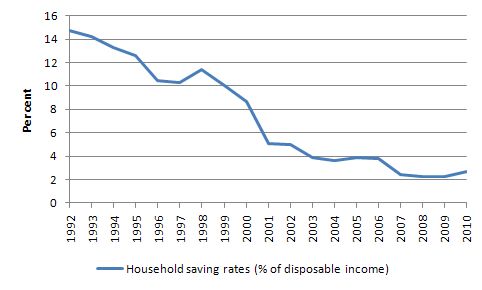
 Japan fascinates Our Man, in part because they were the first country into a debt-deflationary spiral and there’s a reasonable chance that they may be the first country out of it.  What’s intrigues Our Man is that two of the pillars of Japan’s strength, its savings rate and trade surplus, are both fast waning.  The savings rate has been steadily declining from over 15% in the early 1990’s to c2% today, and 2011 saw Japan’s first trade deficit in almost 50yrs.    Though all eyes are focused on Europe at the moment, Our Man’s guess is that it’s Asia (China or Japan) that will prove to be the interesting story of 2012.

- Corporate Margins & Valuation
While all the other ‘fingers of instability’ suggest risks to the global economies, it’s corporate margins and valuations that make the market particularly vulnerable.  While short-term measures (such as trailing P/E or the awful forward Operating P/E) suggest that the market is cheap/fairly valued they require the belief that the current level of margins (near all-time highs) are sustainable ad infinitum.  Perhaps they are, and we’re in a new paradigm but Our Man suspects that reality is that the elevated levels of margins offers more potential for downside surprise than upside opportunity.  While long-term measures of valuation are a terrible guide to any given year’s market performance, they do offer a valuable guide or map for real cheapness or value and they don’t suggest that the broad equity markets offer much in the way of absolute value.

Saturday, January 7

2012: Glimmers of Hope


Traditionally, at the start of each year, Our Man looks at some of the major things that could help or hinder the economy and markets during the upcoming year.  As such, here are this years Glimmers of Hope (see here for an explanation of the thinking behind Fingers of Instability and Glimmers of Hope), which looks at some of the things that could go right in the economy and drive markets higher.

- Monetary Policy and (lack of) Inflation
The largest stimulant to the market in 2012 is once more likely to be the action of central banks and their policies.  Perhaps, I’m just cynical, but it seems to me that the Federal Reserve (since the Greenspan days) is late to every issue and believes that they can all be solved through injecting liquidity.  As such, we’ve seen rates cut (to 0%), promises to keep them there for years, Large Scale Asset Purchases (aka Quantitative Easing 1, 2, Lite, etc) and even recent coordinated central bank actions to help provide liquidity.  With the make-up of the Federal Reserve’s Open Market Committee changing in 2012 to likely become yet more dovish, I’m fully expecting more of the same in 2012; promises to hold rates lower for longer, more asset purchases (QE3…) and probably some new fangled way to try and force longer-term interest rates to stay low (maybe they’re even reckless enough to sell options).  The ‘good’ news is we can probably expect monetary easing from everywhere else of note in the world!  The ECB is already lending to European banks at generous rates (1% p.a. for 3yrs), the Japanese were the first big users of QE, and the Chinese are likely to loosen policy in an attempt to stave off a hard-landing for their economy.  In short; the Central Bankers of the world agree – sell your bonds, and buy risky assets…please!  This plea and its impact on market participants psychology is what most worries Our Man, given his bearishness.

- ‘Constructive’ Government behavior (i.e. can-kicking)
In the US, while the two parties have shown no ability to solve any major problems by working together and with both parties having more incentive to disagree (it’s an election year, after all), it would seem like the possibility for constructive government behaviour is limited.  However, the government behaviour I’m expecting is not the “solving of problems” kind but the “let’s give things a bit of a sugar-high, so the economy is still weak (and thus Obama can lose) but not so bad that we don’t all get kicked out of office (so incumbent Republican congressman can keep their seats)” kind.  This is the type of compromise that leads to terrible long-term decisions, with faux compromises on a small short-term stimulus which will be paid for by some future (probably unspecified) cost cuts.   While these types of deals are not good for the long-term health of the economy, they can help stabilize things in the short-term and also support the equity markets.
In Europe, Our Man expects much more talk of Grand Plans, bazookas, and anything else that can keep sentiment up while only a limited amount of new money is provided (via the EMU countries, or IMF) to deal with budget issues and stave off defaults, Central Banks attempt to provide liquidity, and elected governments are replaced by IMF/EU-approved “technocratic” ones.
In China, with the economy slowing the government will no doubt do its best to try and reignite the credit-fueled boom, be it through encouraging banks to lend (directly or indirectly, through reducing reserve requirements) or other measures.

- Housing Market
It may have taken a while, but the moribund state of the housing market is acknowledged as a major issue problem by both the Administration and the Federal Reserve.  The importance of the issue can be seen in the constant rumors of an Administration plan on housing, as well as a recent speech by William Dudley (President of the NY Fed), which even offered his thoughts on potential solutions.  While there merit and effectiveness of the proposals can certainly be debated, it’s a step in the right direction.  Efforts to help reduce the problems in the housing market, if effective and well-thought out, would unquestionably help both socially and economically.

- Falling Unemployment (and rising incomes)
While there’s many flaws in the data (and its computation), it’s also clear that jobs data in the US is consistently improving, albeit at a slower pace than everyone (I think) would like.   Now perhaps this improvement slows or reverses later in the year and there are seasonal biases benefiting the data currently, but the declining trend in unemployment, positive revisions and increase in hours worked (which will, hopefully, feed through into incomes) is unquestionably good for the economy!  With companies being in a relatively strong position, if demand continues to hold up well, there is potential for this favourable trend to continue.

- China & an Asian soft landing
What if Our Man is wrong?  Just because nobody else has succeeded in controlling their economy, or transitioned from an investment-driven one to a consumer-driven one without going through major pains, it doesn’t mean that the Chinese won’t.  Perhaps they’ve just built a better mouse-trap for managing the economy than the rest of us…

- Valuation
This is a repeat from prior years’ lists..  Our Man continues to mutter that it’s an expensive market (and using longer-term measures it is) but if one only looks at short-term horizons (or uses current year P/E, or mutations of it…such as P/E based on Operating Earnings, or projected forward P/E, etc) then an argument can be made that the market is cheap.