Pages

Showing posts with label Fingers. Show all posts

Monday, January 21

2013: Fingers of Instability

Our Man recently looked at some of the things that could help the economy and markets in the upcoming year, now for some of the things that offer more concerning thoughts. 

- European debt problems (and recession?) 
While Draghi’s efforts have enabled Europe’s weaker countries to have continued access to the debt markets, they haven’t prevented a number of European companies from having tepid growth or falling back into recession.  The risk in Europe continues to be further political breakdown driven by the weak growth (or negative growth), especially if it persists in the stronger European core.  During 2013, some things to watch will be the elections in a number of countries (especially whether we see an anti-reform government in Italy, and what happens in Germany) and whether there will further unrest in the austerity countries (especially Spain and Greece). 

- China (and the rest of the BRICs)  
While China appears not to be a concern in the short-term, after growth picked up in Q4, there continue to remain question marks over the veracity of the data.  The other major concern over China’s growth is the aggressive government-sponsored/encouraged expansion of credit, and whether the sharp increases will feed through to higher NPLs.
  
- Japan  
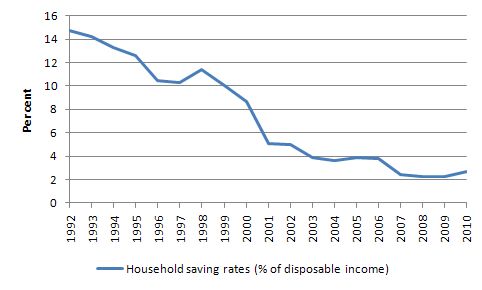
As Our Man remarked last year, Japan is fascinating as they were the first country into a debt-deflationary spiral and there’s a reasonable chance that they may be the first country out of it.  Both of the key pillars of Japan’s strength, its savings rate and trade surplus, continue to wane and the new government appears very inclined to pressure the BoJ into further QE by setting a specific inflation target.

- US Political Intransigence (or Incompetence)  
Over the last few years, one sad truth has been that we shouldn’t underestimate the incompetence of politicians in Washington.  While 2013 seems to have started on a positive trend, with a fiscal cliff deal and an agree to increase the debt ceiling in the short-term, there’s ample opportunity for the sequester and budget hijinks to result in no deal and a government shut-down, or one that has imposes much austerity too quickly and only succeeds in pushing the economy back into recession.

- Negative Contagion  
One of the great positives of 2012 was that we arguably saw positive contagion, where positive developments spilled over from one area to the next.  The risk in 2013 is of negative contagion, where negative events in one region impact the others; such as a slowing Europe exacerbate the problems in China and Japan, which combined with a budget stand-off helps pull the US towards recession.

- Global Trade & Protectionism  
A holdover from previous years!  For those who are historically minded, the steady decline of Global Trade and the rise of protectionism was one of the noticeable features of the 1930's depression in the US.  With so many countries facing growth headwinds, and attempting to encourage exports, the temptation for domestic politicians will continue to be to blame foreigners and the rhetoric about punishing “cheating” (i.e. trade surplus) countries will remain.  Let’s hope we don’t see an equivalent of the Kindleberger spiral for 2010’s!

- Demographics  
A long-term concern for Our Man is the weak demographics of the Western world.  While this is a major problem in Japan, China and many European countries, it’s also starting to impact the US.  In 2011, the US Birth Rate hit a historic low (it’s now about ½ the peak rate of the baby boom years) and the US fertility rate (1.9 children/woman) is now below the rate needed to maintain the current population.  Furthermore, the aging of the baby boomers will continue to have significant impacts on housing, employment and unemployment and investing.

- Corporate Margins & Valuation  
Another holdover from previous years!  While all the other ‘fingers of instability’ suggest risks to the global economies, it’s corporate margins and valuations that make the market particularly vulnerable.  While short-term measures (such as trailing P/E or the awful forward Operating P/E) suggest that the market is cheap/fairly valued they require the belief that the current level of margins (near all-time highs) is sustainable ad infinitum.  Perhaps they are, and we’re in a new paradigm but Our Man suspects that reality is that the elevated levels of margins offers more potential for downside surprise than upside opportunity.  While long-term measures of valuation are a terrible guide to any given year’s market performance, they do offer a valuable guide or map for real cheapness or value and they don’t suggest that the broad equity markets offer much in the way of absolute value.

Saturday, January 19

2013: Glimmers of Hope

Traditionally, at the start of each year, Our Man looks at some of the major things that could help or hinder the economy and markets during the upcoming year.  As such, here are this year’s Glimmers of Hope (see here for an explanation of the thinking behind Fingers of Instability and Glimmers of Hope), which looks at some of the things that could help drive markets higher.
  
- QE-Forever Everywhere and (the lack of) Inflation 
One of the interesting things about crises is that people’s time horizon reduces dramatically.  The aim for folks (almost everyone) becomes to try and limit the impact that they’re feeling (or going to feel) from the crisis, and insulate themselves from the results of the crisis.  For those in power (especially Central Banks and Governments) this results in a string of short-term focused decisions, whose sole aim is to end the crisis as quickly as possible so they can declare their mastery over it.  The downside is that little is done to resolve the underlying problems and it can result in the economy lurching from one crisis to the next, with each ‘successful’ resolution leaving the system more fragile than before.  Some of this can be seen in 2013, which has started with the proponents of Central Banks beginning to declare victory; Mario Draghi has been cheered for saving the Euro, the Fed have publicly committed to continue the QE-experience until either it succeeds (and unemployment falls to an acceptable level) or it fails (and inflation rises to an unacceptable level), and it appears like the BoJ will bow to government pressure and increase QE in an attempt to escape their deflationary trap.  Like 2012, the Central Bankers of the world continue to press the 'sell your bonds, and buy risky assets' line of thinking!  This demand and its impact on the psychology of market participants could well once again prove very supportive to the markets.
  
- Can-kicking Government behavior 
For Government’s the politically optimal way of dealing with crises, is to find a simple quick patch for the problem that pushes the difficult decisions off into the future (and hopefully, onto other folks) even if it means making the long-term issues worse.  This means different things in different countries.  In China, where the ‘crisis’ surrounds the potential slowing of economic growth, the response to any crisis that hints at slower growth (even if it might result in the rebalancing of the economy, which is a longer-term aim) is to increase government-sponsored investment even if the cost is greater overcapacity and a less balance economy.  In Europe, where the crisis revolves around weak government finances, the response is to create ever more complicated and intricate ways to extend, encourage or ease funding to the countries in trouble even if the likelihood of getting a return on that funding is limited, rather than restructuring the debts that are unlikely to be paid.  In the US, with a tax regime that fails to generate sufficient revenues and a spending regime dominated by non-discretionary item (defense, medicare, etc) there’s plenty of scope for short-term fixes (like the fiscal cliff deal) that do little to help resolve the longer-term imbalances.

- Housing Market 
As we mentioned in 2012’s Glimmers of Hope, the housing market was a potential source of upside.  If you look back at historical housing crises, it takes 6-8years (on average) for the housing market to stabilize and start to improve again.  Given that prices peaked in the US back in late-2006, it would suggest that we’re in the neighborhood of seeing (continued) improving prospects here.  While it’s not clear that that Government’s & the Fed’s efforts to reduce the problems in housing are well-thought out, it’s equally clear that any continued stabilization in the housing markets would unquestionably help both socially and economically.

- Global Economic Growth 
Could 2013 be the year that we return more sustainably towards trend economic growth.  There are certainly some positive signs.  In the US, a fiscal deal was agreed and it appears we’re going to have less uncertainty around the debt-ceiling.  In Europe, Draghi has ensured that European government’s will be able to fund themselves and has bought further time for them to see if there are any fruits to the austerity programs they’ve been running.  Finally, in Asia, China has managed to helped stimulate its economy through aggressive bank lending and Japan is discussing a far more aggressive QE program to help try to boost growth.

- State and Local Governments 
One of the consistent drags on the US economy since 2008 has been state and local governments, which have struggled with their own budget woes.  Unlike national governments, they weren’t able to increase deficits as easily and thus were consistent cutters of spending and jobs.  Signs towards the end of 2012 suggested that this trend is approaching its end and while State/Local governments might not be positive drivers of the economy going forwards, they will be likely stop being drags on growth.

- Falling Unemployment (and rising incomes) 
Of all the economic data that's out there, these are the two things that Our Man cares the most about - do people have jobs and do those jobs pay decently.  While there’s many flaws in the data (and its computation), it’s also clear that jobs data in the US is consistently improving, albeit at a slower pace than everyone (I think) would like.   Now perhaps this improvement slows or reverses later in the year and there are seasonal biases benefiting the data currently, but the declining trend in unemployment, positive revisions and increase in hours worked (which will, hopefully, feed through into incomes) is unquestionably good for the economy!  With companies being in a relatively strong position, if demand continues to hold up well, there is potential for this favourable trend to continue. 

- China & an Asian soft landing 
China continues to stimulate their economy whenever there’s the risk of a hard-landing.  While the figures and data coming out of China may be questionable, perhaps they’ve just built a better mouse-trap for managing the economy than the rest of us…

- Valuation
This is a repeat from prior years’ lists!  Our Man continues to mutter that it’s an expensive market (and using longer-term measures it is) but if one only looks at short-term horizons (or uses current year P/E, or mutations of it…such as P/E based on Operating Earnings, or projected forward P/E, etc) then an argument can be made that the market is cheap.

Saturday, January 21

2012: Fingers of Instability

Our Man recently looked at some of the things that could help the economy and markets in the upcoming year, now for some of the things that offer more concerning thoughts.

- European debt problems (and recession?)
In the absence of major Quantitative Easing from the ECB (see Glimmers), which would reflect a transfer of risk from the individual sovereigns to the Euro-collective, Europe’s debt problems are likely to continue apace in 2012.  However, unlike 2012, the uncertainty may spill over more into the real economy and if European banks retrench (which the ECB’s LTRO’s seem designed to prevent) and we could easily see a Europe-wide recession.  The knock-on effects of this both within Europe and globally, are likely substantially under-appreciated!

- Political (and Social) Instability
History suggests that political instability increases during economic downturns, and Europe is likely to see its fair share be it through more elected governments being replaced by unelected technocrats (see Italy and Greece), or some of these technocratic governments falling from power when it becomes clear their policies are (intentionally?) better for “the European project” than the people they’re supposed to represent.  For Europe, an economic recession (especially one that hits Germany and France) may make QE by the ECB more palatable, but it also increases the prospect of French/German citizens becoming less willing to support further bailouts for the PIIGS.   This of course, doesn’t even consider the further issues we’re likely to see in the Middle East (especially Iran) and Asia (North Korea).

- China (and the rest of the BRICs)
As I’m sure you’re all well aware, Our Mani skeptical of the Chinese growth miracle and believes that while they’ve mastered the art of creating GDP-growth but are failing to create wealth due to the credit-fueled malinvestment that’s driving the GDP-growth creation.  Rather than bore you with more of the same, I’ll point you in the direction of a previous post and leave you with one additional thought; in global recessions (and especially debt-driven depressions), it’s the trade surplus countries that suffer the most, as they’re more reliant on foreign demand and at risk as foreign countries try to support and protect their domestic industrial base (e.g. the UK suffered an 8-10% fall in GDP during the 1930’s depression, whereas the trade-surplus US suffered a GDP fall of 3x this!).

- Global Trade & Protectionism
On a related noted, and especially for those who are historically minded, the steady decline of Global Trade and the rise of protectionism, was one of the noticeable features of the 1930's depression in the US.  With so many countries facing growth headwinds, and attempting to encourage exports, the temptation for domestic politicians will continue to be to blame foreigners and the rhetoric about punishing “cheating” (i.e. trade surplus) countries will remain.  Let’s hope we don’t see an equivalent of the Kindleberger spiral for 2010’s!

- Japan
 Japan fascinates Our Man, in part because they were the first country into a debt-deflationary spiral and there’s a reasonable chance that they may be the first country out of it.  What’s intrigues Our Man is that two of the pillars of Japan’s strength, its savings rate and trade surplus, are both fast waning.  The savings rate has been steadily declining from over 15% in the early 1990’s to c2% today, and 2011 saw Japan’s first trade deficit in almost 50yrs.    Though all eyes are focused on Europe at the moment, Our Man’s guess is that it’s Asia (China or Japan) that will prove to be the interesting story of 2012.

- Corporate Margins & Valuation
While all the other ‘fingers of instability’ suggest risks to the global economies, it’s corporate margins and valuations that make the market particularly vulnerable.  While short-term measures (such as trailing P/E or the awful forward Operating P/E) suggest that the market is cheap/fairly valued they require the belief that the current level of margins (near all-time highs) are sustainable ad infinitum.  Perhaps they are, and we’re in a new paradigm but Our Man suspects that reality is that the elevated levels of margins offers more potential for downside surprise than upside opportunity.  While long-term measures of valuation are a terrible guide to any given year’s market performance, they do offer a valuable guide or map for real cheapness or value and they don’t suggest that the broad equity markets offer much in the way of absolute value.

Saturday, January 7

2012: Glimmers of Hope


Traditionally, at the start of each year, Our Man looks at some of the major things that could help or hinder the economy and markets during the upcoming year.  As such, here are this years Glimmers of Hope (see here for an explanation of the thinking behind Fingers of Instability and Glimmers of Hope), which looks at some of the things that could go right in the economy and drive markets higher.

- Monetary Policy and (lack of) Inflation
The largest stimulant to the market in 2012 is once more likely to be the action of central banks and their policies.  Perhaps, I’m just cynical, but it seems to me that the Federal Reserve (since the Greenspan days) is late to every issue and believes that they can all be solved through injecting liquidity.  As such, we’ve seen rates cut (to 0%), promises to keep them there for years, Large Scale Asset Purchases (aka Quantitative Easing 1, 2, Lite, etc) and even recent coordinated central bank actions to help provide liquidity.  With the make-up of the Federal Reserve’s Open Market Committee changing in 2012 to likely become yet more dovish, I’m fully expecting more of the same in 2012; promises to hold rates lower for longer, more asset purchases (QE3…) and probably some new fangled way to try and force longer-term interest rates to stay low (maybe they’re even reckless enough to sell options).  The ‘good’ news is we can probably expect monetary easing from everywhere else of note in the world!  The ECB is already lending to European banks at generous rates (1% p.a. for 3yrs), the Japanese were the first big users of QE, and the Chinese are likely to loosen policy in an attempt to stave off a hard-landing for their economy.  In short; the Central Bankers of the world agree – sell your bonds, and buy risky assets…please!  This plea and its impact on market participants psychology is what most worries Our Man, given his bearishness.

- ‘Constructive’ Government behavior (i.e. can-kicking)
In the US, while the two parties have shown no ability to solve any major problems by working together and with both parties having more incentive to disagree (it’s an election year, after all), it would seem like the possibility for constructive government behaviour is limited.  However, the government behaviour I’m expecting is not the “solving of problems” kind but the “let’s give things a bit of a sugar-high, so the economy is still weak (and thus Obama can lose) but not so bad that we don’t all get kicked out of office (so incumbent Republican congressman can keep their seats)” kind.  This is the type of compromise that leads to terrible long-term decisions, with faux compromises on a small short-term stimulus which will be paid for by some future (probably unspecified) cost cuts.   While these types of deals are not good for the long-term health of the economy, they can help stabilize things in the short-term and also support the equity markets.
In Europe, Our Man expects much more talk of Grand Plans, bazookas, and anything else that can keep sentiment up while only a limited amount of new money is provided (via the EMU countries, or IMF) to deal with budget issues and stave off defaults, Central Banks attempt to provide liquidity, and elected governments are replaced by IMF/EU-approved “technocratic” ones.
In China, with the economy slowing the government will no doubt do its best to try and reignite the credit-fueled boom, be it through encouraging banks to lend (directly or indirectly, through reducing reserve requirements) or other measures.

- Housing Market
It may have taken a while, but the moribund state of the housing market is acknowledged as a major issue problem by both the Administration and the Federal Reserve.  The importance of the issue can be seen in the constant rumors of an Administration plan on housing, as well as a recent speech by William Dudley (President of the NY Fed), which even offered his thoughts on potential solutions.  While there merit and effectiveness of the proposals can certainly be debated, it’s a step in the right direction.  Efforts to help reduce the problems in the housing market, if effective and well-thought out, would unquestionably help both socially and economically.

- Falling Unemployment (and rising incomes)
While there’s many flaws in the data (and its computation), it’s also clear that jobs data in the US is consistently improving, albeit at a slower pace than everyone (I think) would like.   Now perhaps this improvement slows or reverses later in the year and there are seasonal biases benefiting the data currently, but the declining trend in unemployment, positive revisions and increase in hours worked (which will, hopefully, feed through into incomes) is unquestionably good for the economy!  With companies being in a relatively strong position, if demand continues to hold up well, there is potential for this favourable trend to continue.

- China & an Asian soft landing
What if Our Man is wrong?  Just because nobody else has succeeded in controlling their economy, or transitioned from an investment-driven one to a consumer-driven one without going through major pains, it doesn’t mean that the Chinese won’t.  Perhaps they’ve just built a better mouse-trap for managing the economy than the rest of us…

- Valuation
This is a repeat from prior years’ lists..  Our Man continues to mutter that it’s an expensive market (and using longer-term measures it is) but if one only looks at short-term horizons (or uses current year P/E, or mutations of it…such as P/E based on Operating Earnings, or projected forward P/E, etc) then an argument can be made that the market is cheap.

Monday, January 31

2011: Glimmers of Hope

The counterpoint to Fingers of Instability is Glimmers of Hope (see here for an explanation of the thinking behinds Fingers of Instability and Glimmers of Hope), which looks at some of the things that could go right in the economy and drive markets higher.

- Private Sector to drive GDP growth 
While Our Man believes that the underlying problem in the US (and other places) is primarily a solvency issue, the Government and the Fed believes that through increased fiscal spending and liquidity (i.e. QE1, QE-lite and QE2) they can help provide an escape valve.  In essence, QE and fiscal stimulus have supplied liquidity to the market to help boost GDP and asset prices.  This has provided support for the private sector, allowing it time to repair its balance sheet and rebuild confidence in the economy.  The underlying hope is that with confidence rebounding and balance sheets in better shape, the private sector will be able to take over the leadership in driving GDP growth and balance sheets can be further repaired as a function of this growth.  The Q4 survey data showed the first hints of truly positive data points, and this was supplemented by the Q4-10 GDP data which saw Real Final Sales leaping to 7%+ annualized from the 1-2% run-rate since the recession ended.  (Tim Duy has other morcels of good news from the recent Q4-10 GDP data)

- QE2 & the Wealth Effect
The other aim of Quantitative Easing has been to help US households rebuild their balance sheets & net worth, primarily through rising equity prices and the attempt to curtail the fall in house prices.  The additional hope is that a rising market will further help build confidence in the economy by boosting investors’ “animal spirits”.  Should this prove successful, there’s the possibility of the strong market performance (since QE2 rumours abounded during late-Q3) turning into a melt up.

- Falling Unemployment (and Rising Incomes)
It should go without saying that the best way for US households to repair the balance sheets and increase consumption is for them to be employed in jobs whose salaries are increasing!  With regards to the first part, Weekly Unemployment Claims still remain elevated by historical levels, but they have certainly declined from their peak.  This, coupled with hiring starting to edge up as the private sector gains confidence in the economy’s stability, has seen the economy start to produce net hiring over the last 6months.  While the numbers have been small, they have helped chip slowly chip away at the unemployment numbers.  While the second part of the equation has been quieter, Our Man think it’s fair to surmise real incomes are more likely to rise in a falling unemployment market than a rising one!

- China & an Asian soft landing
In much of a similar vein to last year’s Glimmers, perhaps Our Man remains just plain ole wrong on China.  Maybe they genuinely have built a better mousetrap in terms of this whole running an economy thing!  And if they haven’t, well they’ve shown a willingness and ability to throw money at problems whenever they arise.  While this may lead to longer-term imbalances and further misallocation of resources, it could certainly help 2011’s markets.

- Valuation
Like the prior note, it’s another repeat from 2010’s list.  Our Man continues to mutter that it’s an expensive market (and using longer-term measures it is) but if one only looks at short-term horizons (or uses current year P/E, or mutations of it….such as P/E based on Operating Earnings, or projected forward P/E, etc) then the market can look cheap.

- Constructive Government behaviour (in the US and Europe)
Stranger things have happened!  In the US, with a Democratic President looking to run for re-election in 2012 and the Republican’s having taken over Congress there is incentive for both parties to ensure the economy doesn’t suffer a reversal in the next year or two.  Who knows, perhaps they might even find their way to co-operating to do something constructive on Medicare/Medicaid and Social Security over the coming year or so.   In Europe, with Greece and Ireland having to be bailed out by their European partners, and Portugal seemingly next on the list, perhaps recent reports of a move towards investors having to take haircuts on their troubled bonds (i.e. reducing the debt burden, for those countries in trouble by making investors take a loss on their bonds) is the first step towards sorting out their sovereign debt problems.

Sunday, January 9

2011: Fingers of Instability

This is Our Man’s way of (exceptionally broadly, see here for an explanation of the thinking behind Fingers of Instability & Glimmers of Hope) applying the concepts of Bak-Tang-Wisenfeld’s sandpile model to how he thinks about investing

- Fraudclosure & the Housing Market
Residential construction has been an important driver in post-WW2 recoveries.  Unfortunately, there have been recent signs of a double dip in house prices and the underlying problem of too much supply/too many homes on the market has not been solved.   One of the ancillary factors that has been in the background is the “fraudclosure” scandal.  While the long-term impacts are unclear, what is clear is that there is greater doubt surrounding the ownership of homes (both foreclosed and not) in the US, which adds yet more uncertainty to the housing market. In all probability there’s unlikely to be any Federal moratorium on foreclosures, though a State-level moratorium (like we saw in the 30’s) is eminently possible. An interesting, but less talked about issue, remains that most of the Mortgage-Backed Securities vehicles (to whom the mortgages were sold) were enacted under NYS Law, where the dealer has to deliver to the mortgage notes to the trustee.   If the trustee doesn’t have notes, then the contract isn’t alive and is potentially uncollateralized which I’m certain will lead to all manner of legal arguments. 

- Property Taxes, and State & Local Government Finances
The unwritten story of foreclosures is the impact on property taxes, which will hamper state and local governments.  This is just another problem for cash-strapped states and local governments with a number of analysts predicting potential defaults in 2011 and the municipal bond market reacting negatively.  What does seem likely is that we’ll see some belt-tightening at the state level.

- European debt problems
During 2010 we saw bailouts for Greece and Ireland, what does 2011 hold for Portugal, Spain and Italy?  The Europeans have largely been resistant to burden-sharing (i.e. making bondholders take a haircut), instead preferring bailouts of troubled members, as this would force European banks to take losses and potentially raise fears concerning their stability.  It will be worth watching to see if there's any impact from the Irish election in March, where the opposition currently lead by double digits and are threatening to press for debt reduction.

-The make-up of the Fed and Politics
Ron Paul, author of “End the Fed”, is now the chairman of the sub-committee charged with overseeing the Fed which should prove for closer Congressional scrutiny and livelier hearings.  However, a more important change is in the voting make-up of the Federal Reserve; 2 of the new voting Federal Reserve Bank presidents (Charles Plosser, Philly Fed, and Richard Fisher, Dallas Fed) oppose QE and a third (Narayana Kocherlakota, Minneapolis Fed), is skeptical that it will work.   They replace three of the “doves” (Rosengren (Boston Fed), Pianalto (Cleveland Fed) and Bullard (St. Louis Fed), which may not make QE3 as inevitable as it currently seems.

-Inflation (in China)
Our Man has talked about inflation in China before, in large part because it presents great difficulties for the economic planners there.  The two biggest ways that the Chinese have been trying to control it is through raising rates and controlling credit expansion (directly, or indirectly via the banks’ reserve ratios).  However, both of these have the potential impact of slowing down their economy growth which has been a driver of Global growth (and especially commodity prices) and is expected to grow at 10% (ad infinitum!).  Furthermore, given the possibility of a credit-driven bubble in Chinese property are the Chinese about to discover (like their Western peers) that it’s not easy to engineer a soft-landing from a credit boom?

- Global Trade, Protectionism & Emerging Asian Economies

For those who are historically minded, the steady decline of Global Trade and the rise of Protectionism, was one of the noticeable features of the 1930's depression in the US.  With many seeing Quantitative Easing (QE) as an attempt to weaken the dollar, others accusing China of currency manipulation and most countries still hoping to drive GDP gains through increases in exports, it is little surprise that rhetoric surrounding trade wars continues to increase.  Let’s hope we don’t see an equivalent of the Kindleberger spiral for 2010’s!


- Valuation
Though market participants always seem to manage to call the market ‘cheap’, from Our Man’s perspective the market does not appear cheap based on long-term measures.  Both the Shiller CAPE ratio (currently 22x vs. a historical average of 16.5x), and the Tobin’s Q (Q3-end 1.05x vs. a historical average of 0.70x) suggest that markets are over-valued.  While these long-term measures have not helped investors time the markets, they have served as good long-term guides to valuation and are worth noting.

Sunday, January 3

2010: Fingers of Instability

The first few fingers relate to the possibility of Banks suffering from “rolling waves of defaults” (Our Man thinks Mike Mayo, of Calyon Securities and formerly Deutsche Bank coined the term a couple of years ago).  Our Man suspects that most of the cases below bear conceptual similarities to sub-prime in that the risks are well understood by the market but that the consequences (especially the secondary and tertiary impacts; as a result of parceling out of risk from the banks to other investors) are not fully appreciated.

- Commercial Real Estate
The weakness of CRE is well-known, with the Moods/REAL Commercial Property Price Index down 44% from its October 2007 peak and reaching levels last seen in August 2002.  Given how well-known the decline is, the general assumption is that defaults will have limited impact on the markets.  With only a limited number of defaults so far, an estimated $1.4trn of CRE debt scheduled to mature over the next 5-years and 50%+ of it underwater (per Foresight Analytics), Our Man thinks we’ve yet to see how this one plays out.

- Residential Real Estate:
While Our Man thinks it is fair to say that most believe that the residential estate issues are behind us, his opinion is that we’re sitting in the midst of a lull period between the first wave of issues and a second wave.  Unfortunately, while the FED/Treasury has done a fine job in delaying (or ‘extending and pretending’, if you’re feeling less generously inclined) defaults and trying to maintain home prices (think HAMP, first-time tax buyer’s credit and it’s extension and expansion, FED buying mortgages, Treasury backstopping Fannie & Freddie, etc), Our Man is of the opinion that this is all it is…delaying.  Things he worries about in Residential Real Estate world are:
 a). The recast schedule for Option ARMs (which is when the payment changes, to reflect full amortization as well as interest payments). 
Given the predominance of homeowners (analysis from S&P, Moodys, etc suggests they are in the 80%+ range) who’ve been paying only the minimum payment (i.e. interest-only), the jump in payment (to include amortization over the remaining term of the mortgage) is far more important than the impact of a change in rates (known as a “reset”).  The difficulty is knowing when the recast will happen, as it will happen at either at the time of the reset (generally 5-years after the mortgage was taken out) or when the negative amortization cap (normally 125% of the original principal balance) is reached.  Given the level of minimum payments being made, it is likely that recasts will happen before the reset schedule.

b) Prime Mortgages default rates well above historic norms.
Our Man can hear you snickering in the background at this one, after all Prime Mortgages are the good stuff and have been around long-before all this financial shenanigans began so we can data-mine and know how they’ve defaulted historically.  However, Our Man notes that the standard (pre-2003) DTI (Debt-To-Income) ratios were 28% (for housing, 33% for Jumbo loans) and 36% (for total debt) and were based (largely) on documented income.  Post-2003, they could be anything up to 50% and in many cases (data varies from 35-50%+of Prime/Jumbo Prime loans) were based upon limited documentation (which Our Man is willing to bet is because the borrowers didn’t have their stated income).   Given these 2 changes; Our Man isn’t certain that the historical data will be an accurate guide to future problems.

 - Bank Lending (general) and Consumer Deleveraging
Our Man has already mentioned that he thinks Bank Lending & Consumer Deleveraging will prove to be the key factors in the coming months (perhaps years).  The reason is simply that they stand at the hub of the primary debate, will the FED's 'quantitative easing' cause inflation or will we see continued deleveraging from an over-levered consumer causing deflation.

- Sovereign Risk
Dubai & Greece have hit the headlines recently, there have been additional worries over Spain and Ireland during the year, Short Japanese Government Bond trades are being put back on (again!) as their Debt/GDP goes through 200% and there’s been a lot of muttering over the last couple of months about how US rates will have to rise substantially (though Our Man's L Treasury position is clearly a wager that this will not be the case), will there be more tumult (especially across Eastern Europe, Italy and Our Man's homeland) to follow.

- Monetary Tightening
While Our Man would be surprised if the FED Funds rate went up any time soon (in part since many blame the FED for raising too early during the Great Depression causing the relapse; though Our Man's view this is that it's a tad hopeful to try and solve a major solvency crisis by injecting liquidity, and then being shocked that the underlying solvency issues remain when the liquidity is removed).

- China
“The Chinese government…are executing their eleventh ‘five year plan.’ They do exactly what they say they will do. They will likely be the biggest economy in the world someday. Man, these guys are good.” - Jeffrey Immelt, CEO of GE, following a speech at WestPoint earlier this month. 
The point of the quote isn't mean to disparage Jeff Immelt (who in OM’s opinion has done a fine job, given the abysmal quality of the hand dealt to him by Jack Welch) but more to display what's the prevailing conventional wisdom China be it from business folk or finance experts (like Nomura's Richard Koo, an expert on Japan) -- China can do no wrong & will grow at 10%+ forever (ok, maybe that’s a touch of hyperbole).  Sadly, Our Man fears reality is never like that...and notes that in addition to  mass certainty in an outcome (house prices never go down & Tech is the new paradigm (and so deserves a new valuation model where profitability doesn't matter) the other 'best' indicator of an asset bubbles is loose credit conditions (and he'd certainly call China's loose). 

- Terrorism
Enough said.

- Global Trade, Protectionism & Emerging Asian Economies
For those who are historically minded, the steady decline of Global Trade and the rise of Protectionism, was one of the noticeable features of the 1930's depression in the US.  That threat is clearly present today (see this week's decision by the US ITC) and will only become more tempting for US firms/ politicians/ people to demand should the recovery prove sluggish.  With so many Asian economies relying on export driven demand (to Japan, Western Europe, and the US), and gearing their industrial production to a pick-up in this demand, the rise (or not) of protectionism home & abroad could be a vital factor.

- Valuation
 From Our Man’s perspective, the market is not cheap; currently, based on the Shiller 10yr P/E ratio, the S&P trades around 20x, which is above the historical average (c16.5x).  Furthermore, Our Man notes the persistent overvaluation of the S&P over the last 20years and despite expectation of a V-shaped recovery, his simple model (using the very generous assumption of $75+ Earnings for the S&P 500 in 2010) the S&P’s multiple looks set to climb next year (towards 22x) even without an increase from the present S&P level.

Monday, December 28

Fingers of Instability & Glimmers of Hope -- An Explanation

This is Our Man’s way of (exceptionally broadly) applying the concepts of Bak-Tang-Wisenfeld’s sandpile model to how he thinks about investing. While Our Man has no physics background, he’s stumbled across various descriptions of the game (most clearly in “Ubiquity” by Mark Buchanan, which he recently re-read), and found the idea fascinating and most helpful as a discipline in thinking about the world.

So what’s the idea and what does this have to do with investing?
Bak, Teng & Wisenfeld model stems from their investigations into the instability of complex systems, and their discovery was that these systems tended to naturally arrive at a “critical state”, after which any sand grain landing in the wrong spot can start an avalanche. Furthermore, the size of the avalanche is the result of a domino effect – how unstable was where the grain landed, and did the resulting slide cause grains to move over other unstable spots thereby creating more slippages, etc. Clearly the number and size of the “fingers of instability” that are impacted (primarily, and as an after-effect) by that falling grain of sand will play a key role in determining how large the eventual avalanche will be.

Fascinatingly, Bak-Teng-Wisenfeld discovered a mathematical property connecting the number of grains involved in an avalanche and the frequency of an avalanche of that size. Simply put, if you doubled the number of grains involved in an avalanche it becomes about 2.14x as rare. Moreover, the presence of a power law, critical state, and fingers of instability appears to be more widespread; for example, in Ubiquity, Buchanan talks about how similar properties are found in the size of earthquakes, forest fires, scientific paper citations (as a proxy for “new” scientific ideas), deaths in wars & last (but not leastly) stock price fluctuations (though Benoit Mandelbrot deserves a big nod for his works on that specific topic, but Our Man shall leave that for another time).

As such, in an attempt to impose some discipline over his thought process, Our Man hopes to jot down some of the Fingers of Instability (that could drag stock markets downwards) and Glimmers of Hope (that could drag it upwards) to: help him remind himself what he was worried about at the start of each year, to provide a guide of things to keep an eye on during the year, and to look back on in futures and see what he missed & why. It should be noted that these lists are absolutely 100% NOT predictions (it’s a mug’s game) but are things that Our Man is watching out for, worried about, or hoping for – if other people call something a “Black Swan” (something, along with 20-standard deviation events, that Our Man doesn’t believe in) and it’s not on Our Man’s list, he just missed it…