Pages

Monday, March 16

Portfolio Update: No Más!

Our Man followed through with the things on his docket last week, reducing the portfolio’s exposure about 8-10% above Thursday's market bottom.  Frankly, OM hopes it’s a decision that looks abysmal in the future, since that likely means that COVID-19 came and passed quickly with limited impact.

The primary rationale for it was a combination of material year-to-date losses, increasing evidence of the West’s questionable handling of the COVID-19 outbreak, and the increased uncertainty caused by COVID-19.  
  • The losses began with Shipping’s sell-off in January and accelerated last week, as emerging market indices collapsed.
  • It appears that most of the Western governments were caught off-guard by the spread of COVID-19, and reacting to events rather than having proactive plans.   Bizarrely, the UK is an exception; it has a very clear plan though it is highly controversial and has been at least partially misunderstood.   If you’re in the UK you must read Azeem Azhar’s newsletter post on it.  If you're not in the UK, you should read it anyway.
  • The uncertainty around COVID-19’s impact is worth discussing as ideally one should be a buyer in weeks like last week when there is “blood in the streets”.  The argument for buying now is that this too shall pass, and numerous high quality stocks cheap on historical (or post-COVID-19) earnings.  Thus buying today is right, even if there’s another 10-20% downside, as these names will be markedly higher in 12-months’ time.  Normally, OM would nod in agreement.  However, with COVID-19’s spread to Europe and the Americas, the weak response and the potential multiple week lock-downs ahead OM believes the range of outcomes is exceptionally wide.  In the best case, it will look like nothing more than your typical economic or market slowdown and OM’s decision will be costly.  However, the impacts of a prolonged lock-down are non-linear; too many (both large and small) businesses have too thin margins, too many fixed costs, and too much debt to be able to survive with limited revenue for that long.  That starts to raise questions of the health of the economy we'll come back to post COVID-19.  OM suspects that in many scenarios, the solution is going to look a lot like MMT.

Portfolio Changes
The planned reductions to the portfolio were discussed in the previous post but were:
  • Technical Book:  The Technical Book’s sell signal flashed in the final days of February, but OM waited for a meaningful bounce that never really came.  He exited it at the close (thankfully!) on Friday, but the delay (vs. the first trading day of March) cost a couple hundred bps!
  • Greece:  OM cut this back materially.  It was the only particularly hard decision in the reduction of exposure.  The new government in Greece is largely doing very good job, including their fast response to COVID-19, but it doesn’t matter.  The economic rebound is going to be tested by COVID-19’s impact on tourism among other things, and Greek equities are going to get limited attention from investors.  The Greece ETF is trading below the levels when folks thought the country was run by a Crazy Leftist and about to leave the euro for the drachma.   This is why it’s still the 2nd largest position in the book.
  • Brazil, India & Vietnam:  Both Brazil and India saw their first COVID-19 cases during the week, which led to OM to slightly increase his reduction in those positions.  Longer-term, Vietnam continues to a beneficiary of broadening supply chains but was also reduced.
  • SaaS & Uranium:  The exposure to the older ETFs was cut back.  There are some more recently launched ETFs that better fit the theses, and OM will be adding these when the moment comes.  OM also trimmed back the JD.com position, which is up for the year.

OM also bought some more crude and oil product tankers!
In the week since OM’s last post on Shipping, Saudi Arabia and Russia started an all-out price water which saw oil prices tumble 30%+.  The combination of the attractiveness of storing crude & oil products and the Saudis hitting the bid on every VLCC tanker they could find saw tanker rates rise 4-8x last week!  This is the start of the low season, but instead rates are printing at all-time highs; there are ships that are literally making a year’s worth of income in a single 45-day voyage!!  OM added some Double Hull Tankers (DHT, crude tanker company with a fleet of VLCCs) but didn’t get filled in his attempt to buy Teekay Tankers (TNK).  If these rates continue and the stocks don't reflect it, expect OM to continue to keep buying more of his existing positions (and TNK) till he hits 25% NAV.    Given the cash flow that these companies are going to throw off in Q1 and Q2, OM is happy keeping this position at a much higher size though he’ll be selling lots of the rest of the portfolio to keep overall risk in check.  OM exited the existing position in Navigator Holdings (NVGS), which is focused on liquid natural gas not crude and oil products.


Portfolio (as at 03/13/20 - all delta and leverage adjusted, as appropriate)
Dislocations: 31.0%
17.9% - Shipping (STNG, DSSI, EURN, DHT and NVGS)
9.9% - Greece (GREK, ALBKY, and EGFEY)
3.2% - Uranium (CCJ and NXE)

Thematic: 15.1%
5.2% - Tech 4th Industrial Revolution (JD & WCLD)
3.4% - Vietnam (VNM)
3.3% - Brazil (EWZ)
3.2% - India (INDA)
0.0% - Blockchain/Crypto (no positions)

Technical: 0.0%
0.0% - OEW Technical positions (DDM, SSO, and QLD)

Idiosyncratic: 16.9%
14.2% - Funds (ARTTX, CWS, GVAL, and CAPE)
2.6% - Equities (TPL)

Shorts/Hedges: 0.0%

Cash: 37.1%


Disclaimer:  Nothing above represents a recommendation in any way, shape or form so please don’t even think of trying to take it that way.  For added clarity, while Our Man is invested in all of the securities mentioned that’s a terrible reason for anyone else to do so.  Our Man also holds some cash and a few other securities (of negligible value).  You should not buy any of these securities because Our Man has mentioned them, but should do your own work and decide what’s best for you given your own circumstances/risk tolerance/etc. 

Tuesday, March 10

COVID-19 and Portfolio Thoughts

Well, that was a fun! *sarcasm alert*

Our Man isn’t a doctor and, unlike far too many in finance and politics, he doesn’t even want to play one on TV! It says far too much about today’s world that the most sensible thing about COVID-19 from a non-expert came from the manager of Liverpool FC!


Thus OM isn’t going to opine on the spread of COVID-19, how you should deal with it, and what the various estimates of the virus’s potential R0, incubation period and case fatality rate are or what they might mean.  If, like OM, you work at a smaller company he will point you in the direction of Elad Gil’s primer and if you want to start thinking about the broader economic effects of a pandemic then Professor Wren-Lewis has you covered.   The three things OM will note is that so far we’ve learned:
  1. Strict containment works in limiting COVID-19’s spread (see Singapore)
  2. Aggressive and broad testing helps identify early who to isolate in order to prevent the virus' spread (see South Korea).
  3. Western countries have, so far, been slow to do both of these things.

Instead OM is going to talk about is the market and some forward looking thoughts, as well as what it might mean for the portfolio. 

While COVID-19 originated in China, it was largely ignored by Western markets until the end of February, which coincided with (was caused by?) a sharp rise in cases in the West. The subsequent correction has been swift, sharp and brutal.   The largest factor in COVID-19’s market impact is the uncertainty – how far will it spread, how bad or deadly is it, and how much impact will it have on the economy and life. In the absence of high quality data, and limited trust in leadership and institutions (WHO, Chinese Government, CDC, etc.), the range of outcomes is wide and it’s often the loudest, not the best placed, voice that holds court. After not affecting the markets for ~6 weeks, this uncertainty quickly became doubt and fear.  In such times, investors go where they feel safest and to what has worked previously – especially government bonds. In the US equity markets, that has been Software and especially Software-as-a-Service, which ended February +7% for the year.

Since COVID-19 started in China, OM will be watching to see the resumption of normality there first.  Like all systems, China’s is incentives based - watch what the government does not what it says. OM is doing that by stealing Bill Bishop of Sinocism’s playbook for signs of China declaring victory.   OM doesn’t expect to be a buyer of much until we at least start to see:
  • Xi visit Wuhan
  • The Two Sessions is re-arranged
  • Kids are sent back to school
OM’s operating assumption is that the uncertainty is the West will linger until there is greater clarity on COVID-19’s spread and impact, and the stock market will reflect this.  The longer it lingers then the worse the economic impacts of COVID-19 will be.  Even at this stage, OM suspects we’re starting to approach the point where we need both fiscal and monetary stimulus and the much like in 2008, it’s not going to come (in enough size) immediately.  Finally, the UK with an emboldened Prime Minister, a new Chancellor and a new Governor of the Bank of England might even be the first country to go full MMT on us!

So what is OM doing with the portfolio?
Unfortunately, nothing so far. 

Here are the things on his docket for the coming days/weeks:
- Technical Book: It saw its sell signal near the end of February.  Real-life issues meant OM failed to exit it during last week’s bounce, he won’t be so remiss next time.

- Uranium:  Though it has largely held up pretty well, OM is looking to exit the Uranium ETF (URA) position that is about 50% of the uranium exposure.  This reflects the reconstitution of the ETF to provider broader uranium exposure, and not just to the miners.  OM’s thesis is focused on the miners and a new more appropriate ETF (URNM) launched at the tail-end 2019.  Expect the capital to end up there eventually.

- Emerging Markets exposure:  OM has a LOT of it – Greece, Vietnam, Brazil and India are ~40% of the portfolio.  Irrespective of the long-term outlook, in times of financial stress emerging markets are never the place to be and OM will be trimming this exposure back.  This was not an unknown risk, and he should have been more proactive much earlier in the year!

- Software-as-a-Service: is largely flat on the year, despite everything.  OM suspects that it goes one of two ways from here: 
(i) COVID-19 fears are quickly dispelled and Software becomes that mythical investment; it protected when there was huge uncertainty and is also growing rapidly.  If so, OM expects to hear justifications that surely such a business, which was valued at 10x Sales before the model proved itself in times of economic stress deserves a higher multiple still?  And so, a real bubble shall have its narrative (and crypto as the logical extreme of this concept will go crazy).
(ii)  Or perhaps SAAS stocks are just 2020’s version of commodity stocks in 2008 – bullet proof and up healthily in mid-2008, until they collapsed to end the year down ~80%.  If so, they’re probably an attractive buy with far far better valuations at that point!  
Either way, OM will be exiting his position in the broad Software ETF (IGV); originally, it was the best of the bad proxies for SaaS.  OM would rather add capital to the existing position in the WisdomTree Cloud Computing ETF (WCLD), a recently launched SaaS-specific ETF, when it becomes clearer which path software will take.

- Shipping:  Oh shipping, that beautiful delightful hot mess.  See the most recent post!


Disclaimer:  Nothing above represents a recommendation in any way, shape or form so please don’t even think of trying to take it that way.  For added clarity, while Our Man is invested in all of the securities mentioned that’s a terrible reason for anyone else to do so.  Our Man also holds some cash and a few other securities (of negligible value).  You should not buy any of these securities because Our Man has mentioned them, but should do your own work and decide what’s best for you given your own circumstances/risk tolerance/etc. 

Saturday, March 7

Shipping, wtf?

Almost 50% of Our Man’s losses in January and February came from the Shipping positions.  There's a broader post on OM's thoughts coming, but here’s a follow-up to the recent post on shipping.

COVID-19 was identified in January in China and there was a sharply bifurcated reaction in the market.  Initially, Western markets generally held-up well, but economically sensitive stocks exposed to China were dramatically impacted, before markets tumbled in the second half of February.  For example, energy names started falling in mid-January and continued to collapse in February; the S&P Energy Sector lost ~12% in January and then another ~15% in February.  In many cases, the losses in these sectors and stocks were at odds with fundamentals, which brings us nicely to Shipping!

Before we start, some things pulled from the last Shipping post as a reminder of the context around OM’s position:
  • It’s a high conviction Dislocation position that is fully sized and ‘on the clock’.
  • It’s treated as a quasi PE-position in the portfolio. This means it’s not a position OM looks to trade and it’s sized such that he’s willing to absorb the mark-to-market losses as long as fundamentals don’t change. In the long-term, OM expects to be paid for this volatility.
  • It will require patience and will power.
  • Here’s the plan!
 So with that said, it was barely a month or so ago that OM said he wouldn’t be reacting to every 20-30% move in shipping with a post. But a 30-50% move in crude & product shipping prices in 8 weeks was not pretty and deserves a post! The chart below shows OM’s position size and the P&L contribution from tankers:


Why so bad so fast? 
  • Seasonality: It’s a very seasonal business!  Investors should compare rates to this time in prior years rather than what they were a week or month ago!  Rates started to fall from their highs in January and this seasonality seems to have caught a number of investors by surprise!
  • China & Coronavirus: Anything that is a first order impact of the economic slowdown in China was sold, and sold heavily. Oil is down 30%+ from its early 2020 peak, and OM gets it crude/product tankers are a small ugly levered sub-sector that has something to do with oil. 
Given this what is OM doing? 
Well despite the coronavirus, economic slowdown in China, collapse in oil price, etc. the shipping day rates have held up remarkably well.  The below chart is for Medium Range (MR) tankers, but the rates for other tanker types show broadly similar stories

Source: Hellenic Shipping News, Allied

To add further context, despite everything many those rates are at or close to 10-year highs!

Thus, so far OM has done nothing.  There’s a huge dichotomy between shipping rates and its implications for companies’ revenue, earnings and cash flow, and the stock price action.  The stock price matters, the P&L matters, but position sizing matters most! This is where having a plan – the research, time frame, and data points you’re tracking for buying/selling – really helps.

At February-end, OM was largely back to his cost basis in individual names, with the overall position size much reduced as a % of capital.  As long as rates continue to track above previous years, OM won’t be selling.  If the discrepancy continues to grow between the market’s implied valuation and the companies’ likely earnings, he’s far more inclined to buy more.  Maybe a LOT more.  The stocks are trading at 0.5-0.8x NAV (or less than 1.0x EV/GAV, to account for the leverage) and at these rates they are generating a ton of cash. It won’t be today, it likely won’t be tomorrow but the longer the dichotomy persists and the less the stocks appear like a falling knife, the bigger a potential position OM is willing to countenance eventually taking. 

So what is he thinking on the individual names:
  • Navigator Holdings (NVGS):  The one name OM will likely exit.  It is a liquefied gas transportation company not a crude/product transportation one.  Expect it to come out of the portfolio as OM focuses entirely on crude/product tankers.
  • Scorpio Tankers (STNG):  OM will probably not add to this one as it’s the most levered.   The leverage makes it the one most likely to run into problems if the COVID-19 impact is prolonged.  If the impact is not prolonged, OM expects it will also be the one investors flock back to.
  • Euronav (EURN): The safest name with a strong balance sheet, good management, reasonable operational leverage and is cheap (trading at 0.7-0.8x P/NAV and EV/NAV).
  • Diamond S (DSSI): Refinanced its debt out to 2024, is very cheap (0.45-0.6x P/NAV and EV/GAV) but it has a stock overhang (PE lock-up rolls off in March 2020) and management has underwhelmed.
  • Teekay Tankers (TNK): This is a name that OM will be adding to the portfolio to replace Navigator Holdings.  It’s a midsize crude tanker play that’s trading at ~0.75-0.85x P/NAV and EV/GAV, which refinanced its debt and during the first quarter.  Its results summed up the stock price/rates dichotomy; a $12.50 stock (at the time) earned over $2.47 for the QUARTER and is expected to earn over $2.60 for the upcoming QUARTER! Yes it is high season, and yes Q2 and Q3 won’t be close to as good - though analysts still expect them to be profitable - so the market really has to believe things are going to get a LOT worse.
In summation, OM suspects we’ll look back in a year or so and either have a good chortle about how inefficient markets can be or we’ll sadly sup our beers and commiserate about how foolish OM was!

Disclaimer:  Nothing above represents a recommendation in any way, shape or form so please don’t even think of trying to take it that way.  For added clarity, while Our Man is invested in NVGS, STNG, DSSSI and EURN and may invest in TNK - that’s a terrible reason for anyone else to invest in them.  You should not buy any of these securities because Our Man has mentioned them, but should do your own work and decide what’s best for you given your own circumstances/risk tolerance/etc. 

Monday, January 20

How OM Thinks about Sizing Shipping

Given the recent and likely ongoing volatility, OM wanted to talk about how plans on managing his Shipping positions.  As such, this post is primarily a way to help OM clarify his own thoughts and commit them to paper.    

An advantage of being in the investment world over the last 20-years is that OM has seen many otherwise intelligent and rational folks make appalling investment decisions. Typically, these decisions come at times of stress and often around the investor’s high conviction positions! These experiences mean that OM his keenly aware that it is as important to protect your mental capital as it is your financial capital when investing.

This is particularly the case for OM’s position in Shipping. It will be very volatile; the underlying supply/demand dynamics mean shipping rates will fluctuate significantly, the operating and financial leverage of the stocks will add to this and the terrible history of the sector means the marginal investor will initially focus too heavily on short-term data points.   For Our Man’s portfolio, this is magnified further due to the size of the position – it is indubitably the highest risk position in the portfolio. That is not an oversight. 

So how to deal with this volatility and the uncertainty it will naturally engender? 
First of all accept it is coming and be comfortable with the consequences of that.  Shipping will likely dominate the moves of OM’s portfolio over the coming weeks, months and quarters.  It will happen regularly and so OM will not be writing up every 20-30% move up or down in the stocks, or adjusting the portfolio for them.

Second, remember why you’re invested.  For Our Man, it’s a high conviction Dislocation position that is fully sized and ‘on the clock’ now that the catalyst (IMO 2020) to engender investor interest has occurred. The goal for Dislocation positions is that they return multiples of invested capital within a relatively defined time period. To capture the compounding required to generate this performance, OM treats them more like private-equity positions. This means, the positions aren’t really resized or traded unless (i) the long-term thesis changes or (ii) the capital at risk in the position goes beyond OM’s preset tolerance.  

Currently, OM’s view is that “too much” capital at risk would be 25-30% NAV in Shipping and 10% in any of individual names. However, if OM’s thesis is correct then these max capital at risk levels will slowly decline.  So while Shipping is currently OM’s highest risk position, he’s comfortable with the potential mark-to-market losses and expecting to be paid for that risk.

The difficulty of dislocation positions is that even after the ‘catalyst’ they require patience and will-power. This will particularly be the case in Shipping, and Bob Farrell’s Rule Number Four (10 Market Rules to Live By) sums up what to expect.

“Exponential rapidly rising or falling markets usually go further than you think, but they do not correct by going sideways” -- Bob Farrell

Third, have a plan!  A plan is a starting point, and it should change over time as circumstances and data change. Here are the key elements to OM’s plan.  OM is primarily focusing on the fundamentals - relevant crude/product tanker shipping day rates and how they show up in company earnings. He is most interested in the general level of rates and how they compare to prior years, and less so with the short term moves.  The short-term changes will likely be substantial and inconsistent, and overly focusing on them is how you destroy mental capital through obsessing about the trees but missing the forest.  Remember, for Dislocation investments the time horizon for the thesis is 18-24mos (max 30mos), in this case from Jan 2020, so the longer-term levels and their trends matters more. Secondly, Shipping is a very seasonal sector and so comparison to prior years is more important than vs. recent months. Obviously, strong day rates should lead to strong corporate earnings (and potentially dividends), which will help attract other investors.

Meanwhile, understand it is shipping and the crappy history that created the opportunity means that new(er) investors will be skeptical. It will take day rates being meaningfully and consistently higher than previous years, and the companies showing they’re not spending their free cash flow on more ships for the investor community to start to get very interested. Until then, every downturn in rates will lead to “it’s the end of the cycle” comments.  This is another factor that will only exacerbate the volatility in both directions.

Fundamentals will also be the simplest and most important way for OM to be proven wrong.  So expect him to exit if (i) the recent rise in shipping rates is brief and cyclical and then they consistently look like 2018/2019’s rates, or (ii) better rates don’t flow through to company earnings and free cash flow, or (iii) companies repeat the folly of past cycles and order new ships!

What could make OM sell if he’s right?
If OM is correct in his thesis then there are two ‘rules’ – on position size and holding period – for Dislocation positions in addition to any qualitative rationale, for reducing/exiting positions.   As mentioned about these rules are of a typical holding period of 18-24 months (and 30 months maximum) from the narrative changing event (IMO 2020 on Jan 1st, 2020), and OM has set the maximum position size he’s comfortable with at 25-30% today (and 10% per individual position) though both will decline as the thesis progresses.

Assuming the fundamentals continue to trend well, then the qualitative decision is based around price, valuation and sentiment.  The extreme limits of these are easy to specify; expect OM to be well out of these names when you start seeing the companies trading at multiples of NAV, or read/hear about shipping companies as “high dividend names” or that shipping day rates will stay at elevated levels for years (i.e. the sector is no longer cyclical). Finally, Our Man is also watching to see when the names are added to different ETFs. While the stocks will certainly benefit from the wall of passive money flowing into them it’s a strong signal that the end is near for Shipping as a dislocation position in OM’s portfolio*.

Conclusion
Our Man hopes that the three points above – accepting that Shipping will be volatile (and will drive the portfolio’s short-term moves), remembering why he’s invested, and having a plan – will help him manage the shipping positions over the coming quarters.  He’s also listed some of the fundamental and other qualitative factors he’s watching to try and help prevent thesis creep, so expect updates on these during the quarterly reviews.   Finally, if you ever hear OM talking about how Shipping cos are high dividend names…then less than politely ask him what the hell he’s doing and remind him of this post!!


* For future reference, today the stocks are barely owned by ETFs – STNG (3.3% of market cap is held by ETFs), DSSI (2.5%) and EURN (2.1%).  For comparison, large bell weather stocks (AAPL, GOOGL, FB, BA, GE, etc.) have ~10% of their market cap owned by ETFs and some stocks can have 40%+ of their market cap owned by passive investors.


Disclaimer:  Nothing above represents a recommendation in any way, shape or form so please don’t even think of trying to take it that way.  For added clarity, while Our Man is invested in STNG, DSSSI and EURN that’s a terrible reason for anyone else to invest in them.  You should not buy any of these securities because Our Man has mentioned them, but should do your own work and decide what’s best for you given your own circumstances/risk tolerance/etc. 

Saturday, January 18

2019: Fourth Quarter Update

Portfolio Update
- Added to Enterprise SaaS (Thematic: 4th Industrial Revolution):  Over the summer, Our Man lamented the lack of a good ETF that tracks Enterprise SaaS companies.  Well, late Q3 saw the launch of Wisdom Tree’s Cloud Computing ETF (WCLD) which uses the BVP Nasdaq Emerging Cloud Index, OM’s favorite Enterprise SaaS index, as its reference index.   Following a sharp pull back in these names in September, Our Man needed little encouragement to take a position.  The ETF is still very small (<$20mn) but in time expect it to represent the vast majority of the Enterprise SaaS theme.

- Added ARTTX (Funds):  Artisan Thematic Fund (ARTTX) is a thematically driven discretionary mutual fund with a focused portfolio.  OM has known the manager a while, thinks highly of him and currently the portfolio largely overlaps with the 4th Industrial revolution theme.  


Performance and Review
The final quarter saw the portfolio rise +13.3%, which finally outperformed both the S&P 500 Total Return (+9.1%) and the MSCI World (Total Return, Net Dividends; +8.6%).   This meant that portfolio ended the year at +28.3%, which is nestled between the S&P 500 Total Return (+31.5%) and the MSCI World (Total Return, Net Dividends) (+27.4%).


Fourth Quarter Attribution

Dislocation
Shipping drove the portfolio’s performance in the fourth quarter (+570bps), and was the second largest contributor in 2019 (~800bps). The Crude and Product Tanker positions (STNG, DSSI and EURN) represent almost all over the exposure, and were up over 30% during the quarter. The rise reflected very strong shipping day rates and increased media and investor attention as IMO 2020 approached. These rates were further helped by President Trump’s decision to sanction some Chinese firms, including affiliates of COSCO, for their role in transporting Iranian crude oil. The sanctions effectively blacklisted these firms’ ships reducing supply in an already tight market, and further helping drive rates higher.

Greece (+230bps) performed well during the quarter, rising as the Mitsotakis government continues to make positive steps on economic reforms and negotiations with Europe as well as engender goodwill.  Greece was the largest contributor to the portfolio in 2019, adding over 900bps.

Uranium (-15bps) continues to be a disappointment and cost ~120bps for the year.  While there continue to be positive fundamental signs in terms of supply/demand, and pricing being off its lows, there is little that has changed investor sentiment.  Investors have shown little response to the largest players cutting capacity and the IPO of Kazatomprom and OM is loath to increase the position size until there’s concrete evidence of long-term contracts at higher prices.

Thematic
The 4th Industrial Revolution theme (+120bps in Q4) was the most successful thematic position of the quarter and of 2019 (adding ~300bps).  The SaaS exposure generated ~57bps, rebounding in October and November from the weak performance over the summer before giving up some of the gains in December.  Public Cloud/SaaS companies ended the year at ~9.6x EV/Implied Revenue, which is at the high-end of their historical range, and saw reasonable multiple expansion over where they closed 2018.  The valuation, though well down on the highs of recent years (11.6x in August 2018) and the 10x+ multiples seen in the first half of 2019, would have to be much lower for OM to consider increasing the position.  The other position in the 4th Industrial Revolution basket is JD.com, which had a strong quarter with the company planning on listing its logistics business.

The positions in Brazil (+70bps for Q4, +150bps for the year) and India (+25bps in Q4, flat for the year) were both contributors.  The signs remain broadly positive on both fronts and given the long-term theses, OM wouldn’t be surprised to see them still in the portfolio in a few years’ time.

There were two negative contributors amongst the Thematic positions.  Vietnam (-10bps in Q4, though approx. +50bps in 2019) continued to drift as it has since Q1.  The VN Index generally headed in the same direction as the S&P 500 for most of the year, but this changed after the Fed’s October rate cuts when then VN Index pulled back.   Generally, there’s little changed with the long-term thesis with economic growth remaining strong (GDP of 7%) and 2019 seeing a substantially tightening in government bond yields.  However, there were some short-term cracks in Vietnam’s economic story that likely contributed to the fourth quarter weakness. The PMI fell below 50 and inflation rose above 5% (mainly due to pork prices), both for the first time in a number of years, and foreign investors were net sellers of shares for most of the second half of the year.  Finally, OM exited the remaining tiny piece of the Argentina (-2bps) exposure, which has been discussed previously.

Idiosyncratic & Technical
The Funds (+75bps in the quarter, +200bps for the year) performed solidly throughout the year, though their more global nature meant they lagged the S&P 500.  Texas Pacific Land Trust (TPL, +65bps in Q4, and +165bps in 2019) continued to perform well.  After settling with activist shareholders during 2019, the company’s Conversion Exploration Committee is working on ways to convert or reorganize the Trust into a corporation.

The Technical book (+201bps), with its exposure to leveraged equity indices, continued to contribute healthily as markets rose taking its contributions to ~400bps for the year. 

Portfolio (as at 12/31/19 - all delta and leverage adjusted, as appropriate)

Dislocations: 46.9%
23.1% - Greece (GREK, ALBKY, and EGFEY)
18.3% - Shipping (STNG, DSSI, EURN and NVGS)
5.5% - Uranium (URA, CCJ and NXE)

Thematic: 25.1%
8.6% - Tech: 4th Industrial Revolution (JD, IGV & WCLD)
5.7% - Vietnam (VNM)
5.5% - India (INDA and SCIF)
5.0% - Brazil (EWZ)
0.0% - Blockchain (no positions)

Technical: 22.6%
22.6% - OEW Technical positions (DDM, SSO, and QLD)

Idiosyncratic: 15.6%
12.3% - Funds (ARTTX, CWS, GVAL, and CAPE)
3.3% - Equities (TPL)

Shorts/Hedges: 0.0%

Cash: 1.1%


Disclaimer:  Nothing above represents a recommendation in any way, shape or form so please don’t even think of trying to take it that way.  For added clarity, while Our Man is invested in all of the securities mentioned that’s a terrible reason for anyone else to do so.  Our Man also holds some cash and a few other securities (of negligible value).  You should not buy any of these securities because Our Man has mentioned them, but should do your own work and decide what’s best for you given your own circumstances/risk tolerance/etc. 

Friday, November 22

Dislocation: Shipping Thesis - Update

A long update on shipping as Our Man took advantage of the pullback in product and crude tankers, and the increasing proximity of IMO 2020, to increase his Shipping position to 15% at the end of Q3. 
Unless IMO 2020 proves to be a completely damp squib (think Y2K!), it’s a position that Our Man doesn’t expect to trade much for the next year or so. However, should tanker companies start to trade at multiples of NAV or you hear people mention them as “high dividend” stocks let Our Man know, as it will definitely be time to get out of dodge! 

An update to the broad rationale for the thesis is below, though OM will spend less time talking about IMO 2020 and its impacts (see this piece for more on that).

Also, while the thesis holds broadly true for shipping generally, OM’s investment is in Crude Tankers and Clean Product Tankers** and so the below is focused on those.


------------------------------------------------------------------------------------------------

MASSIVE CAVEAT EMPTOR
Shipping is a terrible industry to invest in!
It is a cyclical business with high fixed costs and low operating costs that leads to ugly economics.  Where else could you lever up to buy an asset that has a 20-year life but which is only profitable for 6-8 quarters of that life cycle!  Historically, this has been compounded by largely untrustworthy management teams who have engaged in all kinds of self-dealing transactions!  Meanwhile, in shipping’s rare moments of profitability, lenders have been foolish enough to loan ship-owners more money and ship-owners have ordered yet more vessels.  This has led to an excess supply of vessels that destroys the industry’s future profitability!

So, what is OM doing and why now??
Well, the thesis is a fairly prototypical example of the type of dislocation OM likes; beaten-down stock prices, investor disinterest, attractive valuations and fundamental trends, and something that will change the narrative.

Shipping is a terrible business that’s been oversupplied for years leading to collapsing share prices, investors ignoring it and attractive valuations. This excess supply and subsequent losses led to bankruptcies/restructurings which saw lenders taking losses and equity issuance from the surviving companies and no capital to finance new vessels. Meanwhile, a major regulatory change (IMO 2020) is being enacted on January 1st, 2020 and will potentially cause further disruption to both supply and demand.

Our Man has discussed the attractiveness of optionality in investments before. In Shipping, the operational and financial leverage means that for all of the sector’s many warts, in those 6-8 quarters that a vessel is profitable you make so much $$$ that it pays for the entire vessel!  Our Man believes we are at one of those inflection points due to the combination of the companies already being around break-even, the constrained supply of new vessels, attractive pricing and trends, and the potentially disruptive impact of IMO 2020.

Background since the financial crisis
Since Great Recession, shipping has been a story of oversupply and bad rates! Whenever there were brief respites and shipping rates increased, investors lent money, ship owners ordered more ships, and rates got crushed as this new supply entered the market. Unsurprisingly, this led to falling stock prices, defaults and massive dilution for equity holders. It has also meant that many of the lenders to shipping companies (especially German banks/retail investors!!!) have exited the market.

OM’s largest position is Scorpio Tankers (STNG); this is what its stock price has done since its IPO in early 2010...
Source: Koyfin
Yup, that’s a fall from the $130 (split adjusted) IPO price to a low of $15 in late 2018!

Valuation
Unsurprisingly, after restructurings that saw debt holders suffer meaningful haircuts and further equity raises, investors have not been too keen on the shipping sector! Valuation reached an extreme in late 2018 and early 2019, when crude and product shipping companies traded for about 50-70% of their book value despite seeing stronger rates and with IMO 2020 on the horizon. Though the stocks have risen meaningfully since the start of the year, they still trade at a discount to book value. This is with rates still stronger than prior years and IMO 2020 only now starting to penetrate generalist investors’ consciousness.

Supply, Demand and Rates
As the chart below suggests, the order book for Crude tankers is near the lows of the last ~25 years and this dynamic is further improved by the increasing age of the fleet*. The story is the same for Product tankers, where the order book is the lowest (as % of the fleet) since March 2000. This discipline has largely been driven by shell-shocked management teams following the (often multiple) restructurings coupled with the limited new capital available to the sector.
Source: Clarksons, from Euronav October Presentation (Pg. 18)
On the demand-side, oil demand has grown incrementally by a couple of percent per annum over the last 2 decades and is projected to continue its slow growth for the next few years (the IEA predicts a plateau in 2030!).  More importantly there is a major structural change in the marginal exporter of crude and petroleum products, with the US taking over this role from the Middle East. The discovery of shale oil has led to the US being responsible for up to 85% of the global increase in oil production. This has seen US exports of crude oil double since the start of 2018.  Petroleum products show a similar story and should accelerate in 2020 as new pipeline capacity to refiners comes online. 


This transition to US exports really matters to shipping companies.
Why?  Geography
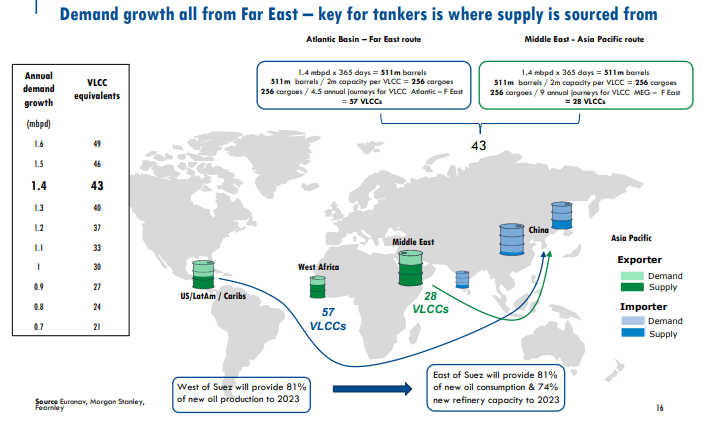
The key for crude and product companies is where supply is sourced.  It takes about twice as long for tankers to travel from the US to Asia, compared to from the Middle East and it requires twice as many tankers. As a ship-owner, that’s a meaningful increase in demand!  With the supply of vessels fixed in the short-term, and limited new vessels on order, even small changes in demand can have major impacts on rates.  Examples of this can clearly be seen historically;
Source:  Clarksons Research Services Ltd, Clarksons Platou Securities Inc.  From Marine Money presentation (slide 7)

The impact of these changes on rates has a material impact on profitability given the operating leverage (high fixed costs, low operating costs) inherent in the business model. For an example, take the example of the crude tanker company Euronav.  The chart below, from Euronav’s October investor presentation, shows management’s guidance on the impact on EBITA (a measure of profitability) of an increase in rates. OM will spare you the math, but the middle scenario below (with VLCC rates of $40K) would lead to earnings of ~$1.40/share on a stock that’s trading at $11 today. 
Source: Euronav October 2019 presentation (slide 8)

Given the tightness of the market, and the impact on rates, could rates go much higher than $40K for VLCC's??  Take a look at that rates chart above!

Something to Change the Narrative: IMO 2020
The improvements in the supply/demand, and the valuation support, make the shipping thesis interesting but it’s the possible disruption from and investor attention caused by the IMO 2020 regulations that leads to the outsized position.   What is IMO 2020? 
  • Well, it’s a new regulatory regime that prohibits vessels from using high-sulfur fuel oil (HSFO) unless they can capture the pollution causing materials.  The allowed sulfur content is falling dramatically from 3.5% to 0.5%.
  • There is no ease-in or adjustment period.  Jan 1st, 2020 is the drop-dead date for compliance.
  • Ship operators have a limited number of choices: Use low-sulfur marine gas oil (MGO), retrofit their ships to use liquefied natural gas, slow-steam (i.e. take longer to do a route, effectively reducing supply) or install scrubbers (to capture the pollution causing materials).
  • Scrubbers are a popular choice but are expensive ($1-10mn/ship) and vessels have to be dry-docked, and removed from service, for them to be fitted.   This temporarily reduces supply.
  • Given the costs of the various options for IMO 2020 compliance a number of older ships are expected to be retired, reducing the supply of vessels.
For crude and product tankers, in addition to the likely supply side impacts above, OM thinks that there will also be positive demand-side impacts!  There’s now a price on sulfur content in oil and this will likely cause changes in refinery demand, and oil trade routes.  If you want to read more on OM’s IMO 2020 thoughts, you can right here!


Some Risks To the Thesis:
A far from extensive list includes:
  • It’s shipping!  Did you not read the caveat emptor – it’s a terrible, horrible, no good, very bad industry.
  • A global slowdown could impact oil demand, meaning headwinds for both the companies and the stocks.
  • IMO 2020’s impact could be more akin to Y2K, meaning that rates wander around current levels.
  • Common perception is that an escalation in the 'trade war' between the US and China would be bad.  Our Man is a little more sanguine on that as trade wars mean the disrupting of old trade routes, and the creation of new and less efficient ones.

-------------------------------------------------------------------------------------------------------

* Vessels over 15yrs old have to be surveyed more frequently (2.5yrs vs. 5yrs) and the cost of this increases with the age of the vessel (~$4mn for a 20yr old ship vs. ~$2mn for a 10yr old vessel)

** Crude Tankers transport unrefined crude oil to refineries, and Product Tankers move the refined oil products (e.g. light petroleum products) to points near consuming markets.


Disclaimer:  As noted above Our Man holds positions in crude and product tanker companies, specifically he has positions in Scorpio Tankers (STNG), Euronav (EUR) and Diamond S Shipping (DSSI).

Saturday, October 19

2019: Third Quarter Update

Portfolio Update
- Added to Greece (Dislocation):  Greece is the Word…and OM took advantage of the pullback in Q3 to add yet more.

- Added to Shipping (Disruption):  OM sized up the positions in Product Tankers and Crude Tankers as we came towards the seasonally strong fourth quarter and the IMO 2020 regulations going into effect at year-end.  Expect to hear a LOT about Shipping!

- Reduced Uranium (Dislocation):  OM reduced the Uranium dislocation position, but trimming the ETF holding (URA).  While the medium-term prospects remain attractive, the expected catalysts have done nothing to change the narrative.  Though there are discussions for various long-term contracts underway, OM decided he’d prefer to wait with a smaller position until something starts to change the narrative.

- Sold Argentina (Theme): As discussed here, Our Man exited the entire Argentina position.

- Sold Blockchain (Theme):  Our Man exited the position in Overstock.  The key for this position was the “execution"; Overstock selling its retail business and for a decent price leaving a pure blockchain focused company, without the CEO Patrick Byrne’s ‘interesting’ side getting in the way.   Well, Byrne was full of surprises including stepping down as CEO and selling his stake, and when the new CEO almost immediately demurred on selling the retail business, OM didn’t hang around!   For all the investment’s volatility over the last ~9mos, it ended flat (almost to the dollar).


Performance and Review
The second quarter saw the portfolio fall -4.0%, which underperformed both the S&P 500 Total Return (+1.7%) and the MSCI World (Total Return, Net Dividends) (+0.5%).   For the year, this leaves the portfolio at +13.3%, which is trailing both the S&P 500 Total Return (+20.6%) and the MSCI World (Total Return, Net Dividends) (+17.6%).


Thematic
The substantial majority of the losses in the Thematic investments came from the positions in Argentina (-152bps).  This was discussed in depth here, and the positions exited during the quarter. 

The Overstock position, which saw the Blockchain theme contribute +57bps, was also exited during the quarter.   True to form, CEO Patrick Byrne proved ‘interesting’ – his claim that he was involved in assisting the FBI led to the stock to fall 30% in 2-days during August, before it rallied strongly following his resignation.  That resignation letter discussed a personal relationship with a Russian agent, assisting the FBI, and referred to “the deep state”.  When the new CEO indicated that Overstock were happy with the retail business and were continuing with the plan to pay a ‘digital dividend’, Our Man decided to use the run-up in price to  leave the drama behind.

The Fourth Industrial Revolution (-40bps) positions fell back, primarily in the early part of September as the market reconsidered the premium valuations it was offering to growth (especially software) name.  The various thematic country positions - Brazil (-18bps), Vietnam (+11bps), and India (-46bps) – were a mixed bag though there was no major news.

Dislocation
Early July saw the Greek elections, which New Legacy won as expected.  After rallying following the second quarter’s European elections, the market sold the news though New Legacy’s securing of an outright majority was a promising surprise.   New PM Kyriakos Mitsotakis laid out his plans for tax cuts and structural reforms in 2020, and began the process of getting the European Commission to sign-off on his plans.  The Greek positions (-60bps) were a small drag on performance though it created the opportunity to further add to them late in the quarter.

The seasonally weak third quarter saw day rates hold up well, meaning the Shipping positions (-14bps) posted a marginal loss.  OM’s holdings continue to trade at a discount to NAV, but with numerous positive trends on the horizon including the seasonally strong fourth quarter, a better supply/demand balance than in many years, refineries coming back online, and the move towards the US becoming an oil exporter well underway.   This is without even mentioning IMO 2020, which goes into effect on January 1st and has the potential to create a major dislocation. 

The Uranium positions continued to disappoint costing -99bps over the quarter; as noted above, there is limited traction in the names and it seems we will need to see long-term contracts signed at materially higher prices before the stocks move.

Idiosyncratic & Technical
Texas Pacific Land Trust (TPL, -63bps) fell despite the company settling its proxy fight with some major shareholders.  It appointed three people from the shareholder group to the exploratory committee looking at whether the company should convert to a C-Corp, and will come to a recommendation by year-end.  There wasn’t much else to report, with the Funds (-3bps) falling slightly caused by the non-US exposure, and the Technical Book (+18bps) participating in the market’s rise.


Portfolio (as at 09/30/19 - all delta and leverage adjusted, as appropriate)

Dislocations: 45.4%
23.9% - Greece (GREK, ALBKY, and EGFEY)
15.1% - Shipping (STNG, NVGS, DSSI and EURN)
6.4% - Uranium (URA, CCJ and NXE)

Thematic: 24.2%
6.5% - Tech: 4th Industrial Revolution (JD & IGV)
6.1% - India (INDA and SCIF)
6.6% - Vietnam (VNM)
5.0% - Brazil (EWZ)
0.0% - Blockchain (no positions)

Technical: 21.6%
21.6% - OEW Technical positions (DDM, SSO, and QLD)

Idiosyncratic: 13.0%
10.0% - Funds (CWS, GVAL, and CAPE)
3.1% - Equities (TPL)

Shorts/Hedges: 0.0%

Cash: 6.6%

Disclaimer:  Nothing above represents a recommendation in any way, shape or form so please don’t even think of trying to take the above that way.  For added clarity, while Our Man is invested in all of the securities mentioned that’s a terrible reason for anyone else to do so.  Our Man also holds some cash and a few other securities (of negligible value).  You should not buy any of these securities because Our Man has mentioned them, but should do your own work and decide what’s best for you given your own circumstances/risk tolerance/etc