First-half disappointments
While the book’s strategic positioning has broadly been a positive during the first half, there has been little contribution from any tactical trades or elements of the book. To look into this disappointment a little more closely, let’s touch on a couple of trades that we have clearly missed in the first half:
- Short Spanish Banks (e.g. Banco Santander)
If we go back to late 2009, when the sovereign problems came to attention in Dubai and then in Greece, one of the prevalent strains of commentary was the fear of contagion from Greece into other European countries. Of these countries, Spain was the one that people were most concerned about due to its size making it difficult to bail out. A consequence of sovereign and financial stress (or its perceived likelihood) is often funding difficulties for the nation’s financial institutions. Thus Spanish banks presented an opportunity where the potential stress (or its perception, at least) was predictable but not particularly priced in. It’s always frustrating to miss a trade that you could and should have seen, especially one that had a strong probability of happening within H1-2010.
- Long Exide (XIDE, Lead-Acid Battery Theme)
Sadly, this one’s entirely down to my failure to get organized and write up the Lead-Acid battery theme, which I had spent a lot of time working on at my previous job. The point of writing up the underlying ideas behind a theme is so that I can move quickly to investigate, document and act should unexpected opportunities appear. Well, an unexpected opportunity did crop up in Exide, my favourite of the lead acid battery companies, during May 2010 just prior to their results. Unfortunately, despite having talked about writing up the theme back in March, I never got around to collating my mass of notes and data and actually doing it and as such, wasn’t in shape to take advantage of the opportunity. Doh! Exide is now up >30% from its lows, double doh! While Part A has now set the scene, expect further posts on Lead-Acid Batteries in the next week or two, so I don’t miss the boat again!
Positioning and Thoughts
The positioning is largely unchanged since I wrote about it in May and so I’m going to try and touch on some different things in this piece rather than repeating myself.
My current expectation is that the day-to-day and week-to-week summer market movements will be “a tale told by an idiot, full of sound and fury, (but) signifying nothing”. The data points will likely be variable enough that the market will continue to be driven by sentiment, though likely trapped broadly in its current range (S&P: 1,000-1,150). Given the limited equity exposure in the book (due to the market hedges, and the Short China thesis), the portfolio’s NAV will continue to be dominated by the movement of long-end Treasuries. I’m prepared for this to prove frustrating on a daily/weekly basis, but it is probable that the bond market direction will lead the equity markets. As such, I’ll be focusing on whether yields continue to crunch lower or whether the (seemingly unlimited number of) bond bears will finally have something to cheer about.
Given this short-term outlook, ‘trading time’ is likely to be slow and there are unlikely to be significant changes to the portfolio until the data helps provide some clarity on the economic situation. That said, looking at the rosy current expectations (the below is from a couple of weeks ago), I’d be surprised not to see GDP forecasts continue to be lowered.
As an aside, it is noticeable how many now simply equate the market with the economy (i.e. market is up 60%+ from last year/5%+ this month, thus the economy has rebounded strongly/is not going to double dip) but the level of confidence in the economy remains the key for the market. Thus, I worry that the economic data over the next 3-4 months could risk setting off either a virtuous or vicious cycle, as the information flows through the feedback loop between the market and the (real) economy that results in stocks moving in a binary fashion to price in either Armageddon or Utopia. When that starts to happen, is when the trading time will speed up and the real opportunities will arise. Until then our job is to continue to eke out a small profit and protect capital so that the portfolio is positioned (and our reserves of mental strength and confidence are intact) so that we can take advantage of the quicker ‘trading time’.
Things I’m looking at for the Second Half
I’ve broadly split the ideas into two camps those that would increase or reduce the book’s existing biases (profiting from tightening long-term Treasury spreads and a noticeable fall in the equity markets). Those that would increase the existing biases are first:
- Zero-Coupon 20Yr+ Treasury Bonds (ZROZ)
A clear increase in the long-end Treasury exposure, through a higher beta instrument. It’s just the kind of tactical trade one would look to put on, if fear had passed through panic and was looking at capitulation (i.e. bad GDP numbers, equities tumbling and people realizing that the expiration of the Bush tax-cuts means 2010’s a great time to book your capital gains).
- 2x Short Euro (EUO)
Generally, I’m not a fan of levered short ETFs as the combination of leverage and the inverse compounding kills you. However, there are signs of complacency amid the belief that Europe’s problems are done/priced-in/etc and the technical signs in the recent bounce in the Euro (this video neatly captures most of them) I am tempted by this one. My skepticism goes back to its launch and my days as wide-eyed Econ undergraduate who irked his professors by failing to comprehend how it could possibly work in the long-term. In short, the Euros flaws (to name the first 2 that come to mind; there’s no stick to punish countries that cheat, in reality there was no requirement for any meaningful convergence) are in its politically-driven construction and unless the sovereign countries join to form a federal Europe there’s little prospect of these flaws being corrected. A weak foundation becomes apparent when it’s stressed and, while the ECB can try and reduce the stress in the short-term without major changes (starting with debt and budget restructuring) and pain (likely significant deflation and entitlement reductions in periphery countries) the stress will only increase over time.
- Rolling the maturities of the market hedge puts
In the absence of a market collapse the market hedges will need to be rolled. The timing of this is flexible, though likely to be end of Q3/start of Q4 (before the theta decay really impacts them too much). There’s the potential for both sets of puts to be on the book at the same time, if economic data shows noticeable weakness, and the market show some weakness but manage to hold up.
- NCAV Portfolio updates
With Q2 reporting season upon us, it’s likely there may be some new names for the NCAV bucket in the coming weeks after companies file their results with the SEC.
- Water Thesis
As this is a long-term strategic theme, it’s something one should be very comfortable starting a small position in and scaling into should it fall with the market. The first step is likely to be through some of the utility-orientated ETFs, before considering adding risk (through more Industrials-focused ETFs, and potentially individual names) only when the timing is more favorable.
- Lead Acid Battery Cos
As mentioned above, we missed out on Exide once and I don’t intend to a second time. As such, expect more on the Lead Acid Battery Co write-up (Part A) to be completed sooner rather than later, so that we’re in a position to put Exide (and other names) into the book should the chance arise.
Thursday, July 22
Thursday, July 15
Half-term ponderings – Random Macro Thoughts
It is a mark of how quickly uncertainty has returned to one’s thoughts that in looking through my notes I was convinced that claims of the economy reaching its fabled ‘escape velocity’ were made last year. They were, of course, not. Instead Larry Summers’ April confidence marked the peak of the positive economic data, which has become increasingly questionable over recent months. The question that thus stands before us today is whether recent weakening data simply illustrates a mere soft patch as the economy (and its participants) digests the sharp changes of recent years before self-sustainable growth is resumed, or if now that the sugar-high of government support is waning we are merely seeing the underlying weakness that was ever present beneath it.
As we are currently in the eye of the storm the data is not conclusive in either direction. As such, much of the debate raging amongst those in the financial world is more ideological and belief-orientated in nature. On the one-hand, those who believe that this is a run-of-the mill recession, and can be modeled as such, can point to numerous historical examples of soft patches that have proven non-fatal. Their point is well-founded; most of us (especially in the US, and Western Europe) have never experienced anything bar a run-of-the mill recession, so why should this time be different? On the other-hand, for those who see this as a credit crisis, whose primary underlying cause (too much debt) hasn’t been attacked and fear the debt-driven deflation as it is reduced, largely see the current weakness as a come-down from the sugar-high of QE and Stimulus-driven GDP. Their argument is that no, this time is not different and implementing Japan-esque policies, albeit in much larger size, will not produce a different end result. Some might even say it is insanity.
However, only data and time will provide the answer to this debate, though as a tangent it seems quite possible that we will fail to draw the right conclusions; when one is only left with bad choices, the temptation is to blame the last of those ill-fated choices rather than appreciating the underlying problem that led us down the path. This is apparent from the rhymes of history; after all, no lesser lights than Fed Chair Ben Bernanke and Milton Friedman have noted that the Fed’s raising of rates in 1932 was cause for the economy falling back into recession. Or that the leading expert on Japan’s lost decade(s), Richard Koo, blames Japan’s relapses on the various moments when the government tried fiscal reforms (and reduced Quantitative Easing). Sadly, I fear both are arguing over the footnotes of history; is the real sin the normalization of policy or the implementation of the “extraordinary” policy in the first place?
Perhaps the prevalence of economic weakness across many countries means that the modern-day Austerians will have greater luck than those in the past as those countries that stick with the program emerge solvent and in better shape.
The underlying problem is, of course, the level of debt, which is a cultural phenomenon of Anglo-Saxon capitalism (in particular) with debt being something we’ve quite mastered creating and disbursing be it through securitization, collateralization or just your plain old leveraged financing. For those who balk at the word cultural, consider the following true tale. Mrs OM’s insistence on fulfilling the American dream of homeownership means that we have a nice little mortgage, for which we receive a tax break on the interest payments. However, our small savings (bar this portfolio) sit in the bank accruing interest but we’re not rewarded by the government for this and instead watch some of the interest generated head over to the taxman. Given these simple government incentives, is it thus any kind of surprise that Americans (and Brits, amongst others) have a proclivity to take out too much debt and buy shiny new things with it, along with an aversion to saving? The same incentive structure holds true for corporations, except that their executives have even greater personal incentives to use debt rather than the equity they’re paid in. What’s more, if it all goes wrong…that’s ok, because you get a bail out (if you have the right friends) or a mortgage modification (meaning you pay less that your neighbor who didn’t show such poor judgment of their finances) or some other juicy offering from the powers that be. In the absence of a firm willingness to subject debtors to the creative destruction of the bankruptcy process, especially when it’s felt that it may be a systemic issue, shouldn’t the incentive structures be set such that the level of debt is never a structural issue and one is encouraged to save. But I digress…
Those that venture here often know that my opinion has long-been that this is credit crisis (see Plight of the Consumer and Commercial Lending) and so I fear now for the economy as the sugar-high subsides, with the Fed’s efforts having failed to spur any revival in bank lending. If one could only pick one graph, to suggest why this is your normal recovery…the weakness of real final sales, as shown compared to the 80’s recovery below, would be it.
Last month’s Chartology showed the signs of the leading indicators (including two of my favourites in ECRI and Consumer Metics) declining along with both M2 and M3 (which is declining at the fastest pace since the Great Depression), and these trends have continued with a number of coincident indicators (including my favourite, the ADS) threatening to roll-over. The data in the remainder of the year will be important and likely unpredictable on a short-term basis. While I will touch on the portfolio’s positioning and my thoughts on it in the coming days, it’s fair to say that from a macro perspective I worry about a second pre-emptive QE from the Fed. Should it happen, it’s likely to be a rough time for the book though perhaps fortune will smile on us and the Fed will buy long-end Treasury bonds…
As we are currently in the eye of the storm the data is not conclusive in either direction. As such, much of the debate raging amongst those in the financial world is more ideological and belief-orientated in nature. On the one-hand, those who believe that this is a run-of-the mill recession, and can be modeled as such, can point to numerous historical examples of soft patches that have proven non-fatal. Their point is well-founded; most of us (especially in the US, and Western Europe) have never experienced anything bar a run-of-the mill recession, so why should this time be different? On the other-hand, for those who see this as a credit crisis, whose primary underlying cause (too much debt) hasn’t been attacked and fear the debt-driven deflation as it is reduced, largely see the current weakness as a come-down from the sugar-high of QE and Stimulus-driven GDP. Their argument is that no, this time is not different and implementing Japan-esque policies, albeit in much larger size, will not produce a different end result. Some might even say it is insanity.
However, only data and time will provide the answer to this debate, though as a tangent it seems quite possible that we will fail to draw the right conclusions; when one is only left with bad choices, the temptation is to blame the last of those ill-fated choices rather than appreciating the underlying problem that led us down the path. This is apparent from the rhymes of history; after all, no lesser lights than Fed Chair Ben Bernanke and Milton Friedman have noted that the Fed’s raising of rates in 1932 was cause for the economy falling back into recession. Or that the leading expert on Japan’s lost decade(s), Richard Koo, blames Japan’s relapses on the various moments when the government tried fiscal reforms (and reduced Quantitative Easing). Sadly, I fear both are arguing over the footnotes of history; is the real sin the normalization of policy or the implementation of the “extraordinary” policy in the first place?
Perhaps the prevalence of economic weakness across many countries means that the modern-day Austerians will have greater luck than those in the past as those countries that stick with the program emerge solvent and in better shape.
The underlying problem is, of course, the level of debt, which is a cultural phenomenon of Anglo-Saxon capitalism (in particular) with debt being something we’ve quite mastered creating and disbursing be it through securitization, collateralization or just your plain old leveraged financing. For those who balk at the word cultural, consider the following true tale. Mrs OM’s insistence on fulfilling the American dream of homeownership means that we have a nice little mortgage, for which we receive a tax break on the interest payments. However, our small savings (bar this portfolio) sit in the bank accruing interest but we’re not rewarded by the government for this and instead watch some of the interest generated head over to the taxman. Given these simple government incentives, is it thus any kind of surprise that Americans (and Brits, amongst others) have a proclivity to take out too much debt and buy shiny new things with it, along with an aversion to saving? The same incentive structure holds true for corporations, except that their executives have even greater personal incentives to use debt rather than the equity they’re paid in. What’s more, if it all goes wrong…that’s ok, because you get a bail out (if you have the right friends) or a mortgage modification (meaning you pay less that your neighbor who didn’t show such poor judgment of their finances) or some other juicy offering from the powers that be. In the absence of a firm willingness to subject debtors to the creative destruction of the bankruptcy process, especially when it’s felt that it may be a systemic issue, shouldn’t the incentive structures be set such that the level of debt is never a structural issue and one is encouraged to save. But I digress…
Those that venture here often know that my opinion has long-been that this is credit crisis (see Plight of the Consumer and Commercial Lending) and so I fear now for the economy as the sugar-high subsides, with the Fed’s efforts having failed to spur any revival in bank lending. If one could only pick one graph, to suggest why this is your normal recovery…the weakness of real final sales, as shown compared to the 80’s recovery below, would be it.
Last month’s Chartology showed the signs of the leading indicators (including two of my favourites in ECRI and Consumer Metics) declining along with both M2 and M3 (which is declining at the fastest pace since the Great Depression), and these trends have continued with a number of coincident indicators (including my favourite, the ADS) threatening to roll-over. The data in the remainder of the year will be important and likely unpredictable on a short-term basis. While I will touch on the portfolio’s positioning and my thoughts on it in the coming days, it’s fair to say that from a macro perspective I worry about a second pre-emptive QE from the Fed. Should it happen, it’s likely to be a rough time for the book though perhaps fortune will smile on us and the Fed will buy long-end Treasury bonds…
Friday, July 9
DragonWave Update
Results
As noted in the original write-up the major risk for DRWI is its current dependence on 1 customer (Clearwire, 80%+ of revenues) and its need to increase its customer base. As such, until it has a broader customer base, the potential for DRWI to be volatile, especially around earnings, is very high. This is what we have seen over the last week around Q1-11 earnings.
- The earnings numbers were adequate ($48mn revenue, $9.7mn profit, $0.27 EPS)
- However Q2 guidance spooked the market; with Clearwire only expected to contribute $6.25mn (vs. $38mn in Q1) and other customers expected to contribute $18.8mn (vs. $10.7 in Q1) to revenues. The Clearwire drop being larger than the market expected, while other customers is growing quicker than the market expected.
- This obviously leads to questions:
While a drop in Clearwire sales was expected (they are approaching the end of phase I of their 4G rollout), is the Clearwire drop a one-off (inventory digestion), a result of competition, or what?
Is the increase in other customers a one-off, one big customer, lots of little ones, etc?
Other Information
Here’s some of the other information that I’ve gathered (from reading the release and presentation, listening to the conference call, digging around a bit, etc)
- DRWI was surprised by CLWR’s Q2 demand, but the guidance is conservative so a new surprise is unlikely. They’ve shipped 90-95% of the equipment for Phase I of CLWR’s buildout (where competitors won <10% market share), and Q2 represents c1/3 of what’s left.
- CLWR has been silent (so far) on the details of the Phase II rollout (150mn households vs. 120mn in phase I) though given they’ve not been shy of touting the speed of their 4G network, amongst other things, all indications are that it’s almost certainly going to go ahead. Based on my assumptions on market share, number of towers involved, etc, this would represent c$175-200mn for DRWI spread over a number of quarters.
- Other Customers: Plans have accelerated and DRWI claims the pipeline is stronger than at any point historically. It also should be noted that the Q2 revenue projection would be the highest non-CLWR quarterly revenue.
- OEMs: DRWI indicated it expects to sign a deal with a 2nd OEM in the next quarter. DRWI aren’t giving much more details, except it’s a Tier-1 player and they’re expecting the demand to help in LatAm/Asia (good as only 17 of 88 customers, and <$0.5mn of revenue, are from those regions) and it’s likely to represent 10% of revenue within 1 year.
Other Thoughts
- Balance Sheet Value: After Q1-11, DRWI has $3.15.share of Cash/ST Investments, a $3.49/share liquidation value and a Book Value of c$4/share. In short, while the business is clearly risky, will be volatile and my thesis remains based on potential growth, you’re not paying a lot for the growth given the company is currently break-even (in Q2)/profitable (historically, and with any increase from Q2 revenues) and the value of the balance sheet supporting it.
- Management: The sense that I get is that they believe this is a soft patch, a gap between the first CLWR roll-out ending and new customers buying in size/CLWR Phase II kicking in. However, from my conversations, they seem to be willing to cut costs appropriately should the soft patch be more prolonged.
- Final Thought: Given all the information, and the positive long-term thesis coupled with the balance sheet value, I’m comfortable with the DRWI position. The major question that’s unresolved is how large this soft patch between CLWR Phase I and the take-up by new clients (and/or CLWR Phase II) is. Should that extend into the 2nd half of the year, there may be the chance to pick-up some DRWI at close to its liquidation value (i.e. really get the business for free) but if it ends sooner, then yesterday’s $4.60’s prices will be the best we’ll see. At this point, I’m comfortable with the current size of the position (1.4%), though could be looking to add to it if we see any prints in the $4 or below range.
As noted in the original write-up the major risk for DRWI is its current dependence on 1 customer (Clearwire, 80%+ of revenues) and its need to increase its customer base. As such, until it has a broader customer base, the potential for DRWI to be volatile, especially around earnings, is very high. This is what we have seen over the last week around Q1-11 earnings.
- The earnings numbers were adequate ($48mn revenue, $9.7mn profit, $0.27 EPS)
- However Q2 guidance spooked the market; with Clearwire only expected to contribute $6.25mn (vs. $38mn in Q1) and other customers expected to contribute $18.8mn (vs. $10.7 in Q1) to revenues. The Clearwire drop being larger than the market expected, while other customers is growing quicker than the market expected.
- This obviously leads to questions:
While a drop in Clearwire sales was expected (they are approaching the end of phase I of their 4G rollout), is the Clearwire drop a one-off (inventory digestion), a result of competition, or what?
Is the increase in other customers a one-off, one big customer, lots of little ones, etc?
Other Information
Here’s some of the other information that I’ve gathered (from reading the release and presentation, listening to the conference call, digging around a bit, etc)
- DRWI was surprised by CLWR’s Q2 demand, but the guidance is conservative so a new surprise is unlikely. They’ve shipped 90-95% of the equipment for Phase I of CLWR’s buildout (where competitors won <10% market share), and Q2 represents c1/3 of what’s left.
- CLWR has been silent (so far) on the details of the Phase II rollout (150mn households vs. 120mn in phase I) though given they’ve not been shy of touting the speed of their 4G network, amongst other things, all indications are that it’s almost certainly going to go ahead. Based on my assumptions on market share, number of towers involved, etc, this would represent c$175-200mn for DRWI spread over a number of quarters.
- Other Customers: Plans have accelerated and DRWI claims the pipeline is stronger than at any point historically. It also should be noted that the Q2 revenue projection would be the highest non-CLWR quarterly revenue.
- OEMs: DRWI indicated it expects to sign a deal with a 2nd OEM in the next quarter. DRWI aren’t giving much more details, except it’s a Tier-1 player and they’re expecting the demand to help in LatAm/Asia (good as only 17 of 88 customers, and <$0.5mn of revenue, are from those regions) and it’s likely to represent 10% of revenue within 1 year.
Other Thoughts
- Balance Sheet Value: After Q1-11, DRWI has $3.15.share of Cash/ST Investments, a $3.49/share liquidation value and a Book Value of c$4/share. In short, while the business is clearly risky, will be volatile and my thesis remains based on potential growth, you’re not paying a lot for the growth given the company is currently break-even (in Q2)/profitable (historically, and with any increase from Q2 revenues) and the value of the balance sheet supporting it.
- Management: The sense that I get is that they believe this is a soft patch, a gap between the first CLWR roll-out ending and new customers buying in size/CLWR Phase II kicking in. However, from my conversations, they seem to be willing to cut costs appropriately should the soft patch be more prolonged.
- Final Thought: Given all the information, and the positive long-term thesis coupled with the balance sheet value, I’m comfortable with the DRWI position. The major question that’s unresolved is how large this soft patch between CLWR Phase I and the take-up by new clients (and/or CLWR Phase II) is. Should that extend into the 2nd half of the year, there may be the chance to pick-up some DRWI at close to its liquidation value (i.e. really get the business for free) but if it ends sooner, then yesterday’s $4.60’s prices will be the best we’ll see. At this point, I’m comfortable with the current size of the position (1.4%), though could be looking to add to it if we see any prints in the $4 or below range.
Thursday, July 1
June Review
Performance Review
As regular readers will know, the portfolio is currently set up to broadly benefit from a flight to quality and weakness in equity world and it was helped by both during June, resulting in a decent 2.32% month (putting the YTD at 5.3%).
There continued to be a decent bid for safe instruments through-out the month, including when the equity markets rallied some in mid-month, resulting in strong contributions from the Treasury Bucket (+213bps) and the Bond Funds (+30bips).
The lack of the equity markets embrace of risk was noticeable in the NCAV bucket (-38bps), which saw steady losses from most of the micro-cap names involved throughout the month. Elsewhere, the long equity positions were fairly muted, with both Value Equities (-2bps) and Other Equities (-9bps) hanging around, despite the lack of news flow. The Short China thesis (+8bps) became a positive contributor in the final days of the months as fears over the strength of Chinese-growth saw a sharp decline in commodity-related stocks (FCX being the portfolio’s beneficiary). Finally, the Hedge/Put Option bucket (+30bips) contributed strongly helped by the expansion of implied volatility as the market jagged downwards in the final week.
Portfolio
43.8% - Long Treasury Bonds (21.1% TLT and 22.7% in the Aug-29 Bond)
14.3% - Long Bond Funds (6.6% HSTRX, and 7.7% VBIIX)
4.6% - Value Idea Equities (2.8% THRX, and 1.8% DRWI)
2.9% - NCAV Equities
2.9% - Other Equities (1.4% NWS, 1.5% CMTL, and 0.0% SOAP)
-1.1% (delta-adjusted) - China-Related Thesis (24bps premium in FCX put, 4bips premium in EWA put)
-7.8% (delta-adjusted) - Hedges/Put Options (75bps premium in S&P put, and 112bps premium in a GS put)
29.4% - Cash
As regular readers will know, the portfolio is currently set up to broadly benefit from a flight to quality and weakness in equity world and it was helped by both during June, resulting in a decent 2.32% month (putting the YTD at 5.3%).
There continued to be a decent bid for safe instruments through-out the month, including when the equity markets rallied some in mid-month, resulting in strong contributions from the Treasury Bucket (+213bps) and the Bond Funds (+30bips).
The lack of the equity markets embrace of risk was noticeable in the NCAV bucket (-38bps), which saw steady losses from most of the micro-cap names involved throughout the month. Elsewhere, the long equity positions were fairly muted, with both Value Equities (-2bps) and Other Equities (-9bps) hanging around, despite the lack of news flow. The Short China thesis (+8bps) became a positive contributor in the final days of the months as fears over the strength of Chinese-growth saw a sharp decline in commodity-related stocks (FCX being the portfolio’s beneficiary). Finally, the Hedge/Put Option bucket (+30bips) contributed strongly helped by the expansion of implied volatility as the market jagged downwards in the final week.
Portfolio
43.8% - Long Treasury Bonds (21.1% TLT and 22.7% in the Aug-29 Bond)
14.3% - Long Bond Funds (6.6% HSTRX, and 7.7% VBIIX)
4.6% - Value Idea Equities (2.8% THRX, and 1.8% DRWI)
2.9% - NCAV Equities
2.9% - Other Equities (1.4% NWS, 1.5% CMTL, and 0.0% SOAP)
-1.1% (delta-adjusted) - China-Related Thesis (24bps premium in FCX put, 4bips premium in EWA put)
-7.8% (delta-adjusted) - Hedges/Put Options (75bps premium in S&P put, and 112bps premium in a GS put)
29.4% - Cash
Friday, June 25
Lead Acid Battery Companies – Part A: Introduction
Given the all the news flow on alternative energy over the last couple of years, and the successful IPO of A123 Systems and the upcoming IPO of Tesla Motors, why would Our Man be expressing his interest (again) in the boring old Lead Acid battery companies that they’re likely to put out of business?
The simplest place to start is probably a simple thought experiment – think about all the times you’ve driven your car, how many times have you had battery problems? I’m guessing that the answer’s not many, irrespective of whether it’s hot, cold, snowy, sunny, rainy, etc. That’s the standard that we’ve come to expect from our car batteries. Now, think about your cell-phone or laptop and how many times you have had battery problems – I suspect it’s a whole lot more often. Yet, people seem to have pre-determined that updated versions of the same technology will be able to meet the standards we’re accustomed to at a price we can afford. The key here is my use of predetermined, as it seems to me that the overwhelming consensus (by industry, the government and the market) is that it has been decided that Lithium-Ion is the future of vehicular power, and such stocks should trade on that. To Our Man’s mind, that such a decision appears to have been made before the race is run is interesting but the fact that the market is already pricing it as a fait accompli into stocks is enticing! Is there a cheap option to be had for people’s assumption proving wrong or overly optimistic?
Overview
Currently, the major US Lithium Ion (“Li-Ion”) battery companies have barely any sales (e.g. A123’s revenue last Q was $25mm, with a negative gross margin) but significant market caps based on the expectation of the key role that they will play in our vehicular future. The major Li-Ion battery companies that I’ll be referring to are A123 Systems and ENER1 Inc, though I’m sure electric vehicle manufacturers like Tesla and Fisker will get a mention.
However, given the horrendous history of Lead-Acid battery companies and the seeming lack of innovation in lead-acid batteries, it’s easy to see why a new technology seems attractive. As such, current lead-acid batteries are a commodity product and though the industry is dominated by a small number of players, they have no real pricing power. I also feel the consensus ignores the obvious question; why should Lead-Acid batteries have seen any innovation until recently? After all, they do what they’re supposed to well and they do it cheaply.
Electric Vehicles – Li-Ion’s future
When I mention Li-Ion being our vehicular future, it is because of their use in Hybrid Electric Vehicles (“HEVs”. While this may bring images of battery powered cars to the forefront of our minds, there are in fact four primary classes of HEVs:
1. Micro Hybrids – Do not use an electric motor to drive the vehicle, instead use battery to:
• Stop/Start the Internal Combustion Engine (“ICE”)
• Power accessories (e.g. air conditioning, etc) when the ICE is off
• Uses energy from braking to recharge the battery
2. Mild Hybrids – Uses the battery for everything that a micro hybrid does plus:
• The electric motor is integrated into the ICE to boost power during acceleration
3. Full Hybrid – Uses the battery for everything that a micro hybrid does plus:
• The electric motor is separate from the ICE and is powerful enough to drive the vehicle. Typically, use the electric motor to launch from stop and start the ICE when needed, using both for acceleration
4a. Parallel Plug-in Hybrid: Same as full hybrid, but with a bigger battery pack that increases the Electric range, which means less reliance on the ICE.
4b. Series Plug-in Hybrid: Electric Vehicle that runs on battery power for 10-40miles then uses a small ICE to drive the power-train.
You’ll note that the first 3 classes of car are available today, with the 4th class being the much discussed Plug-in Hybrid Electric Vehicle (“PHEV”) for which the Nissan’s Leaf and GM’s Volt are hoping to be standard bearers. Furthermore, despite the press attention, hybrid cars (in all their forms) make up an exceptionally small part of the current car market.
Historic Annual Hybrid Car Sales
While this is expected to change, going forwards, despite all the attention on PHEVs they are not anticipated to make up a noticeable portion of car sales in the next 20years, with the majority of hybrid sales falling into the micro/mild hybrid category. While I’m using Energy Information Administration and DOE projections below, the projections from private consultants (e.g. Frost & Sullivan, etc) is similar.
Expected Hybrid Vehicle Market Size (Energy Information Administration/DOE)
Thus, it seems to me that in the medium-term Lead Acid (and any upgrades to it) only needs to be competitive in terms of power and cost in micro/mild hybrids rather than be able to power an electric vehicle tomorrow. For those who think Li-Ion is the battery of the future, I think you’ll be somewhat surprised by the results.
The simplest place to start is probably a simple thought experiment – think about all the times you’ve driven your car, how many times have you had battery problems? I’m guessing that the answer’s not many, irrespective of whether it’s hot, cold, snowy, sunny, rainy, etc. That’s the standard that we’ve come to expect from our car batteries. Now, think about your cell-phone or laptop and how many times you have had battery problems – I suspect it’s a whole lot more often. Yet, people seem to have pre-determined that updated versions of the same technology will be able to meet the standards we’re accustomed to at a price we can afford. The key here is my use of predetermined, as it seems to me that the overwhelming consensus (by industry, the government and the market) is that it has been decided that Lithium-Ion is the future of vehicular power, and such stocks should trade on that. To Our Man’s mind, that such a decision appears to have been made before the race is run is interesting but the fact that the market is already pricing it as a fait accompli into stocks is enticing! Is there a cheap option to be had for people’s assumption proving wrong or overly optimistic?
Overview
Currently, the major US Lithium Ion (“Li-Ion”) battery companies have barely any sales (e.g. A123’s revenue last Q was $25mm, with a negative gross margin) but significant market caps based on the expectation of the key role that they will play in our vehicular future. The major Li-Ion battery companies that I’ll be referring to are A123 Systems and ENER1 Inc, though I’m sure electric vehicle manufacturers like Tesla and Fisker will get a mention.
However, given the horrendous history of Lead-Acid battery companies and the seeming lack of innovation in lead-acid batteries, it’s easy to see why a new technology seems attractive. As such, current lead-acid batteries are a commodity product and though the industry is dominated by a small number of players, they have no real pricing power. I also feel the consensus ignores the obvious question; why should Lead-Acid batteries have seen any innovation until recently? After all, they do what they’re supposed to well and they do it cheaply.
Electric Vehicles – Li-Ion’s future
When I mention Li-Ion being our vehicular future, it is because of their use in Hybrid Electric Vehicles (“HEVs”. While this may bring images of battery powered cars to the forefront of our minds, there are in fact four primary classes of HEVs:
1. Micro Hybrids – Do not use an electric motor to drive the vehicle, instead use battery to:
• Stop/Start the Internal Combustion Engine (“ICE”)
• Power accessories (e.g. air conditioning, etc) when the ICE is off
• Uses energy from braking to recharge the battery
2. Mild Hybrids – Uses the battery for everything that a micro hybrid does plus:
• The electric motor is integrated into the ICE to boost power during acceleration
3. Full Hybrid – Uses the battery for everything that a micro hybrid does plus:
• The electric motor is separate from the ICE and is powerful enough to drive the vehicle. Typically, use the electric motor to launch from stop and start the ICE when needed, using both for acceleration
4a. Parallel Plug-in Hybrid: Same as full hybrid, but with a bigger battery pack that increases the Electric range, which means less reliance on the ICE.
4b. Series Plug-in Hybrid: Electric Vehicle that runs on battery power for 10-40miles then uses a small ICE to drive the power-train.
You’ll note that the first 3 classes of car are available today, with the 4th class being the much discussed Plug-in Hybrid Electric Vehicle (“PHEV”) for which the Nissan’s Leaf and GM’s Volt are hoping to be standard bearers. Furthermore, despite the press attention, hybrid cars (in all their forms) make up an exceptionally small part of the current car market.
Historic Annual Hybrid Car Sales
While this is expected to change, going forwards, despite all the attention on PHEVs they are not anticipated to make up a noticeable portion of car sales in the next 20years, with the majority of hybrid sales falling into the micro/mild hybrid category. While I’m using Energy Information Administration and DOE projections below, the projections from private consultants (e.g. Frost & Sullivan, etc) is similar.
Expected Hybrid Vehicle Market Size (Energy Information Administration/DOE)
Thus, it seems to me that in the medium-term Lead Acid (and any upgrades to it) only needs to be competitive in terms of power and cost in micro/mild hybrids rather than be able to power an electric vehicle tomorrow. For those who think Li-Ion is the battery of the future, I think you’ll be somewhat surprised by the results.
Thursday, June 17
Endowments – Part B: Why Our Man doesn’t love the current Endowment Model
As Our Man’s mentioned, he’s not the biggest fan of the endowment model and one of the reasons stems from the following question; are they really perpetual and permanent sources of capital?
Given that an endowment is there to support an institution (be it a foundation or a university) the level of risk that an endowment takes should be related to how the institution uses the annual. For example, Universities that get a significant percentage of their operating revenue from endowment disbursals (e.g. Princeton at c45%, Yale at c45%, Harvard at 35%, etc) should have different investment and risk objectives for their endowments than those where the disbursals represent a minimal amount of operating revenue. Larger endowments (in terms of disbursals as % of operating revenue) should be more risk averse than smaller ones, unless the institution is prepared to make significant cuts in its operating budget (e.g. by firing professors, doctors, etc or substantially reduce grants) every time there’s a noticeable fall in the endowments value. As such, can an endowment really be considered permanent when it provides a significant part of the operating income of the attached institution?
Illiquidity and being Short an Option
If we go back and look at the Endowment Model and how Harvard and Yale’s endowments have changed over time - we can see a reduction in fixed income and listed equities. Based on Mebane Faber’s work; at Yale between 1985 and 2008, Fixed Income (10.3% to 4%), Cash (10.1% to -3.9%) and Equity (67.9% to 25.3%) were all sources of cash. They were replaced by investments in Private Equity, Real Assets and Absolute Return strategies. This represents both a move towards more illiquid equity-orientated strategies and a subtle increase in leverage (as a result of investing in strategies, and outside managers, that employ leverage).
Unquestionably, one of Harvard and Yale’s great successes was realizing in the late 80’s and early 90’s that there was substantial illiquidity premium to be reaped by those investors who had a longer-time horizon. However, with the publicizing of the Yale model, and the move by others to copy it post-2000, does that illiquidity premium still exist?
Harvard and Yale’s macro call on the use of leverage has also proven to be successful – as investments that rely on leverage have benefited over the last 20years from the increased availability and low cost of credit. The use of credit and leverage has helped drive Equity and Real Estate markets to well above historical valuations, benefiting the users and their investors. However, given what we’ve seen since late-07 and the subsequent tightening of credit and leverage, is allocating capital to these areas the best strategy going forwards?
My final concern is that many illiquid strategies require advance commitments for funding. Endowments have generally been willing to over-commit vs. their target allocations with the intent of using cash from the successful exit of existing investments to fund future investments. For example, per Yale’s Annual Financial Report, they have $7.5bn+ of unfunded commitments to Private Equity, or almost 50% of the endowment’s total value. This makes complete sense if the standard assumption is that prices are constantly rising, but it also creates a short-option position for the endowment. How?
Well, a down market results in the investor failing to receive their expected cash back (because returns are bad) and/or it takes longer for the cash to come back (e.g. the PE firm can’t IPO the business due to ‘market conditions’ so has to wait to do so). This results in new investments having to be funded out of cash or by selling liquid investments, which creates the short option position. I believe that endowments should count this short option position against illiquid investments and as result undersize rather than oversize them. Especially given that a fall in public equity markets already results in an increased allocation to illiquid markets before the above-mentioned cycle begins. This impact was clear in Jun-09, when both Yale and CalPers (amongst others) increased their target allocation to private equity to reflect the reality of their already increased exposure.
Trusting Efficient Market Hypothesis(“EMH”) and Modern Portfolio Theory (“MPT”) – Why?
One of the arguments for having these alternative assets in the portfolio is that they are less/ un-correlated with equities and bonds. However, this begs the interesting question… what time period do you use for correlations? If you truly believe that an endowment is permanent then you should use long-term ones (e.g. 10 or 30-year correlations). However, if you do that then the endowment and the institution associated with it have to accept that there will be a big down year (and hence budgets will have to be cut, people let go, etc) when the assets correlate. Can endowments really do that and are they willing to live with the consequences Siegel’s paradox?
In addition to this, there are the myriad of well-known problems with the EMH and MPT, the most important of which being the normality assumption. The conceptual conclusion of MPT is that asset-specific risk (non-systematic risk) is minor compared to asset-class risk (systematic risk) but this is dependent upon the assumption that investment risk is normally distributed. However, research has continually found that this normality assumption does not hold true for equities and bonds, let alone other (leveraged and illiquid) assets, resulting in a far larger left tail. Or more simply put, actual losses are regularly far higher than the expected losses.
Why have static allocation targets?
The faith in EMH and MPT leads to a broader question - why have static allocation targets? Shouldn’t the targets be dependent on the risk (i.e. shouldn’t price and ‘value’ matter)? While endowments may well have a long-term time horizon, this presumably does not obligate them to ignore current or medium-term information. One would think, as the attractiveness of asset classes changed both compared to their respective fundamentals and to other asset classes, the allocations would change. However, this seems not to be the case with the target allocations changing slowly (normally annually) and by very small amounts. The largest single reason was mentioned early in Part A, and is related to EMH/MPT, a focus on return targets!
A large part of finance, in particular in equity & equity-orientated world, asks us to believe that you can calculate an expected return for something. Couple with This is EMH/MPT telling us that the volatility is an appropriate measure of risk. It has resulted in a general belief that expected returns (i.e. target returns) are defined and inputs with that the level of risk that we take to achieve them merely being an output. As those of you who stumble to this blog will know, my opinion is the opposite of that; I find it easier to understand the level of risk that I’m taking, and allocate my capital to risk-related buckets, and view the return as an output of those decisions.
How else can one explain why endowments hate bonds (especially sovereign) and cash so much, yet adore equity-orientated strategies. Especially when you consider the propensity of sovereign bonds (particularly the US) to perform strongly at the time when an investor needs them the most; when equities suffer. As for cash, I’ve talked before on the blog about the positive optionality that cash offers; especially when times are uncertain, possessing it makes future decisions easier and allows you to be greedy when everyone else is fearful. In fact, for an endowment that’s heavily invested in illiquid strategies and barely any bonds, I would think holding a large amount of cash would be a prerequisite given the short optionality position that they face.
Given that endowments choose not to hold cash (or even more bizarrely hold negative amounts of cash by directly employing leverage) I can only posit that they must believe in the quaint notion that the value of assets must always be upward-trending and cannot possibly fall.
Until such time as Endowments recognize risk at the core of their portfolio allocation decisions, they are likely to be ‘shocked’ by years like 2008, and have to deal with the consequences of Siegel’s paradox. As my regular readers will know, my personal view is that that we have had a 25year+ era of increasing use of credit and leverage that has hidden many of the flaws in the markets and created numerous investing myths (starting with “markets are self-correcting”). Thus, while the Endowment Model represents a truly excellent way to have invested over the last 25-years, I believe that its lack of consideration for risk and its inflexibility means that it will likely fail to meet the needs of non-profit institutions going forward, something that I fear will be proved spectacularly over the coming decade.
Given that an endowment is there to support an institution (be it a foundation or a university) the level of risk that an endowment takes should be related to how the institution uses the annual. For example, Universities that get a significant percentage of their operating revenue from endowment disbursals (e.g. Princeton at c45%, Yale at c45%, Harvard at 35%, etc) should have different investment and risk objectives for their endowments than those where the disbursals represent a minimal amount of operating revenue. Larger endowments (in terms of disbursals as % of operating revenue) should be more risk averse than smaller ones, unless the institution is prepared to make significant cuts in its operating budget (e.g. by firing professors, doctors, etc or substantially reduce grants) every time there’s a noticeable fall in the endowments value. As such, can an endowment really be considered permanent when it provides a significant part of the operating income of the attached institution?
Illiquidity and being Short an Option
If we go back and look at the Endowment Model and how Harvard and Yale’s endowments have changed over time - we can see a reduction in fixed income and listed equities. Based on Mebane Faber’s work; at Yale between 1985 and 2008, Fixed Income (10.3% to 4%), Cash (10.1% to -3.9%) and Equity (67.9% to 25.3%) were all sources of cash. They were replaced by investments in Private Equity, Real Assets and Absolute Return strategies. This represents both a move towards more illiquid equity-orientated strategies and a subtle increase in leverage (as a result of investing in strategies, and outside managers, that employ leverage).
Unquestionably, one of Harvard and Yale’s great successes was realizing in the late 80’s and early 90’s that there was substantial illiquidity premium to be reaped by those investors who had a longer-time horizon. However, with the publicizing of the Yale model, and the move by others to copy it post-2000, does that illiquidity premium still exist?
Harvard and Yale’s macro call on the use of leverage has also proven to be successful – as investments that rely on leverage have benefited over the last 20years from the increased availability and low cost of credit. The use of credit and leverage has helped drive Equity and Real Estate markets to well above historical valuations, benefiting the users and their investors. However, given what we’ve seen since late-07 and the subsequent tightening of credit and leverage, is allocating capital to these areas the best strategy going forwards?
My final concern is that many illiquid strategies require advance commitments for funding. Endowments have generally been willing to over-commit vs. their target allocations with the intent of using cash from the successful exit of existing investments to fund future investments. For example, per Yale’s Annual Financial Report, they have $7.5bn+ of unfunded commitments to Private Equity, or almost 50% of the endowment’s total value. This makes complete sense if the standard assumption is that prices are constantly rising, but it also creates a short-option position for the endowment. How?
Well, a down market results in the investor failing to receive their expected cash back (because returns are bad) and/or it takes longer for the cash to come back (e.g. the PE firm can’t IPO the business due to ‘market conditions’ so has to wait to do so). This results in new investments having to be funded out of cash or by selling liquid investments, which creates the short option position. I believe that endowments should count this short option position against illiquid investments and as result undersize rather than oversize them. Especially given that a fall in public equity markets already results in an increased allocation to illiquid markets before the above-mentioned cycle begins. This impact was clear in Jun-09, when both Yale and CalPers (amongst others) increased their target allocation to private equity to reflect the reality of their already increased exposure.
Trusting Efficient Market Hypothesis(“EMH”) and Modern Portfolio Theory (“MPT”) – Why?
One of the arguments for having these alternative assets in the portfolio is that they are less/ un-correlated with equities and bonds. However, this begs the interesting question… what time period do you use for correlations? If you truly believe that an endowment is permanent then you should use long-term ones (e.g. 10 or 30-year correlations). However, if you do that then the endowment and the institution associated with it have to accept that there will be a big down year (and hence budgets will have to be cut, people let go, etc) when the assets correlate. Can endowments really do that and are they willing to live with the consequences Siegel’s paradox?
In addition to this, there are the myriad of well-known problems with the EMH and MPT, the most important of which being the normality assumption. The conceptual conclusion of MPT is that asset-specific risk (non-systematic risk) is minor compared to asset-class risk (systematic risk) but this is dependent upon the assumption that investment risk is normally distributed. However, research has continually found that this normality assumption does not hold true for equities and bonds, let alone other (leveraged and illiquid) assets, resulting in a far larger left tail. Or more simply put, actual losses are regularly far higher than the expected losses.
Why have static allocation targets?
The faith in EMH and MPT leads to a broader question - why have static allocation targets? Shouldn’t the targets be dependent on the risk (i.e. shouldn’t price and ‘value’ matter)? While endowments may well have a long-term time horizon, this presumably does not obligate them to ignore current or medium-term information. One would think, as the attractiveness of asset classes changed both compared to their respective fundamentals and to other asset classes, the allocations would change. However, this seems not to be the case with the target allocations changing slowly (normally annually) and by very small amounts. The largest single reason was mentioned early in Part A, and is related to EMH/MPT, a focus on return targets!
A large part of finance, in particular in equity & equity-orientated world, asks us to believe that you can calculate an expected return for something. Couple with This is EMH/MPT telling us that the volatility is an appropriate measure of risk. It has resulted in a general belief that expected returns (i.e. target returns) are defined and inputs with that the level of risk that we take to achieve them merely being an output. As those of you who stumble to this blog will know, my opinion is the opposite of that; I find it easier to understand the level of risk that I’m taking, and allocate my capital to risk-related buckets, and view the return as an output of those decisions.
How else can one explain why endowments hate bonds (especially sovereign) and cash so much, yet adore equity-orientated strategies. Especially when you consider the propensity of sovereign bonds (particularly the US) to perform strongly at the time when an investor needs them the most; when equities suffer. As for cash, I’ve talked before on the blog about the positive optionality that cash offers; especially when times are uncertain, possessing it makes future decisions easier and allows you to be greedy when everyone else is fearful. In fact, for an endowment that’s heavily invested in illiquid strategies and barely any bonds, I would think holding a large amount of cash would be a prerequisite given the short optionality position that they face.
Given that endowments choose not to hold cash (or even more bizarrely hold negative amounts of cash by directly employing leverage) I can only posit that they must believe in the quaint notion that the value of assets must always be upward-trending and cannot possibly fall.
Until such time as Endowments recognize risk at the core of their portfolio allocation decisions, they are likely to be ‘shocked’ by years like 2008, and have to deal with the consequences of Siegel’s paradox. As my regular readers will know, my personal view is that that we have had a 25year+ era of increasing use of credit and leverage that has hidden many of the flaws in the markets and created numerous investing myths (starting with “markets are self-correcting”). Thus, while the Endowment Model represents a truly excellent way to have invested over the last 25-years, I believe that its lack of consideration for risk and its inflexibility means that it will likely fail to meet the needs of non-profit institutions going forward, something that I fear will be proved spectacularly over the coming decade.
Monday, June 7
Chartology Redux: The latest charts that have caught Our Man’s eye...and why!
1). The Dollar (as shown by the DXY Index)
How things change! Three-Six months ago, and the poor old Greenback couldn’t find any friends. Now it’s threatening its 2008 flight-to-quality highs. Why’s it interesting; well, the dollar not been particularly strong for the last 15 years. Sure in 2000-2002 and 2008 it found a good flight to quality bid, but other than that it’s been pretty weak. However, for the one other occasion of dollar strength think back to the late 90’s Asian crisis and how it was preceded by a strong dollar rally.
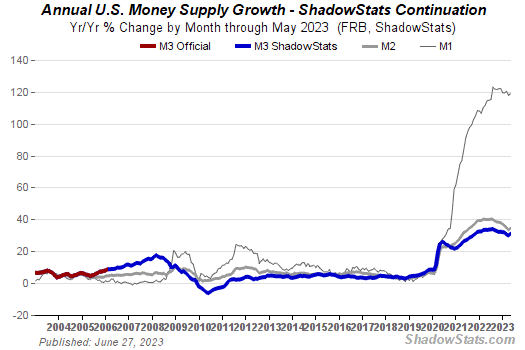
2). M2 and M3 collapsing.
The monetarists amongst us claim that the FED’s money printing ways in 08-09 will inevitably lead to hyperinflation. Yet, over the last few months, M2 and M3 (as seen below, courtesy of Shadow Stats) have reversed course and are tumbling, in M3’s case at a speed not seen since the 1930’s.
Until we see a pick-up in lending, and the transmission of money from the asset markets to the real economy, we’re going to struggle to see the promised hyper inflation.
3). On the negative side, the Consumer Metrics contraction watch, is not pretty.
4). Adding to that, the leading indicators are tumbling.
Given my broad thoughts on some of the lessons we should learn from Japan (here and here), this is a big reason why I have no real interest in adding to my equity exposure (specifically the Water Thesis and the unwritten, so far, Lead-Acid Battery thesis) – I think I’ll be able to get them cheaper.
5). On the positive side, my favourite up-to-the moment snapshot of the economy, the ADS, shows no signs that its impacting the economy at the moment. In fact, it suggests thinks are looking quite peachy.
6). It seems like a long time ago, but we talked about the important of thinking about levels vs. changes.
Yes, the changes are dramatic (especially when using year-over-year in a world in flux) and that makes for interesting news-copy and something for talking heads to prattle on about. But it’s the levels that matter. In short, it’s fantastic the unemployment claims are down from their peak and that auto sales have risen from their lows but just look at the levels.
(Below, courtesy of Calculated Risk)
I’m not saying that the levels cannot, will not or should not rise from here, indeed they may well. However, for anyone whose base case is that they will then you’re already pricing in some level of GDP growth as your base case, and your risk management antennae should be well aware of that as more news comes out.
Subscribe to:
Comments (Atom)