Pages

Wednesday, April 14

2021 First Quarter Update

Portfolio Update 

OM made limited changes to the portfolio during the first quarter, as an influx of cash is expected early in the second quarter.  Expect a portfolio update when it’s put to work. 
 
- Uranium: OM added a small position in Paladin Energy (PALAF).  Paladin was one of the very few successes of the last Uranium bull market, meaning it actually built a mine.  Paladin is a mid-tier producer and would be one of the first uranium companies that could bring back capacity if prices rose to more economical levels. 
 
- Tin:  OM began a thematic position in Tin!  It’s another area of the market that’s seeing constrained supply, but also has the tailwind of attractive demand dynamics (think 5G, EVs, etc.).   Expect something more substantial in the coming weeks.

Performance and Review

The first quarter of 2021 proved to be a continuation of the final couple of months for OM’s portfolio, which climbed +21.9%.  This handily outpaced the S&P 500 TR (+6.2%) and the MSCI World (Net), which rose +6.1% 
 
The last 15 months have been a strange time for OM’s portfolio; after losing 31% in the first 10 months of 2020, the portfolio has gained 65% in the last five months!  However, the power of that initial negative compounding can be seen as the portfolio is only up ~15% over that period.  As such, despite handily outperforming the S&P 500 TR and the MSCI World (ND) during the first quarter, the portfolio trails them since the start of 2020.
 

First Quarter Attribution


The portfolio primarily benefited from its exposure to uranium, cryptocurrencies and energy during the first quarter.  Uranium (+749bps) remains the largest position and is benefiting from what Justin Huhn has dubbed the “flywheel effect"; news flow is positive, which is opening the sector up to more investors, which is leading to further positive news flow, which is…and on.   We saw confirmation of the West’s changing views with France extending the life of its oldest power plants, the previously anti-nuclear Democrats including nuclear in their clean energy standard, and EU experts saying nuclear qualifies for green investment label.  Investors responded by increasingly investing in the sector (e.g. the major ETFs saw significant inflows), which allowed a number of junior uranium miners to raise capital backed by institutional demand.  To the surprise of the market (and OM) a number of these junior miners used the proceeds to purchase physical uranium, further tightening supply!
 
OM’s position in Blockchain/Crypto (+484bps) contributed well a Bitcoin rose strongly at the start of the year.  As mentioned last quarter, while digital assets continue to benefit from the increased institutionalization of the ‘asset class’ they also capture the zeitgeist of the moment.  Bitcoin, in particular, remains the logical extension of almost everything various market factions currently believe!  This will change.
 
The energy exposure was the most subtle of these, indirectly aiding the positions in Shipping/Tankers (+460bps) and Idiosyncratic equities (+367bps) while more obviously helping the Energy (+94bps) position.  In Shipping/Tankers, the rates for oil tankers (which transport crude oil) remain terrible though those for product tankers (which transport petroleum-related products) have improved markedly.  There is increased optimism amidst signs that many economies are slowly heading towards reopening in the middle of the year.   In Idiosyncratic equities, the position in Texas Pacific Land Corp finally completed its conversion to a corporation from a trust which removes some of the company’s idiosyncrasies and opens it up to a wider shareholder base.   However, given its extensive land holdings in West Texas it was also a beneficiary of increased activity in oil/gas markets.   Finally, the position in Antero Resources (AR) benefited from the healthy natural gas price, and the good moves the company made throughout 2020.

The rest of the portfolio was largely a wash.  The Funds (+57bps) participated in the market rally, and India (+15bps), Vietnam (+13bps) and Greece (+14bps) contributed moderate gains.  The Technology: 4th Industrial Revolution holdings (-55bps) gave back gains; as the chart below shows, the Software-as-a-Service (“SaaS”) names had become severely over-extended with the median SaaS company trading at 20x NTM Sales!   Brazil (-5bps) and Tin (-6bps) were marginal detractors.
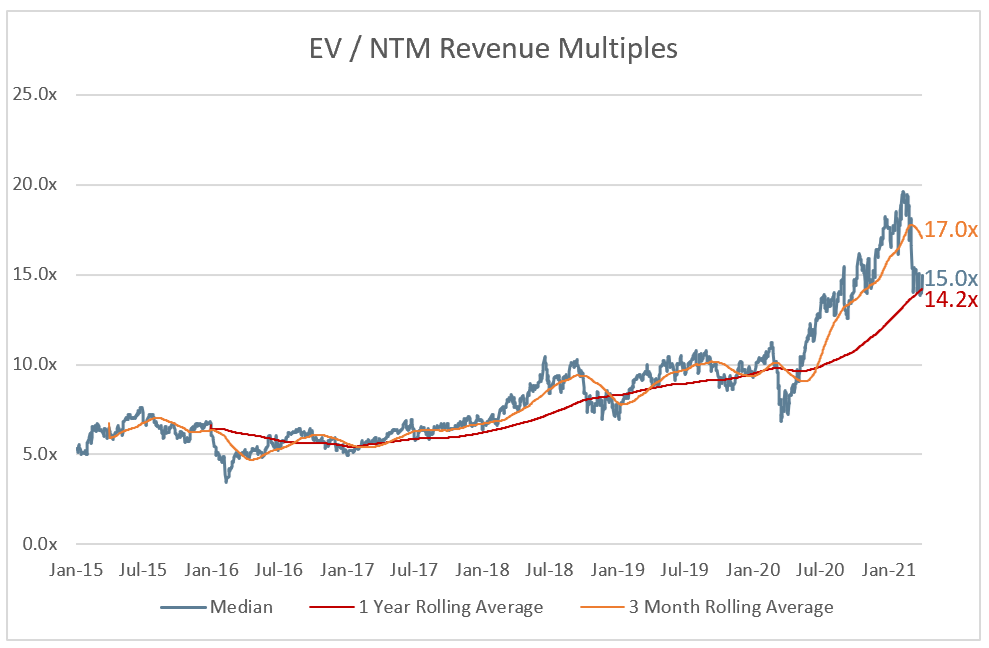
Source: Clouded Judgment (a blog all interested in SaaS should follow!)

Portfolio (as at 03/31/21 - all delta and leverage adjusted, as appropriate) 

Dislocations: 45.8% 
25.7% - Uranium (URNM, CCJ, NXE, PALAF and URG) 
14.5% - Shipping/Tankers (STNG, DSSI, EURN, TNK and DHT) 
3.5% - Greece (GREK & ALBKY) 
1.7% - Energy (AR)
 
Thematic: 21.3% 
9.3% - Blockchain/Crypto (GBTC) 
4.9% - Tech: 4th Industrial Revolution (JD & WCLD) 
3.2% - Vietnam (VNM) 
2.7% - India (INDA) 
1.0% - Tin (AFMJF 
0.5% - Brazil (EWZ)
 
Technical: 0.0%  
0.0% - OEW Technical positions (DDM, SSO, and QLD)
 
Idiosyncratic: 17.4% 
11.9% - Funds (ARTTX, CWS, GVAL, and CAPE) 
5.5% - Equities (TPL)
 
Shorts/Hedges: 0.0%
 
Cash: 16.0% 


Disclaimer:  Nothing above represents a recommendation in any way, shape or form so please don’t even think of trying to take it that way.  For added clarity, while Our Man is invested in all of the securities mentioned that’s a terrible reason for anyone else to do so.  Our Man also holds some cash and a few other securities (of negligible value).  You should not buy any of these securities because Our Man has mentioned them, but should do your own work and decide what’s best for you given your own circumstances/risk tolerance/etc.  


Sunday, January 31

Things from my Newsblur; 2021 Part 1

To borrow liberally from something I read this week; it doesn’t really feel like 2021 has started yet, so welcome to Day 397 of 2020!   Hopefully, the real 2021 will stand up and be a little calmer than the start!

The Wall Street Insurgency
This is the MUST READ for folks in Finance, or just curious about WallStreetBets and events of the last fortnight.  There has been a lot of debate in financial circles about the short squeezes in GameStop and other names, and why it’s happened.  Spoiler alert: it has little to do with finance, and is an expression of much broader trends. (Radigan Carter)


The Incredible Story of the Great Cannonball Run Boom
How quickly could you drive from New York's Red Ball Garage to the Portofino Hotel in LA? That, is the Cannonball Run!  One of the few good things about the COVID-19 pandemic is the limited number of cars on the road.   For some enterprising folks this meant the perfect scenario to try for the Cannonball Run record.   Last year saw the record fall numerous times and tumble to 25 hours and 39mins.  For all you budding racers out there, that's a 110mph average speed driving coast to coast! (Alex Palmer, GQ) 


India Stack: The Art of Digital Alchemy
India is known for many things though speed and efficiency are not amongst them!   Yet, it has one of the most advanced and successfully financial technology stacks in the world.  This is a fine deeper look into India Stack – coordinated technologies that promise to help governments, businesses and the people.  Hopefully, it lives up to its early promises…(The Emissary)  


The Rise and Fall of Vanilla Ice
Folks of OM’s generation will remember “Ice Ice Baby”, which became the first rap song to top the Billboard Hot 100!  Vanilla Ice’s rise and fall was dramatic, and here it is in his own words…(Jeff Weiss, The Ringer) 


The Donut King who went full circle – from rags to riches, twice!
The story of Ted Ngoy who came to the US as a Cambodian refugee and built a fortune running donut shops in California. However, after starting to gamble he lost it all – the donut shops and his family.   After scuffling around rock bottom for a number of years, he managed to turn himself into a multi-millionaire back in Cambodia.  Quite the wild ride!  (Vibeke Venema, BBC) 


Did the Coronavirus Escape from a Lab
A year ago it was a crazy conspiracy.  The lack of information and clarity since, means it’s now just one theory amongst many.  Nicholson Baker digs deeper… (Nicholson Baker, New York Magazine)

Monday, January 18

2020: Fourth Quarter Update

 Portfolio Update
- Energy: One of the epicenters of the collapse in March, and OM suspects it will be a substantial dislocation opportunity.  OM thought this opportunity was likely still a year or two away in oil-related names, but there were some interesting US natural gas names.  OM took a position in Antero Resources (AR), who bought back both stock and bonds during the market stress and are well-hedged on their gas production.  

- Blockchain/Crypto:  Our Man sold 25% of his Bitcoin exposure (GBTC) in late December.  The position was up almost 3x from its cost basis and the position was bumping up against the maximum size (~12%).   

Performance and Review
Our Man’s portfolio finally participated in 2020’s equity party, rising over 30% during the fourth quarter and comfortably outperforming the markets.  It was a long time coming after the portfolio suffered mightily in Q1, and failed to join the equity rally until November.   

The fourth quarter’s performance saw the portfolio end the year down -5.8%, which still materially lagged equity markets.  For comparison the MSCI World (ND) was up +15.9%, and the S&P 500 was up +18.4% in 2020.

Fourth Quarter Attribution


The portfolio’s fourth quarter performance was driven by the positions in Uranium (+11.56%) and Blockchain (10.87%).   The Uranium performance was the least surprising; COVID-19 brought the supply deficit in the Uranium market to the fore.  This was further highlighted by Cameco halting production at its Cigar Lake mine in the 4th quarter and increasing its purchases in the spot market.   Unlike earlier in the year, investors were more interested this time with volumes in most Uranium names increasing materially along with prices.  After an almost decade long wait, the bull market in Uranium seems to have finally started.   Given the material supply deficits in the upcoming years, and the lack of capex over the last decade, OM hopes that this is just the start of the Uranium positions contribution.

OM’s position in Bitcoin (within the Blockchain theme) was well-timed with the crypto-asset rallying spectacularly.  Bitcoin is the logical extension of almost everything various market factions currently believe!

  • Software’s taking over the world!  Bitcoin’s software, that’s it…
  • Total Addressable Market (TAM) is more important that profit!  What has a bigger TAM than pristine collateral and/or money!
  • Concerned about Fed money printing, unlimited stimulus and (hyper)inflation?  Bitcoin has limited supply and is a hedge to those risks!
  • Frustrated by the ‘elites’ – politicians, Fed, etc?  Stick it to the man, and own bitcoin.
  • Need faith in something?  Bitcoin’s even been compared to a religion…

And so on…Is Bitcoin really all of these things?  Of course not, it may not even be any of them.  However, in this moment, Bitcoin is the reflection that people want to see.  Throw in a reflexive technical situation – an institutionalizing asset where one vehicle (GBTC) is consuming all of the new supply – and there’s a possibility of a bubble that will extend far beyond even the bulls’ imaginations.  As previously noted, OM has some long-term crypto exposure elsewhere and the position in this portfolio is more flexible.  It is currently managed within a 6 to 12% band; when it reaches the maximum it is cut back to the middle, and should it reach the bottom-end OM is inclined to add more.  As bitcoin (and GBTC’s) price increases, expect the position size to fall and that band to narrow.

The 4th Industrial Revolution (+155bps) technology positions in SaaS companies (WCLD) and JD.com were the most consistent performers throughout 2020, and performed well again in Q4.

The portfolio also clearly benefited from the sector rotation in the market, with both the Energy (+44bps) and position in Texas Pacific Land Corporation (TPL, +161bps) rising.   TPL will also complete its reorganization from a Trust to a Corporation following a year-long process at the start of 2021.

The Funds (+254bps) exposure was a healthy contributor, benefiting from the rotation in stocks and the out performance of non-US markets.  This exposure to international markets, especially
Emerging markets, saw healthy gains for India (+67), Vietnam (+77bps), Greece (152bps) and Brazil (17bps).

The sole detractor from performance was the Shipping/Tanker (-34bps).

Portfolio (as at 12/31/20 - all delta and leverage adjusted, as appropriate)
Dislocations: 43.1%
25.7% - Uranium (URNM, CCJ, NXE and URG)
13.2% - Shipping/Tankers (STNG, DSSI, EURN, TNK and DHT)
4.2% - Greece (GREK & ALBKY)
1.1% - Energy (AR)

Thematic: 24.9%
9.6% - Blockchain/Crypto (GBTC)
6.6% - Tech: 4th Industrial Revolution (JD & WCLD)
3.8% - Vietnam (VNM)
3.2% - India (INDA)
0.5% - Brazil (EWZ)

Technical: 0.0%
0.0% - OEW Technical positions (DDM, SSO, and QLD)

Idiosyncratic: 17.3%
14.2% - Funds (ARTTX, CWS, GVAL, and CAPE)
3.1% - Equities (TPL)

Shorts/Hedges: 0.0%

Cash: 14.7%

Disclaimer:  Nothing above represents a recommendation in any way, shape or form so please don’t even think of trying to take it that way.  For added clarity, while Our Man is invested in all of the securities mentioned that’s a terrible reason for anyone else to do so.  Our Man also holds some cash and a few other securities (of negligible value).  You should not buy any of these securities because Our Man has mentioned them, but should do your own work and decide what’s best for you given your own circumstances/risk tolerance/etc. 

Saturday, October 31

2020: Third Quarter Update

Portfolio Update
- Uranium:  Our Man continued to materially increase the Uranium position, as the positive signs continued.

- Blockchain/Crypto:  Our Man added to the Bitcoin (GBTC) position near quarter-end.

Performance and Review
OM’s portfolio hasn’t yet been invited to the market fun, rising just +2.2% during the third quarter.  This pales in comparison to the S&P 500 Total Return (+8.9%) and the MSCI World (Total Return, Net Dividends; +7.9%).  For the year, this leaves the portfolio down -28.3% while the market indices have recovered their early year losses (S& P 500: +5.6%, MSCI World: +1.7%).

Third Quarter Attribution


The third quarter was surprisingly quiet for OM’s portfolio, with broad-based gains being partially offset by losses in Shipping/Tankers (-103bps) and the Texas Pacific Land Trust (TPL, -82bps) position in the Idiosyncratic book.   Both positions  indirectly impacted by oil, especially fears about second COVID waves and a slow recovery in oil demand.  In the case of tankers, the market expects exceptionally weak rates through 2021 with the companies receiving little credit for the extraordinary earnings of the last 12mos that have radically improved their balance sheets.

The two other positions that fit into the broad “supply is constrained” theme – Uranium (+55bps) and Blockchain/Crypto (+60bps) were good contributors.  The news flow on Uranium continues to be positive on the supply side, as well as the removal of some regulatory uncertainty that may encourage utility demand.  The Blockchain/Crypto book benefited as bitcoin continued to see increasing acceptance as a store of value, with Microstrategy, a publicly listed company, moving part of its cash holdings into bitcoin.  OM believes that this institutional acceptance is likely to continue, but that the role GBTC may play in consuming the supply of bitcoin (similar to GLD's impact on gold during the 2000s) is under-rated.   Given the commodity-bias (Uranium & Tankers) at the top of OM’s portfolio, the Blockchain/Crypto exposure is OM’s hedge in case we get a full on bubble in software/growth.  Bitcoin is digitization and "software taking over the world" taken towards its logical extreme.

The rest of the portfolio showed reasonable gains led by the exposure to the 4th Industrial Revolution, especially Software-as-a-Service (SaaS) stocks.  While SaaS is a great business model and technological progress has been pulled forward by COVID, the valuations are exceptionally high.  The median public SaaS company trades at 16.0x next-twelve month’s revenue estimates, a healthy jump from the already nosebleed 13.1x pre-COVID.  Caveat emptor; beware, they’re not ALL going to turn into the next FANG companies!

The thematic exposure to Vietnam (+38bps) and India (+49bps), both emerging markets countries with attractive demographics, finally started to participate in the market rally.  This broader participation also helped the Funds (+128bps), which recouped its losses for the year during the quarter.


Portfolio (as at 09/30/20 - all delta and leverage adjusted, as appropriate)
Dislocations: 41.5%
18.8% - Uranium (URNM, CCJ, NXE and URG)
17.8% - Shipping/Tankers (STNG, DSSI, EURN, TNK and DHT)
4.0% - Greece (GREK & ALBKY)

Thematic: 21.2%
7.1% - Tech: 4th Industrial Revolution (JD & WCLD)
5.8% - Blockchain/Crypto (GBTC)
4.2% - Vietnam (VNM)
3.6% - India (INDA)
0.5% - Brazil (EWZ)

Technical: 0.0%
0.0% - OEW Technical positions (DDM, SSO, and QLD)

Idiosyncratic: 18.8%
16.3% - Funds (ARTTX, CWS, GVAL, and CAPE)
2.5% - Equities (TPL)

Shorts/Hedges: 0.0%

Cash: 15.3%

Disclaimer:  Nothing above represents a recommendation in any way, shape or form so please don’t even think of trying to take it that way.  For added clarity, while Our Man is invested in all of the securities mentioned that’s a terrible reason for anyone else to do so.  Our Man also holds some cash and a few other securities (of negligible value).  You should not buy any of these securities because Our Man has mentioned them, but should do your own work and decide what’s best for you given your own circumstances/risk tolerance/etc. 

Wednesday, October 21

Things from my Newsblur; 2020 Part 3

It’s been too long since OM’s last “Things from” so I’ll spare you much of an introduction.  The broad inspiration for this “Things from” is the FT interview with the world’s greatest short seller, where he called this “the golden age of fraud”.  While it’s rarely wise to disagree with Jim Chanos, perhaps the more charitable “the golden age of half-truths” is a better description.

The Vampire Ship
As you know, OM likes tankers and here’s a wild tale about one, the Noor One.  It’s a tale about heroin smuggling and Europe’s largest ever drugs bust, but that’s just the opening act.  The main course sees the gangsters involved trying to murder each other across the globe, together with witnesses and journalists dying in unexplained circumstances in Greece.  It ends with still-raging political corruption scandals in Turkey and the Middle East, as well as in Greece where the one of the country’s leading oligarchs has been enveloped.
(Alexander Clapp, The New Republic)

Beware What Sounds Insightful
With the proliferation of newsletters (and Medium posts) comes a fine warning; what sounds insightful and what is useful or true are often not the same thing!
(Cedric Chin, Commonplace)

Wirecard and me: Dan McCrum on exposing a criminal enterprise
Wirecard, a multi-billion dollar market cap German fintech company, which imploded earlier this year is the public market's poster child for the Golden Age of Fraud.   This article is just the cliff notes of the FT’s 5-year investigation of the firm, which included providing evidence that much of the business wasn’t real.  Yet all this led to was the stock rocketing upwards (and into Germany’s DAX index), Wirecard spying on the journalists and the BAFIN (German securities regulator) choosing to investigate McCrum & the FT rather than Wirecard.  In the end, a special audit by KPMG led the company to announce $2 billion was ‘missing’ in June 2020, and this turned out to be the tip of the iceberg.  Today, the stock is worthless, the CEO and various associates are in jail awaiting charges, and the COO is on the run.
(Dan McCrum, Financial Times)

An Arrest in Canada Casts a Shadow on a New York Times Star, and The Times
This story, about the unraveling of Rukmini Callimachi’s reporting on terrorism is one OM was sad to read.  It shows the difficulty for journalism as it seeks a profitable business model, but also – much like the markets – how bad incentives can lead to narrative driving everything, and facts being rearranged to suit them.
(Ben Smith, New York Times)

From Boom to Bloodbath
One of the things OM is currently researching is the opportunities arising as a result of the collapse of Shale – I see your natural gas producers, and (eventually) offshore oil services cos!   With the collapse in oil prices bringing the Shale revolution to a screeching halt, Justin Miller looks at what it means for Texas and whether the state can transition to become a renewable energy powerhouse.
(Justin Miller, Texas Observer)

This Overlooked Variable is the Key to the Pandemic
Spoiler alert, it’s not R!  Another fantastic piece by Zeynep Tufekci – the West has been slow to understand and adapt to the evidence that ‘the corona’ (to quote OM’s kids) doesn’t spread like the flu but more like 2003’s SARS.  Super-spreader events are far more important than the average captured by R, and recognition of this leads to VERY different policy choices.  See Japan for more information.  (Zeynep Tufekci, The Atlantic).

The Students Left Behind by Remote Learning
“The desire to protect children may put their long-term well-being at stake” sub-heading is another reminder of the touch choices COVID-19 has forced upon us, and how we struggle when the benefits and costs are unequal and when measured on different time horizons.  
(Alec MacGillis, New Yorker)

Saturday, August 22

Uranium - COVID-19 Brings the Supply Deficit to a Head.

It’s been a while since OM last talked about Uranium in depth – over 2.5 years(!) – and with it closing in on becoming the largest position in the portfolio, what better time for an update!

    
Demand
The demand for uranium comes from one source – nuclear power plants, which generate ~10% of the world’s electricity, and show consistent and steadily increasing demand.  
 
Since the Fukushima tsunami in 2011, the trend in the US & Europe had been towards closing nuclear power plants leading to a belief (and lots of press articles!) that nuclear was being phased out.  Since OM started investing in uranium this has changed, with existing plants seeing extensions and projects being planned.   The change has been driven by a recent focus on ‘clean energy’ (vs. ‘green’ energy) that values nuclear’s carbon-free, safe(!) and low cost provision of base power,  coupled with the beginning of the development of small and advanced modular nuclear reactors.
 
While the Western world and press was focused on the decline of nuclear, the same was not true in Asia where countries, led by India and China, continued to plan and construct nuclear power plants.  

Finally, nuclear utilities typically purchase uranium through primarily through  long-term contacts and the cost of uranium is a small % of their total costs.  The chart below shows the long-term contracting boom of the last cycle, with the recontracting phase expected to be begin in the next 18 months.


Supply Side
While demand for uranium has been a nice gentle incline, the attractiveness of the opportunity reflects that supply is constrained!   Almost 2.5 years ago, OM discussed how the 2 largest miners – Cameco (through its Mcarthur River/Key Lake mine) and Kazataprom – both cut supply by a combined 20% in an economically rational attempt to help bring the market back towards balance.  
 
The magnitude of these supply cuts has seen the Uranium market shift from being oversupplied to a supply deficit of ~20mn lbs (or 15% of global production) before COVID-19!  COVID-19 had a major impact on uranium mining with  Cameco closing its remaining flagship Cigar Lake mine (12% of primary uranium supply!), and Kazataprom having to reduce both its production targets (by 10mn lbs, or 8% of annual primary supply) and its 2020 wellfield development (which will reduce its 2021 production capacity).  This led to fears of a potential supply shortfall of ~40mn lbs in 2020!  The cutbacks also led to both Cameco (especially in Q2) and Kazatprom (beginning in late Q2) entering the spot market to fulfil existing contracts.

This short video from Purepoint Uranium shows the impact of the cuts.


Eagle-eyed readers will have noted (i) the importance of Kazataprom and Cameco (Cigar Lake & McArthur River) due to both their size and as the lowest cost producers and (ii) that almost half of the existing & idled production is uneconomic at today’s prices!
 
While Cigar Lake will start coming back online in September 2020, the market is expected to remain in significant deficit, which is exacerbated by major mines (Ranger in Australia & COMINAK in Niger, which are a combined >5% of primary supply) permanently closing at the start of 2021 and Kazataprom confirming low 2022 production levels (i.e. no attempt at trying to recover from 2020/21 production losses).
 
Why Now?
Earlier this year, before the impacts of COVID were fully felt, the World Nuclear Association published its biennial "Nuclear Fuel Report", and for the first time made the Expanded Summary available publicly.  For those who don't follow the space, charts such as the below helped codify the supply gap.


However, even the WNA report was overshadowed by the impacts of COVID-19 - demand for nuclear power remained largely unchanged, while the impact on supply pulled everything forwards.   The Uranium spot price jumped ~50% after Cameco started purchasing in the open market, and both Cameco & Kazataprom will be doing so in the second half.  OM suspects Cameco is re-opening Cigar Lake, both due to the costs of keeping it in care & maintenance but also for security of supply (to meeting existing contracts) given the limited inventory in spot markets, and Kazataprom needing to buy.   

This combination has made clear that after the decade long bear market Uranium trades below its cost of supply limiting the incentive for new mines to be built.  COVID-19 has exacerbated and highlighted the supply deficit.  For utilities (and the primary consultant that advises them) security of supply is a vital factor, and the upcoming contracting cycle will being the problem to a head and OM believes to materially higher prices to encourage new uranium mining development.  Our Man hopes to capture the vast majority of this move in the Dislocation book over the next couple of years!
 
 
Major Risks

 - It’s long been claimed the secondary supply, or spot market traders, will make up the difference.  With both Cameco & Kazataprom in the spot market during H2-20, we will find out.

- Idled supply will rush back into production though this is largely Cameco and Kazataprom.  It reflects a belief that Kazataprom will return to its 2014-era behavior of maximizing supply, despite the firm's changes (no longer selling in spot market, IPO, etc) and statement/behavior (supply cuts and statement re. supply through 2022).

- Less uranium being required (i.e. following the WNA’s lower scenario for reactor requirements) due to fewer nuclear reactors being built or greater efficiency.

- Another Fukushima!

Thursday, July 23

2020: Second Quarter Update

Portfolio Update
Please see the recent Portfolio Update piece, for some thoughts on the current portfolio and its structure. 

During the quarter OM made the following changes:
New Position:  Blockchain/Crypto (Thematic)
Added to: Shipping/Tankers (Dislocation), and Uranium (Dislocation)
Reduced: Greece (Dislocation), Brazil (Thematic), and Fourth Industrial Revolution (Thematic)
Exited: None.


Performance and Review
Following the dismal first quarter, equity markets surged during the second quarter with the S&P 500 posting its best performance since the fourth quarter of 1998!  OM’s portfolio sadly failed to join the Q2 party, rising a measly +0.7% and significantly underperforming both the S&P 500 Total Return (+20.5%) and the MSCI World (Total Return, Net Dividends; +19.4%).  For the year, this leaves the portfolio down -29.9% while the market indices are down mid-single digits (S& P 500: -3.1%, MSCI World: -5.8%).


Second Quarter Attribution


Our Man’s Q2 can largely be summed up as a significant negative contribution from Shipping/Tankers, a good contribution from the 4th Industrial Revolution theme and reasonable contributions elsewhere.

Shipping/Tankers (-853bps) were a significant drag on performance during the quarter, and for the first half of 2020.  While tanker rates are shaping up to have a stellar year and companies have performed exceptionally strongly, the stock price performance has been abysmal with most trading at or below the lows of March 2020!  

The bear case for tankers is centered on expectations of a prolonged period of rates at or below break-even stretching into early 2022.  These low rates will be driven by (i) demand for oil coming back slowly, (ii) floating storage - where oil was stored on tankers at sea - unwinding over a prolonged period now there is no contango, and (iii) ship owners will order more vessels.    Let’s be clear, these are not unreasonable or crazy fears especially for an industry that’s been in a 10-year bear market.   Certainly, it’s hard to argue that post-COVID demand is uncertain and that unwinding of floating storage will likely increase pressure on rates as more ships become available for transportation.  However, as noted in the recent portfolio update, OM believes that “if demand remains weak then pricing will not be as bad as investors fear”.  Why?  Firstly, supply is constrained; it’s one of the oldest fleets, with one of the smallest order books of the 2000s.  Secondly, the strong rates over the last 9 months coupled with the operational and financial leverage have created options for tanker companies to weather periods of low rates and reward shareholders.  This is best shown through a couple of examples.  

Teekay Tankers (TNK) came into Q4-2019 over-levered and with significant debt payments due within 12-24mos.   The exceptional rates of the last 9mos have allowed the company to (i) refinance 31 vessels pushing its debt maturities out 4 years, (ii) earn ~$7.50-8.00/share in 9 months (or almost two-thirds of its Q2-end market cap), which it wisely used to (iii) reduce its net debt by over 35%, and finally (iv) it leased some of its ships out for 6-24mos at strong rates, thereby reducing the break-even of its vessels in the spot-market to ~$10K per day.  The end result is a company vastly better poised to handle a period of lower rates, through both its financial position and its reduced sensitivity to those rates (due to the ships out on those 6-24month time charters).  OM rather hopes this starts to get reflected in stock prices, especially if/when tanker rates prove to be “not as bad” as investors fear.

On the other hand, Euronav (EURN) is the least levered and best managed of OM’s tanker names.  In 2020, it has so far returned 10% of its market cap in dividends and is happily purchasing its shares in the open market while they trade at a discount.

Given the rise in the markets, it’s not surprising that most of the portfolio were at least positive contributors.  The Idiosyncratic book led the way, aided by solid performance from the Funds (+238bps) which all rose 15-21% leaving 3 of the 4 broadly in line with the S&P 500.  GVAL, which systematically focuses on the most undervalued stocks in the most undervalued markets is lagging.   The position in Texas Pacific Land Trust (TPL, +130bps) rallied strongly, as oil prices rebounded and the company edged closer to converting to a corporation (from a land trust).

The Thematic book’s performance was driven by its 4th Industrial Revolution (+270bps) holdings, and especially the positions in Software-as-a-Service/Cloud software (WCLD).   With many of us working from home during the government lockdowns, these companies saw significant demand for the technological solutions.  Unfortunately, the median SaaS company now trades at 12x revenue, with many of the leaders trading at 20x revenue.  Though the group may continue to trade higher, OM isn’t comfortable adding at these valuations.   The rest of the thematic group performed reasonably win both India (+49bps) and Vietnam (+80bps) outpacing global markets during the quarter, though both lag meaningfully year-to-date.   Unfortunately, OM trimmed back the position in Brazil (+16bps) just before it rallied strongly.  The Blockchain/Crypto (-68bps) position was added late in the quarter.


Portfolio (as at 06/30/20 - all delta and leverage adjusted, as appropriate)

Dislocations: 38.5%
19.6% - Shipping/Tankers (STNG, DSSI, EURN, TNK and DHT)
14.5% - Uranium (URNM, CCJ and NXE)
4.3% - Greece (GREK & ALBKY)

Thematic: 18.1%
6.4% - Tech: 4th Industrial Revolution (JD & WCLD)
4.1% - Blockchain/Crypto (GBTC)
3.9% - Vietnam (VNM)
3.1% - India (INDA)
0.5% - Brazil (EWZ)

Technical: 0.0%
0.0% - OEW Technical positions (DDM, SSO, and QLD)

Idiosyncratic: 16.0%
15.4% - Funds (ARTTX, CWS, GVAL, and CAPE)
3.4% - Equities (TPL)

Shorts/Hedges: 0.0%

Cash: 24.6%

Disclaimer:  Nothing above represents a recommendation in any way, shape or form so please don’t even think of trying to take it that way.  For added clarity, while Our Man is invested in all of the securities mentioned that’s a terrible reason for anyone else to do so.  Our Man also holds some cash and a few other securities (of negligible value).  You should not buy any of these securities because Our Man has mentioned them, but should do your own work and decide what’s best for you given your own circumstances/risk tolerance/etc.