Pages

Saturday, March 26

Chartology – March 2011

Here are some charts that have caught Our Man’s beady eye over the recent few weeks:

1) Double Dip in Housing?
The above graph (courtesy of Calculated Risk) shows the Case-Shiller home prices indices starting to turn negative again.  Given that one of the aims (and successes) of QE2 was to influence the economy through the “wealth” effect this should be concerning.  For all the incremental help that a higher equity market offers to some, it’s far overshadowed by the impact of house prices.  Finally free of government stimulus and support, house prices have started to fall once more and if it continues this will have far more serious implications for the economy.


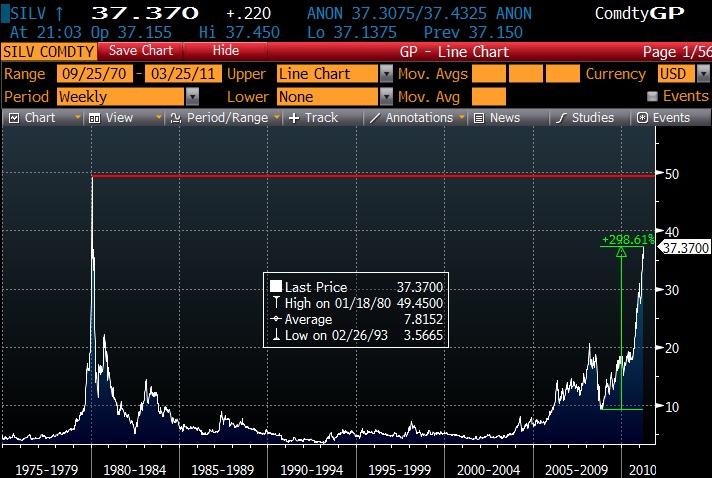
The story of the last few months has been the rise of various commodities, and few have moved as obviously as Silver.  For reference, the peak on the left of the graph is when the Hunt Brothers tried to corner the silver market.   While silver is still short of that peak, and there are valid reasons for holding silver, the speed of the ascent and the psychology that has gone with it makes Our Man think that the time is coming when it’ll be opportune to have some puts on Silver.

 In its latest FedViewspiece, the San Francisco Fed argues that “Global commodity prices have followed economic activity as measured by industrial production”.  That’s a fair enough argument and to back it up they produce this pretty compelling chart:

Case closed! 
 Well, except for one minor thing – those with more skeptical minds might notice that there’s a bit of a scaling issue (i.e. the scales on the 2 y-axes are somewhat different).  What would the chart look like if they axes were scaled similarly?  Furthermore, given industrial production and commodity price data have been around a while, why such a limited historical chart to back up their view?
Thankfully, John Kemp of Reuters had similar questions and saved me an hour in front of Bloomberg this morning by plotting them for us. 


For some reason, these graphs show the linkage is somewhat less clear!  Perhaps the Fed needs to brush-up on its Wall Street-esque marketing techniques

Wednesday, March 23

Revisiting China

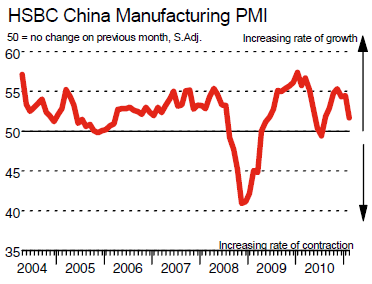
As Our Man suggested last week, now’s a good time to check-in on China and that’s because there have been subtle signs of a slow-down there.  This is most clearly seen by looking at the PMI’s; both the manufacturing and services sectors have shown signs of slowing growth.
However, the January-February data is generally given short-shrift by investors as it contains the Chinese New Year and can thus be confusing/distorted depending on when the New Year falls.  Thus, it will be interesting to observe February & March’s data to check whether these signs remain -- expect people to be “shocked” if they do.

As Our Man noted some time ago, inflation is the one of the key data points that he’s watching in China.  The last 3-4months have shown signs that it has started to pick-up.

At some point, it becomes the variable that forces the government to make the choices that they’ve avoided so far; how much polarization (and potential social unrest) do the Chinese want for their GDP growth, do they really want a consumer-driven economy (i.e. do they really want to pay workers more) rather than an investment-driven one (that they can control), etc. 

So far, the signs are that they’re willing to tackle inflation at the cost of growth; we’ve seen yet more reserve ratio hikes (the most recent pushing it to 20%, up from 15.5% in mid-2010) but also mandated wage rises. 

China’s new five-year plan: well the headline news that the country will eschew its pursuit of investment-driven growth and encourage consumer spending has certainly excited some.  However, colour Our Man a little more skeptical – while targeting a 2-3-percentage point increase in Consumer Spending (as a % of GDP) over 5-years sounds most impressive, it reveals the problems China faces.  Why?  Consumer spending was a mere 35.1% (in 09) of China’s GDP, the lowest by some distance globally.  Should they achieve their aim, and Consumer Spending would still be below the 40% of GDP that it was 5-years ago!  And this is before we consider whether China can do this while seeing no drop off in exports but an increase in imports, a rise in wages but no inflation and all this while being better to the environment.

Finally, a couple of random China-related things that I’ve seen over the last couple months that are worth bearing in mind.  Firstly, we’ve all seen videos of deserted cities and malls in China (and here’s an in-depth Australian news report that's well worth the 5-10mins) – it’s just another reminder that GDP can be manipulated (build a house, knock it down and rebuild it…2 houses to GDP, but only 1 to wealth/productive stock) and that the quality of GDP matters over time.  Secondly, my google crawlers have shown a pick-up of articles like this (“Economic slowdown in China Likely in 2nd Half of 2011”) in the mainstream media.  On its own it means nothing, but cumulatively articles like these are worth noticing.  Lastly, in the absence of being able to use more complicated instruments (CDS and receiver swaptions), Our Man has focused expressing his Short China thesis through puts on Commodity & Industrial names (see here for explanation).   When rumours persist that firms are allowing copper to be used as collateral in financing, well it’s safe to say Our Man feels a little more comfortable about how the dynamics of this would all play out when the worm turns. 

Thus, while the exposure to the China theme remains very small, it's also one of the places that's likely to see increased capital over the coming months.

Sunday, March 13

Things Our Man’s pondering

In the words of President Eisenhower; “plans are nothing, planning is everything” - here are some of the things that Our Man’s been looking at.  They’re a mixture of some of the existing ideas in book and some new things that Our Man’s been reading up on and thinking about.

- "Lower for Longer” trades
As readers will know, Our Man believes that the Fed (and ECB and BoE, in Europe and the UK) will ed up having to keep interest rates lower, for a far longer period, than most people expect.  This is because I believe the ongoing impact of debt-deflation mean that the economy remains weak without the support of the government (either directly through Stimulus, or indirectly through Quantitative Easing).  While it is hard to execute this idea very efficiently (i.e. by using interest rate receiver swaptions) given the instruments that Our Man can use, the idea is reflected in the portfolio.  At the moment, this is predominantly through being Long 20Yr+ Treasury Bond position, though over time this exposure may be expressed through Long 20Yr+ Treasury Bonds, Zero-Coupon Bonds and options on either of these.  In the short-term however, Our Man would like to see the idea of inflation and the need for rate rises further embedded within investors’ expectations before increasing or re-adjusting the position.  As such, while it will hurt the NAV in the short-term, don’t be surprised to hear Our Man cheer some of the following: month-on-month CPI numbers of 0.3-0.4% in the next few months, a European rate rise (with firming expectations of more to come - something that could potentially encourage Our Man to increase the S Euro position too), and a strong Non-Farm Payroll number or two.

- Tobacco & Other Deflation-proof Staples
These businesses tend to be somewhat…well, boring!  As such, their stocks are the kind of ones that investors ignore in these fabulous (bear-market) rallies.  However, that also leaves opportunity for those less excitable.  For example, Altria is up a mere 67% from its lows up a (paling in comparison to the market’s c100% rise), but people seem to forget it is also trading above its 2008 highs and pays a healthy 6% annual dividend yield.  Furthermore, as we all know, while smoking isn’t pleasant, it’s certainly a habit that’s difficult to kick.  Now all Our Man needs is to persuade Mrs. OM to drop her valid moral objections, and these names will finally make it into the portfolio.

- China
This is a topic that Our Man has written about before and in the next week or so, we’ll be checking in to see whether the time is right to increase the small exposure to the Short China thesis.

- Japan
Before Friday’s earthquake, Japan was at the very top of Our Man’s list of things that he was cogitating, reading about and working on.  However events have changed that and it goes without saying that the human impact is far more important than the uncertain economic toll of the earthquake and tsunami.  As for Our Man’s thoughts, prior to Friday the outline was that a continued appreciation of the yen (vs. the USD) would eventually set the stage for the Nikkei to have an inflation-fueled run at its all-time high.  We shall have to see what happens in the coming days (and/or weeks) with the impact on Yen repatriations and Central Bank policy, let alone a whole host of other issues, all unknown at this point before making any major decisions.

- Previously discussed Themes: Energy Efficiency and Storage Theme and Water Theme
Both remaining attractive secular themes, though it has been hard to find ETFs or stocks that are not over-valued at this point.  Our Man has some names on his radar screen and continues to look for interesting opportunities in the respective spaces.

- Value Ideas
Our Man continues to scour for interesting value ideas, with a couple of names like Capstone Therapeutics (CAPS) and REalNetworks Inc (RNWK) almost at attractive levels.

Sunday, March 6

Why so quiet…

Given the dearth of posts over the last few weeks, it would certainly be fair for you to wonder where Our Man has been!  Sadly, there are no tales of excitement (or woe) to break to you but nonetheless a simple explanation shall be offered.

Partially it is because Our Man returned to the world of the gainfully employed at the start of the year.  While earning a wage and having some job-security are a long-term boon to this portfolio’s continued existence, some of the time that was devoted to writing has been lost.  Separately, for those of you hoping that gainful employment would result in Our Man being more “in the know” - you will, I’m afraid, be sadly disappointed.  However, with Our Man’s now allocating his time better (goodbye sleep, we enjoyed the best of times together!) work will be but a minor factor going forwards, and I will be here to offer you my unsolicited and unvarnished thoughts. 

However, the primary reason for my silence is that not all that much has changed over recent months.  It’s tempting for those of us involved in the markets to talk breathlessly of all the data releases, changes and market movements as though each one will be THE driver of the economy or market (or even our returns) over the coming periods.  The truth is, that is rarely the case.  However, we help justify our own existences by substituting real-time with its far flashier cousin, dramatic-time, where everything is vital and which only an expert could navigate through.  While CNBC is the most extreme (or should that be comical) example of this in finance, it’s prevalent in some way in the dealings of almost every financial professional (and I suspect, an equivalent is prevalent outside finance too!).  This is interesting but why does it matter, I hear you clamour.   Well the reason is two-fold:

1.  A large part of Our Man’s approach is to generate medium to long-term thematic premises.  By their nature, these premises will take time to play out and require some element of patience and long-term resolve.  In real-time things change slowly, and it is people’s perceptions of reality that change rapidly leading to 'dramatic-time'.  As the legendary Bob Farrell used to say, “Fear and greed are stronger than long-term resolve”. 

2.  The biggest risks to Our Man’s premises are being early and wrong; and being too early is often the same as being wrong.  This is where the portfolio management comes; it is important to balance having some exposure to the thesis with containing the losses when one is too early.  As such, Our Man’s portfolio management relies on having exposure to the key theses that is akin to being Fabian** in nature.  In essence, it is about finding a way to hang around without suffering major losses until a thesis starts to play out (or people’s perceptions to the underlying thesis change), and then looking to capitalize as the thesis plays out.

So why has Our Man been quiet?  Well, not much has changed to either validate or invalidate the underlying theses, and a larger part of the portfolio is in its Fabian setup, and thus the returns are also not fluctuating wildly.  While patience and long-term resolve may be investing virtues, they don’t always make for frequent updates or a permanently entertaining blog.  However, the good news is that there are some posts on tap for the coming week or two; some things I’ve been pondering, checking in on the China thesis, and some further early thoughts on Japan.


** Now, those who’ve had the benefits of a classical education will know that the Fabian strategy was named after Quintus Fabius Maximus Verrucosus Cunctator (or Fabius Maximus, to you and me) and refers to his (unpopular but ultimately successful) military strategy to defeat Hannibal of Carthage (not to be confused with this Hannibal).  On a random but unrelated note, Hannibal is one of Our Man’s favourite historical figures.  Equally unrelated, another of Our Man’s favourite historical characters is Air Marshal Hugh “Stuffy” Dowding, who gets somewhat overlooked when people come to discuss the Second World War (much like Alan Turing, one of the fathers of the computer!) because his most vital role (the Battle of Britain) occurred far too early in the War (1938-1940) to get appropriate notice.  While Our Man is tempted to take advantage of your unsuspecting state and fulfill his childhood ambition of offering some history lectures, Mrs. OM has wisely pointed out that this would likely be exceptionally long and only bore people further.  So instead a mere run-down of Dowding’s major decisions in 1936-1940; approving the building of both the Hurricane (allegedly based on seeing the first one fly) and the Spitfire fighter planes, seeing the importance of radar in the late 30’s and integrating it centrally into the British defence system (which came to be known as the “Dowding System”), and refusing Prime Minister Churchill’s requests to send fighter planes to France and also to offer greater air support for the evacuation at Dunkirk (both rejected on the basis that they would reduce Fighter Command's strength for defending Britain).  The point of all of this?  Dowding in the summer of 1940 implemented a classic Fabian strategy to defeat the significantly larger and more experienced German Luftwaffe.  Finally, for those of you who appreciate irony, both Dowding and Fabius were fired from their jobs as a result of their successful strategy.  Let us hope Our Man suffers no similar fate...

Wednesday, March 2

February Review

Portfolio Update
There were no changes to the portfolio during February though we did receive the semi-annual interest payment on the Aug-2029 Treasury bond, which added to the level of cash.

Performance Review
February saw a slight bounce back in the portfolio’s performance, with a 1.5% gain helping offset part of January’s losses (-1.0% YTD).

The tension in the Middle East resulted in increased risk aversion in the markets during the middle part of February.  As a result, the Long Treasury Bonds book (+55bps) was a strong contributor, despite the continued relatively positive tenor of the economic data.  The majority of the portfolio’s risk remains concentrated in this book, and it’s likely to be volatile given the numerous economic (ranging from potential US Govt shut-downs, to potential short-term inflation, to the end of QE2, to name just three) and political (further Middle-East protests, German regional elections, new Irish government trying to renegotiate their bail-out, etc) factors that may affect markets over the coming months.  The Bond Funds bucket (+10bps) was a small contributor during the month.

The Value Equities book (+60bps) recovered part of its January losses, largely as a result of THRX bouncing back from its January swoon on the back of decent results and the progression of a drug into phase III trials.  The Other Equity (+14bps) and NCAV (+25bps) were helpful contributors to performance, both outperforming the equity markets.  Against their gains, the Puts/Hedges book (-7bps) and the small Short China book (-<1bp) both hampered performance.   Finally, with Europe showing some signs of calm the Currency book (-6bps) was also a negative performer.

Portfolio

40.7% - Long Treasury Bonds (Aug-29 Bond & TLT)
21.8% - Long Bond Funds (VBIIX, DLTNX and HSTRX)
7.5% - Value Idea Equities (THRX, and DRWI)
4.9% - NCAV Equities
3.3% - Other Equities (NWS, CMTL and SOAP)

-0.8% (delta-adjusted) - China-Related Thesis (22bps premium in FCX put)
-0.74% (delta-adjusted) - Hedges/Put Options (21bps premium in S&P Dec-11 puts)

-5.7% (leverage-adjusted) – Currencies (EUO – Short Euro)

18.7% - Cash

Thursday, February 24

Things from my Google Reader: Feb-11 Edition

Hopefully, Our Man will have more productive things to say in the upcoming weeks but until then…here’s some things from my google reader!  As usual, I’ve put the finance ones at the top and the non-finance (more interesting?) ones at the bottom.

- What Hoenig said…
I don’t always agree with KC Fed President Thomas Hoenig (who deserves great credit as the only one to actually dissent on Fed policy votes over the last year) but he's always interesting to listen to.  Now that he can longer vote, he’s not been shy about criticizing the Fed and the Administration (with truisms such as “it is ironic that in the name of preserving free market capitalism in this country, we have undermined it so deeply.”)  The entire speech is worth a read, but for those after just the interesting bits, the Pragmatic Capitalist has culled them for you. 

- When Irish Eyes are Crying
Michael Lewis continues his worldwide tour of collapsing sovereigns with a visit to Ireland.  If you’ve seen this movie before, it's because the tale is not dissimilar to that of Greece or Iceland but with its own unique twists.  I suppose Portugal and Spain are up next...

- It’s the Income Inequality, Stupid….
In Our Man’s brief divergence into politics during the tail-end of last year, we touched on income inequality.  Here are 11 charts that explain it a little further (and also why Our Man sniggers whenever anyone says that the solution to our problems is cutting Corporate Taxes)

- The History of the Honey-trap
Over the last 12-15months, there have been various accusations leveled at China most notably currency manipulation.  However, according to the Times of London leaked documents from MI5 purport that China “bugs and burgles Britain” using some of the oldest methods!

- Some thoughts on Cities 
Our Man is a city person having spent the vast majority of his life in London and New York, and as such he’s quite prone to reading articles about cities.  After all, some think that their core elements just be reduced to equations by physicists.  Elsewhere, others thing they need saving…and that skyscrapers can do it!

- The Adventures of Egglant
While Jersey Shore provides entertainment for us in the US, there’s no doubt that the Japanese are the kings of the reality game show!

Wednesday, February 2

January 2011 Review

Portfolio Update
A slight change to the format this year; rather than post every time there’s a change to the portfolio, I’m going to update you at the end of the month (unless there’s a large flurry of activity during a month).  The second half of this month saw some small additions to the portfolio. 

i). The short China thesis (see this post, for an explanation of Our Man's skepticism) was reintroduced to the book.  Again, it was expressed through a put position in FCX (see here, for discussion on timing and instruments), though the position is once again pretty small (25bips max loss in 2011).

ii). A Long position was added to the Bond Funds book.  Buying individual bonds is exceptionally hard for a small investor (ironically, the excellent David Merkel wrote an article about it recently) and as such Our Man looks to get his bond exposure entirely through Treasuries, ETFs or Bond Funds.  The position is in DoubleLine Total Return Bond Fund (DLTNX) run by Jeff Gundlach & Phil Barach.  In the medium-term the fund will be an actively managed replacement for the existing holding in VBIIX (a passively managed fund).

Performance Review
January saw a continuation of the weak performance of recent months, with the portfolio beginning the year by falling 2.5%.  What differentiated January from the tail-end of 2010 was the correlation amongst the various buckets/books, with almost every one providing negative performance.

The Long Treasury Bonds book (-91bps) suffered as the tenor of the economic data released during January remained relatively positive.  Though the position was the strongest contributor to performance in 2010, it has been a negative contributor over each of the last 5-months, as QE2 has helped buoy investors’ animal spirits and strengthened the belief that 2011 GDP will prove self-sustaining.  This increased optimism coupled with concerns over the US government deficit has made Treasury Bonds (especially long-term ones) one of the few assets on which the market is uniformly bearish.  As regular readers know, Our Man isn’t put off by the controversy of being long Treasury Bonds (some might even say he embraces it a little too much) and despite the efforts of QE2, he still leans towards both deleveraging and deflation as the probable outcomes.  The Bond Funds book (-4bps) was also a small negative contributor.

The Value Equities book (-129bps) was the largest negative contributor during the month.  The majority of the negative contribution came from THRX, which is (and will continue to be) volatile and largely gave up its November and December gains.  DRWI suffered after weak guidance due to the lack of clarity regarding Clearwire’s (it largest customer) demand in the upcoming quarters.  This uncertainty is nothing particularly new and has been touched on before and while it adds volatility the position, it doesn’t at this point change the thesis.  The Other Equity (+3bps) and NCAV (+5bps) were minor contributors to performance, though both underperformed the equity markets.  Against their small gains, the Puts/Hedges book (-16bps) and the reintroduced China (-4bps) book both hampered performance.   Finally, with Europe showing some signs of calm the Currency book (-15bps) was also a negative performer.

Portfolio
41.3% - Long Treasury Bonds (Aug-29 Bond & TLT)
22.1% - Long Bond Funds (VBIIX, DLTNX and HSTRX)
7.0% - Value Idea Equities (THRX, and DRWI)
4.7% - NCAV Equities
3.2% - Other Equities (NWS, CMTL and SOAP)

-0.8% (delta-adjusted) - China-Related Thesis (c25bps premium in FCX put)
-2.0% (delta-adjusted) - Hedges/Put Options (29bps premium in S&P Dec-11 puts)

5.9% (leverage-adjusted) – Currencies (EUO)

18.3% - Cash